The research, one pixel at a time
Every publication on this site now has its own little pixel-art scene — 22 pictures for 22 papers, each one drawn from scratch, block by block, with a shared palette of 18 colours on a 320 × 180 canvas. Follow a title to read the plain-language summary behind the picture.
How to read them: the scenes are metaphors, not data. A balance for baryogenesis, a lens for a photophobic axion, an orbiting pair for a bound state — each picture tries to capture the paper's one big idea in a single glance.
Dark matter 2 scenes
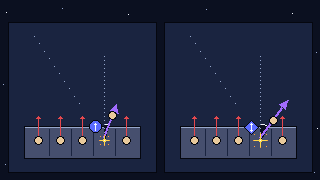
Direct detection of fermionic and vector dark matter with polarised targets
Polarised nuclei with aligned spin arrows; a dark-matter particle strikes and the struck nucleus recoils at an angle — a small recoil for fermionic DM, a larger one for vector DM.
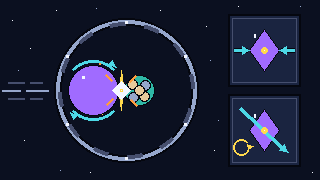
Non-relativistic Effective Interactions of Spin 1 Dark Matter
A spinning vector dark-matter ball with curved spin arrows strikes a nucleus inside a detector ring, while two operator tiles show the new momentum-and-spin interactions.
Baryogenesis 5 scenes
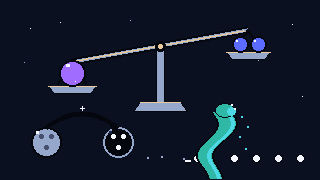
Probing baryogenesis with neutron-antineutron oscillations
A balance scale tips heavy-low against light-high while a neutron flips into its colour-inverted antineutron and a teal wave washes out a row of matter particles.
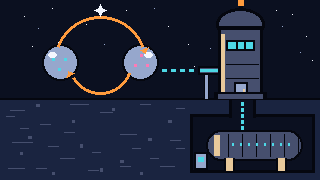
Probing Baryogenesis using Neutron-Anti-Neutron Oscillation
A neutron and its mirrored antineutron linked by a swirling exchange loop beside the tall NNBAR detector tower, its neutron beam falling into a huge capsule detector in an underground cavern.
Neutron-antineutron oscillations as a probe of baryogenesis
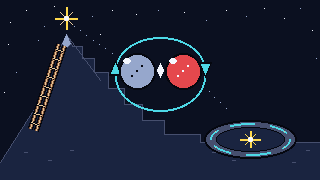
A neutron flips into its antineutron at centre stage while a ladder of energy scales climbs the high-scale baryogenesis mountain and a collider ring waits in the low-scale valley below.
New Ideas in Baryogenesis: A Snowmass White Paper
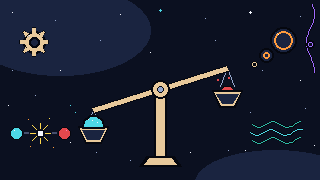
A great cosmic balance tips toward a heaped bowl of glowing matter over a nearly empty antimatter pan, ringed by survey vignettes — a gear, phase bubbles, gravitational waves, a collision spark and a cosmic string.
Impact of Bound State Formation on Baryogenesis
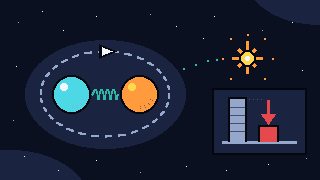
Two heavy particles bound in a glowing orbit radiate force carriers into an annihilation flash, while a falling red arrow shrinks the matter–antimatter yield bar.
Neutrinos & lepton number 7 scenes

Constraining lepton number violating interactions in rare kaon decays
A pink kaon arrives on a solid track and decays in a flash at the centre of three ring detectors, sending a solid pion one way while two dotted trails of invisible neutrinos escape the rings.
Implications of Rare Kaon Decays on Lepton Number Violating Interactions
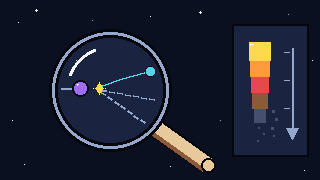
A magnifying glass zooms in on a kaon decaying into a pion plus two invisible neutrinos, while a neighbouring matter bar fades from bright to dim as time advances.

Probing lepton number violation: a comprehensive survey of dimension-7 SMEFT
Twelve operator tiles on a survey board: a collider ring above and detector rings below light matching tiles, while a magnifying glass inspects a lit orange tile.
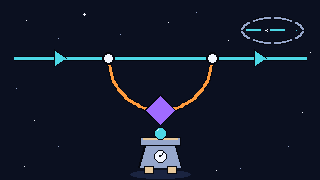
Simplified models of d=7 lepton number violation
Two heavy fields form an orange loop over a neutrino line; a purple mass insertion drops a tiny neutrino onto a weighing scale, with a small collider ring in the corner.
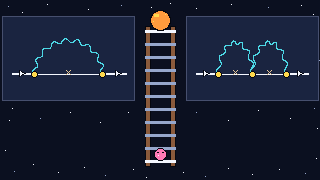
Radiative neutrino masses from dim-7 SMEFT: a simplified multi-scale approach
A one-loop and a two-loop diagram flank a tall ladder whose top rung holds a heavy particle and whose bottom rung carries a tiny neutrino — loops plus wildly different scales make a neutrino mass.
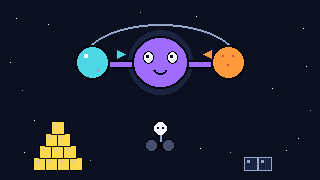
Leptogenesis and neutrino mass with scalar leptoquarks
A smiling leptoquark bridges a cyan lepton orb and an orange quark orb under a quantum loop, while a tiny neutrino on a dumbbell weight hangs over a huge gold matter pile and an almost empty antimatter pile.
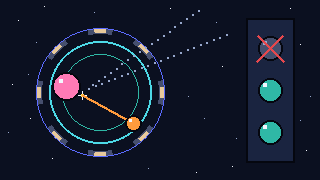
Feasibility study of lepton number violation in rare B and K meson decays
A B meson inside a segmented detector ring decays into a K meson plus a dotted pair of invisible particles, beside three lepton-family icons with one crossed out.
Colliders & experiments 7 scenes
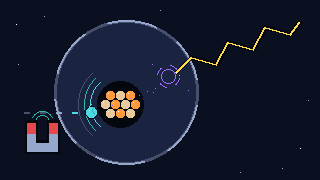
Probing active-sterile neutrino transition magnetic moments with photon emission from CEνNS
A neutrino grazes a nucleus in a detector, ripples gently, flips into a faint ghost sterile twin and shoots off a photon zigzag, with a magnet for its magnetic moment.

Distinguishing Dirac vs Majorana Neutrinos at CEνNS experiments
Two neutrino twins: a Dirac particle with a direction arrow beside its separate mirror copy, and a Majorana overlapping its own reflection, above a detector catching a recoil and a photon flash.
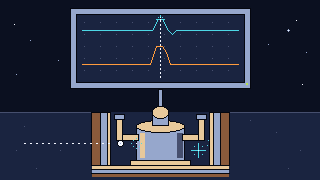
Transition neutrino magnetic moments in CEνNS
A NUCLEUS-style cryostat detector in its layered shielded pit, with a neutrino strike flash, an emitted photon sparkle, and a readout scope showing the coincident photon spike and nuclear-recoil kick.
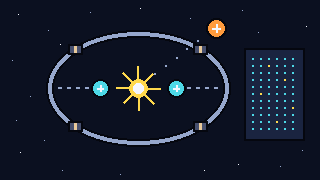
Lepton flavor physics at μ⁺μ⁺ colliders
Two identical plus-marked muons race along a teal collider ring into a bright central flash, while a heavier orange tau flies out beside a counter panel glowing with more than a hundred events.
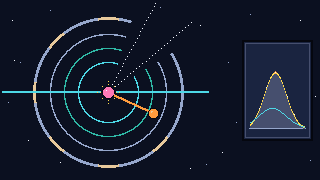
Decoding the B⁺ → K⁺ νν excess at Belle II: Kinematics, operators, and masses
Belle II detector cutaway: beams meet at a glowing decay vertex, the K track stops inside, invisible particles escape as dotted trails through a gap, beside an event-hill plot.
Noncanonical nucleon decays as window into light new physics
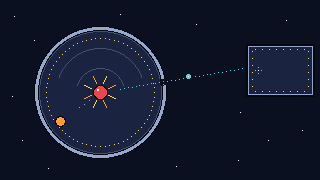
Inside a giant water tank, a proton decays and an exotic light particle sails through a glowing gap in the wall on a dotted trail toward a far detector.
Heavy photophobic ALP at the LHC
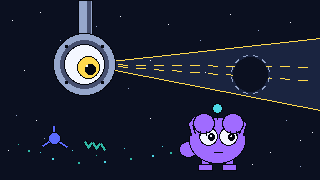
A lens-eyed photon detector sweeps its beam over an empty target while a purple photophobic ALP, paws pressed over its eyes, sneaks beneath it, trailing W and Z boson sparks.
PhD thesis 1 scene

Phenomenology of Baryogenesis and Neutrino Physics: From Effective Field Theory to Simplified Models
An open thesis pops physics to life: kaon and pion orbs, a neutrino with a magnetic-moment arrow, a flipping neutron–antineutron pair and a graduation cap in warm lamp light.
How these were made
Each scene is a small program: it draws rectangles, polygons and circles onto a 320 × 180 grid using one shared 18-colour palette, then everything is rendered with sharp pixels — no smoothing, no gradients, no text. The pictures were made for this page, paper by paper. (There is a sister collection for Astrid's tree experiment, too.)