2024 · Physical Review D (Letter) · Open access
Noncanonical nucleon decays as window into light new physics
Proton decay is a classic signature of grand unified theories — but searches assume the debris is made of ordinary particles. This paper shows that if nucleons instead decay into light new particles such as sterile neutrinos, dark photons, axion-like particles or dark scalars, the visible particles come out with much less momentum than expected. Existing experiments can therefore misread the signal, or miss it completely — and the same momentum distributions turn these “noncanonical” decays into a broad, decades-wide search program for new physics below a few GeV.
Published as: K. Fridell, C. Hati, V. Takhistov, Noncanonical nucleon decays as window into light new physics, Phys. Rev. D 110, L031701 (2024). doi:10.1103/PhysRevD.110.L031701 · free preprint on arXiv · publisher page
Background: why hunt for nucleon decay?
In the Standard Model, the proton is stable: baryon number — the tally of quarks minus antiquarks — is conserved, so nucleons never decay. But many well-motivated theories beyond the Standard Model, including grand unified theories (GUTs) and supersymmetry, predict that baryon number is violated, making the proton and neutron slowly unstable. That is why giant underground detectors such as Super-Kamiokande watch huge tanks of water for the flash of a decaying nucleon, and have pushed the proton lifetime above about 1034 years for the classic modes p → e⁺π⁰ and p → μ⁺π⁰.
Conventional searches all assume that the decay products are ordinary particles: photons, charged leptons, light mesons, or missing energy carried away by neutrinos. But nothing forces new physics to behave that way. If a nucleon can decay into light new particles — the kind of dark-sector particles that are actively being hunted elsewhere — then the final state is “noncanonical”, and the visible pieces can arrive with very different energies and momenta than standard searches expect.
What the paper does
The authors define noncanonical nucleon decays (NCNDK): nucleon decays in which one or more final-state particles is a new light particle with a mass below roughly a few GeV. They systematically classify the baryon-number-violating interactions that can produce them — operators up to dimension 9 involving light scalars (dark scalars, majorons), neutral fermions (sterile neutrinos), gauge bosons (dark photons) and axion-like particles (ALPs). The catalogue includes modes such as p → π⁺N (a pion plus a sterile neutrino N), p → e⁺ϕ (a positron plus a dark scalar ϕ), n → νX (a neutrino plus a dark photon X) and n → Na (a sterile neutrino plus an ALP). The last two are the most minimal invisible nucleon decays — with only Standard Model particles, the analogous neutron process would be n → ννν.
To show the idea is not idle, the paper builds two concrete models. In an SO(10) grand unified theory broken through the Pati–Salam route with D-parity breaking, the decay p → Nπ⁺ can occur with a sterile neutrino lighter than the proton. Alternatively, two scalar leptoquarks, S1 and S1′, generate p → e⁺(μ⁺)ϕ.
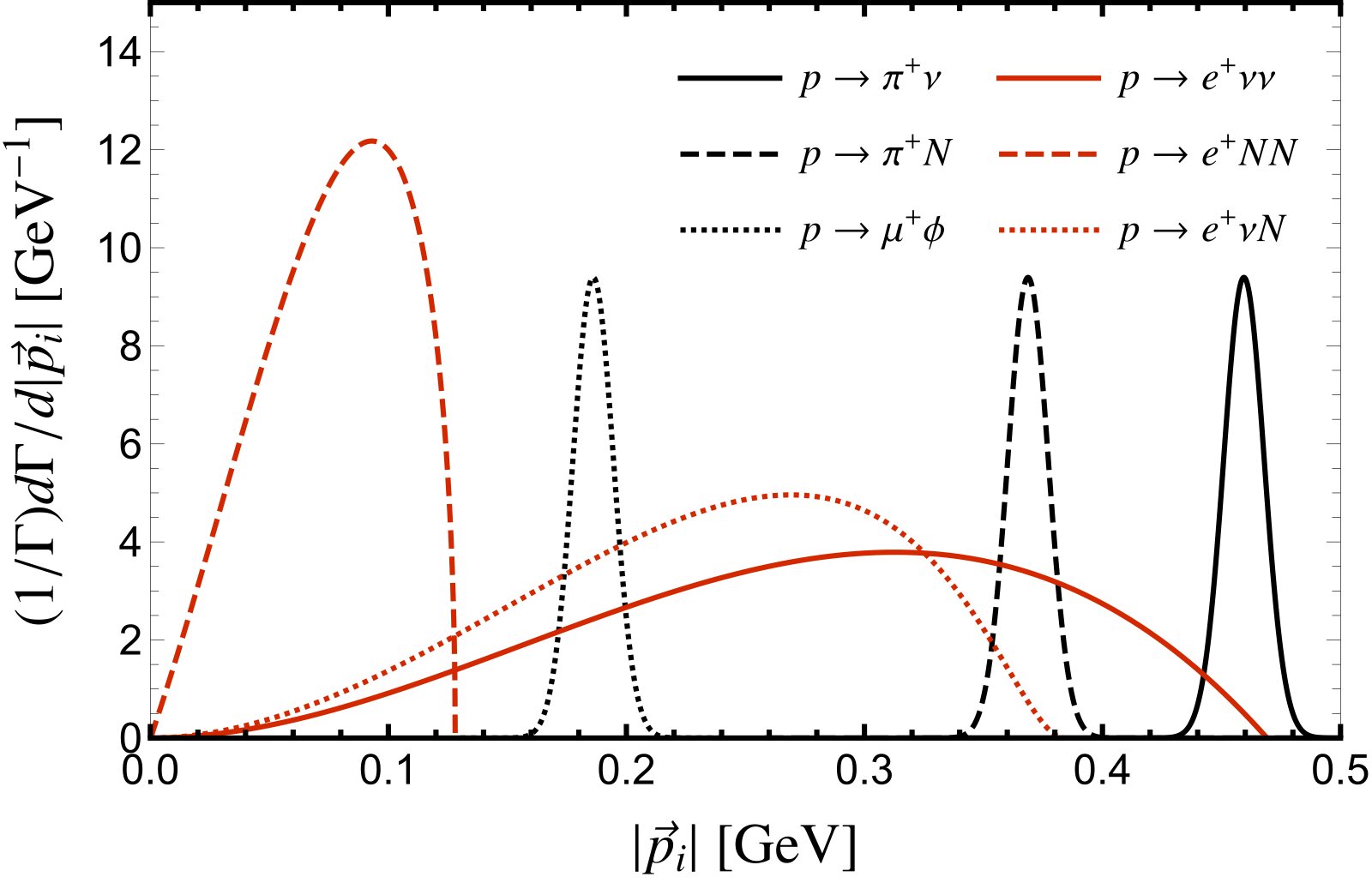
The central proposal is a strategy: measure the momentum distribution of the visible final-state particles. Because the new particles are massive (even if light), they take away energy that would otherwise go to the visible particle. The visible momentum spectrum is therefore shifted to lower values — a distinctive fingerprint, and a trap for conventional searches tuned to standard decays.

What they found
Benchmark lifetimes
With a sterile neutrino mass mN ≈ 400 MeV and a Pati–Salam scale of 2 × 10⁸ GeV, the decay p → Nπ⁺ gives a proton lifetime of about 1.1 × 1035 years — potentially within reach of Hyper-Kamiokande. A second benchmark, p → μ⁺ϕ with dark scalar mass ≈ 700 MeV and leptoquarks around 100 TeV, also yields ≈ 1.1 × 1035 years.
The visible particles slow down
In the conventional decay p → e⁺νν, 97% of the visible positron signal lies above 100 MeV. For the noncanonical mode p → e⁺NN with mN = 400 MeV, only 26% does — the positron momentum peaks near 0.1 GeV, well below the conventional spectrum.
Signals can vanish below the cut
For mN = 420 MeV the whole p → e⁺NN signal falls below the 100 MeV threshold used by the Super-Kamiokande spectral search — completely invisible. The same happens to p → e⁺ϕ for a dark scalar of 840 MeV, while p → μ⁺ϕ at 700 MeV sits mostly below the 200 MeV muon cut. Lifetime limits can shift by more than a factor of a few.
A wider reach with more energy
Dinucleon and trinucleon decays release more energy than a single nucleon, so they can probe new particles heavier than 1 GeV. The authors propose this momentum-based program for existing and upcoming experiments: Super-Kamiokande, Hyper-Kamiokande, DUNE and JUNO.
In one line: Nucleon decays into light new particles — sterile neutrinos, dark photons, ALPs, dark scalars — open a decades-wide window on new physics below a few GeV, but their visible debris comes out so slow that conventional searches can miss it.
Why it matters
Nucleon decay is one of the oldest and most powerful probes of physics beyond the Standard Model, but until now it has been interpreted almost exclusively through Standard-Model final states. This paper connects that mature experimental program to the fast-moving hunt for light dark-sector particles, and it does so with experiments that already exist or are being built. It also delivers a practical warning: a search that assumes the wrong momentum spectrum can not only weaken its limit but overlook a signal completely. Adding momentum-distribution analyses — especially for invisible final states — gives experiments like Super-Kamiokande, Hyper-Kamiokande, DUNE and JUNO a much broader discovery reach for free.
Key concepts
- Nucleon decay
- The hypothetical decay of a proton or neutron. It would violate baryon number and has never been observed, but many theories beyond the Standard Model predict it.
- Baryon number
- A conserved quantity in the Standard Model, roughly “number of quarks minus number of antiquarks”. Nucleon decay requires it to be violated (ΔB ≠ 0).
- Noncanonical nucleon decay (NCNDK)
- A nucleon decay whose final state contains one or more light new particles (below roughly a few GeV) instead of only Standard Model particles.
- Sterile neutrino
- A hypothetical neutral fermion that does not feel the weak force and only mixes feebly with the ordinary neutrinos. If lighter than the proton, it can be produced in nucleon decays, carrying energy away invisibly and leaving the visible particles with unusually low momentum.
- Dark photon and axion-like particle (ALP)
- Light dark-sector particles: the dark photon is a vector boson like a photon but belonging to a hidden sector, and an ALP is a very light pseudo-scalar boson. Both are well-motivated and actively searched for, and both can appear in nucleon decay final states.
- Spectral search
- A search that uses the distribution of the visible particle’s momentum (its spectrum), not just the total event count, to separate signal from background — the tool this paper puts at the centre of the strategy.
Citation
Kåre Fridell, Chandan Hati, Volodymyr Takhistov, Noncanonical nucleon decays as window into light new physics, Physical Review D 110, L031701 (2024), published 13 August 2024 as a Letter. arXiv:2312.13740 [hep-ph] · doi:10.1103/PhysRevD.110.L031701. The published article is open access under CC BY 4.0; figures are reproduced from the paper. This page is a plain-language summary and any simplification is the fault of the summary, not the authors.