2024 · Proceedings of Science (ICHEP 2024) · Conference proceedings
Simplified models of d = 7 lepton number violation
This short ICHEP 2024 contribution is a companion to the team's full dimension-7 survey: for a representative dimension-7 operator that violates lepton number, it works out every tree-level completion by a pair of new fields, shows how the observed neutrino mass arises at one loop in each of them, and finds that the hierarchy between the two new particles decides whether the model stays within reach of the LHC and neutrinoless double beta decay. LHC data, not 0νββ, constrains the viable regions most sharply.
Published in: K. Fridell, L. Gráf, J. Harz, C. Hati, Simplified models of d = 7 lepton number violation, PoS ICHEP2024 (2024) 187. doi:10.22323/1.476.0187 · free to read on pos.sissa.it. The full analysis is the companion paper Probing lepton number violation: a comprehensive survey of dimension-7 SMEFT; these proceedings are the short conference write-up, not the full survey.
Background: where neutrino masses come from
In the Standard Model neutrinos are strictly massless, yet neutrino oscillations show that they have tiny but non-zero masses. The simplest repair adds a right-handed partner for each neutrino: for a coupling of about 10−12 the observed mass scale of roughly 0.1 eV is reproduced, but such an absurdly small number looks unnatural. The alternative is for neutrinos to be Majorana particles — identical to their own antiparticles — in which case their mass term violates lepton number by two units (ΔL = 2).
Majorana masses are usually described with effective operators, ranked by their mass dimension. The lowest is the famous dimension-5 Weinberg operator, which at tree level has only three completions — the three seesaw models. Dimension 7 is the next possibility, and it is a much richer one: the number of viable tree-level completions grows dramatically. The team's full dimension-7 SMEFT survey studies all twelve such operators and their experimental fingerprints; this proceedings contribution zooms in on how the neutrino mass itself is generated inside one of them.
What the paper does
- Picks one representative operator. The authors focus on the ΔL = 2 operator OprstdLQLH1 = εij εmn (d̄p Lir)(Q̄cjs Lmt) Hn, built from one down-type quark, one quark doublet, two lepton doublets and the Higgs. It is one of the dimension-7 operators catalogued in the literature.
- Enumerates every completion. There are nine possible new fields that can appear in tree-level completions of this operator — five scalars and four fermions, including leptoquarks and exotic states (Paper Table 1). Each completion uses exactly two of them, so the authors map out which pairs generate the operator (Paper Table 2).
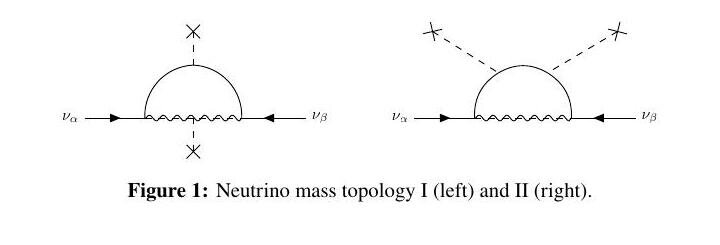
- Computes the neutrino mass three ways. The two new fields form a loop that gives the neutrino its mass via topology I or II (Paper Figure 1). The paper compares the textbook estimate — connect two fermion legs and cut the loop off at the new-physics scale — with a two-scale formula that accounts for a possible hierarchy between the two new masses, and with the exact result in a concrete leptoquark model.
- Confronts data. The resulting parameter space is compared with global LHC fits of dimension-6 operators and with the neutrinoless double beta decay constraint based on KamLAND-Zen data.
| Field | Type | SM representation |
|---|---|---|
| Δ | scalar | (1, 3, 1) |
| φ | scalar | (1, 2, 1/2) |
| S1 | scalar | (3̄, 1, 1/3) |
| R̃2 | scalar | (3, 2, 1/6) |
| S3 | scalar | (3̄, 3, 1/3) |
| N | fermion | (1, 1, 0) |
| Σ | fermion | (1, 3, 0) |
| Q5 | fermion | (3, 2, −5/6) |
| T2 | fermion | (3, 3, 2/3) |
Hierarchy complicates the estimate
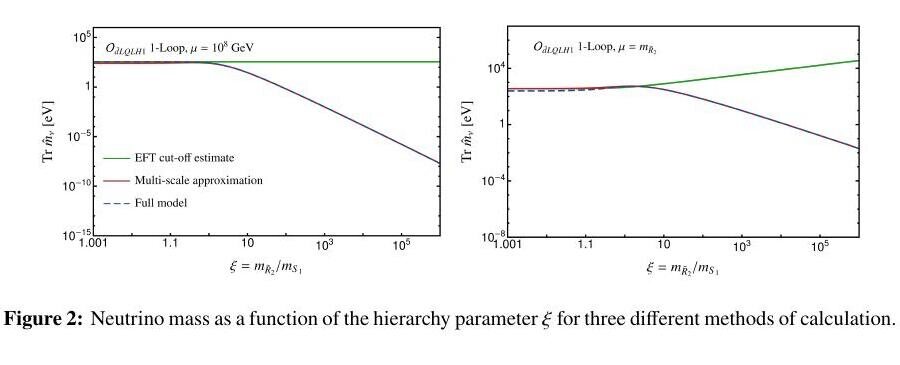
If the two new fields have similar masses, the naive estimate — evaluated at a single energy scale — works fine. But when one is much heavier than the other, the estimate misses a large logarithm. The paper's two-scale formula accounts for this: the neutrino mass gains a factor log(ξ + 1) and an explicit dependence on the heavier of the two new masses, where ξ is the ratio of the heavier to the lighter new mass — so the hierarchy can shift the predicted mass by orders of magnitude.
The authors test the formula against a concrete model with two scalar leptoquarks, S1 and R̃2, which generate the same operator after being integrated out. The comparison uses μ = 108 GeV (left panel) and the case where the lepton-number-breaking mass μ equals the heavier leptoquark mass, with mR̃2 = 108 GeV at ξ = 1 (right panel).
What they found
A catalogue of completions
Nine new fields pair up into many distinct tree-level completions of the example operator. The catalogue marks which loop topology each completion realises (I or II) and circles the completions that unavoidably also generate the dimension-5 Weinberg operator.
Some completions are secretly seesaws
When a pairing also produces the Weinberg operator, the neutrino mass is dominated by the type-I or type-III seesaw contribution, not by the dimension-7 operator — a useful warning when building a model that claims to test dimension-7 physics.
The hierarchy matters
A large mass splitting between the two new fields changes the predicted neutrino mass well beyond what the naive single-scale estimate suggests. The two-scale formula captures this and matches the full leptoquark model well across the whole range of ξ, while the single-scale estimate fails badly.
LHC data bites hardest
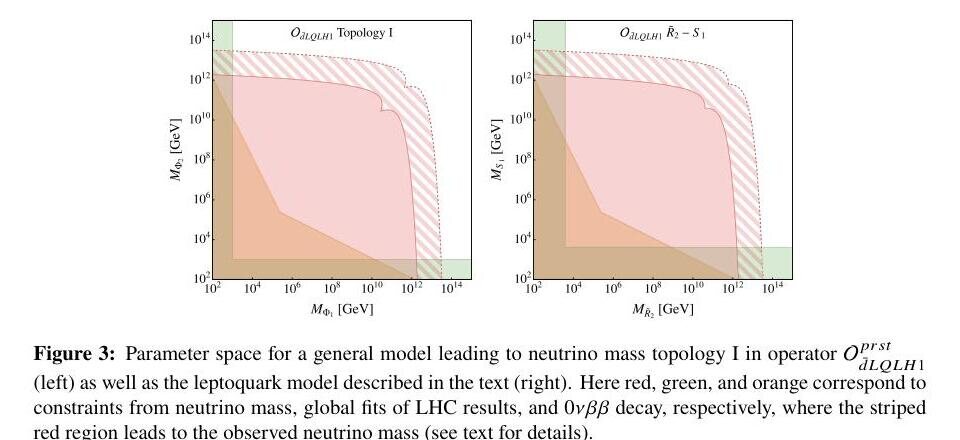
Both for generic completions and for the leptoquark model, the region that reproduces the observed neutrino mass is most stringently constrained by global LHC fits — not by neutrinoless double beta decay, which probes less of the viable parameter space here.
In one line: A dimension-7 lepton-number-violating operator can generate the observed neutrino mass at one loop in a whole catalogue of two-field completions — and how strongly LHC data constrains those models depends delicately on the mass hierarchy between the two new fields.
Why it matters
If lepton number is broken at dimension 7 rather than dimension 5, neutrino masses come with a much larger cast of new particles — and a richer set of experimental handles. This contribution shows that the mass hierarchy between those new particles is not a technical detail but a phenomenological knob: it can shift the predicted neutrino mass by orders of magnitude, and it decides which experiment sees the model first. In the scenarios studied here the answer is the LHC, with neutrinoless double beta decay providing a complementary but weaker constraint. The result feeds directly into the simplified-model toolbox used to interpret collider and 0νββ searches for lepton number violation.
Key concepts
- Lepton number and its violation
- A bookkeeping rule that counts leptons (electrons, muons, taus, neutrinos) as +1 and antileptons as −1. The Standard Model conserves it; a Majorana neutrino mass would break it by two units (ΔL = 2).
- Majorana neutrino
- A neutrino that is its own antiparticle. Unlike a Dirac neutrino, it has a mass term that violates lepton number — the target of searches such as neutrinoless double beta decay.
- Effective operator and mass dimension
- Instead of guessing the new heavy particles, one writes down every allowed interaction of the known fields. Operators with higher mass dimension are suppressed by more powers of the new-physics scale, so dimension 5 matters first and dimension 7 next.
- UV completion
- A concrete renormalisable model — with actual new particles and couplings — that produces a given effective operator once the heavy particles are integrated out. The paper lists all completions built from two new fields.
- Seesaw mechanism
- The three classic tree-level completions of the dimension-5 Weinberg operator. Heavy neutral partners of the neutrinos generate the observed tiny masses through a very heavy mass scale or a very small coupling.
- Neutrinoless double beta decay (0νββ)
- A hypothetical nuclear decay in which two neutrons turn into two protons and two electrons, with no neutrinos emitted. It can only happen if neutrinos are Majorana particles, making it a direct test of lepton number violation.
Citation
Kåre Fridell, Lukáš Gráf, Julia Harz, Chandan Hati, Simplified models of d = 7 lepton number violation, Proceedings of Science, PoS(ICHEP2024)187 (2024). doi:10.22323/1.476.0187 · pos.sissa.it/476/187. Proceedings of the 42nd International Conference on High Energy Physics (ICHEP2024), Prague, 18–24 July 2024. This is the short conference write-up; the full analysis is K. Fridell, L. Gráf, J. Harz, C. Hati, JHEP 05 (2024) 154, arXiv:2306.08709 — see also the plain-language page for the full survey. Figures reproduced from the paper (© the authors, CC BY-NC-ND 4.0); this page is a plain-language summary and any simplification is the fault of the summary, not the authors.