2024 · Journal of High Energy Physics · Open access
Probing lepton number violation: a comprehensive survey of dimension-7 SMEFT
Neutrinos may be their own antiparticles, which would mean that lepton number is not a true symmetry of nature. This 52-page survey catalogues all twelve independent dimension-7 operators that could break lepton number, confronts each of them with every relevant low- and high-energy experiment — from neutrinoless double beta decay to the LHC — and shows how combining the different frontiers can distinguish them. The grand picture: neutrinoless double beta decay dominates the electron flavor, colliders and meson decays cover the muon flavor, and no single experiment can see everything.
Published in: K. Fridell, L. Gráf, J. Harz, C. Hati, Probing lepton number violation: a comprehensive survey of dimension-7 SMEFT, JHEP 05 (2024) 154. doi:10.1007/JHEP05(2024)154 · free preprint on arXiv
Background: a symmetry that might not be a symmetry
Lepton number counts leptons: an electron, muon, tau or neutrino carries L = +1, each antiparticle L = −1. Every interaction of the Standard Model conserves it. But neutrino oscillations prove that neutrinos have mass, and the simplest explanation — the seesaw picture — makes neutrinos Majorana particles: identical to their own antiparticles. That would violate lepton number by two units (ΔL = 2), and it would mean that lepton number is not a symmetry of nature after all.
The classic way to look for this is neutrinoless double beta decay (0νββ): a nucleus would emit two electrons and no neutrinos, a process that is only possible if neutrinos are Majorana particles. But 0νββ is sensitive to the electron flavor. If lepton number is broken mainly in the muon or tau sector instead, it would stay invisible.
To organize the possibilities, the paper uses effective field theory: the unknown heavy particles are integrated out, and their footprint at accessible energies is written as a list of operators built from known fields, each weighted by a coefficient that scales with the new-physics energy. Lepton-number-violating operators exist only at odd dimensions. Dimension 5 is the famous Weinberg operator behind ordinary neutrino masses; the next stop is dimension 7, the first place where new physics can break lepton number in many different ways — and, in some scenarios, generate neutrino masses by itself. There are exactly twelve independent ΔL = 2 dimension-7 operators (catalogued by Lehman in 2014 and refined by Liao and Ma in 2016). Earlier studies looked at them one observable at a time; this paper is the first dedicated global comparison, including a new collider analysis.
What the paper does
- Builds the framework. The authors list the twelve independent dimension-7 ΔL = 2 operators and work out how each one matches onto the low-energy effective theory, so that any experiment — collider or tabletop — can be computed for each operator in turn. Limits are derived one operator at a time, which gives the most stringent possible bound; if nature turns on several operators at once, the bounds can be weaker through cancellations.
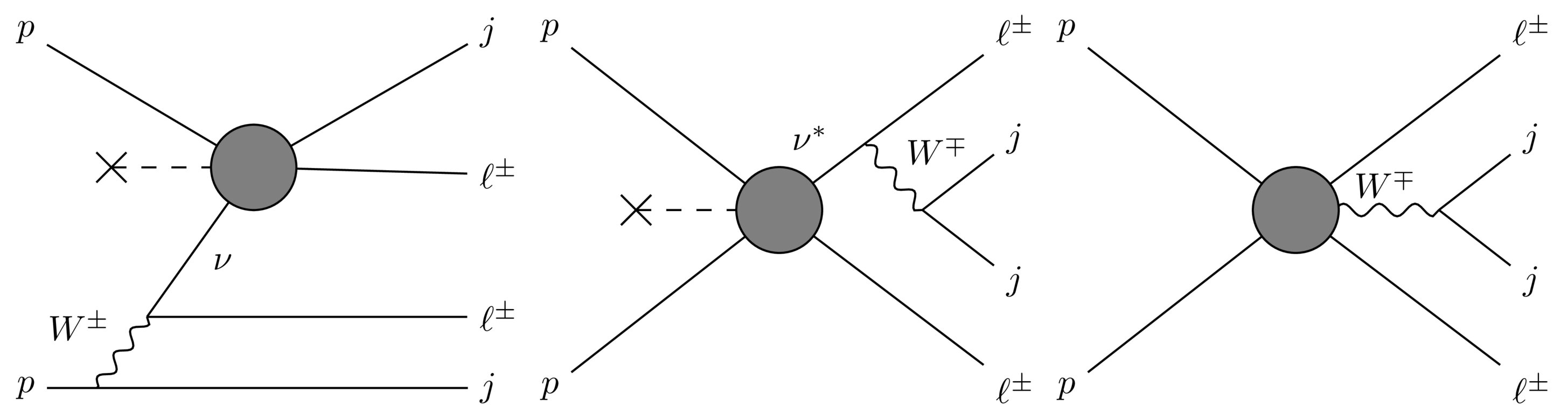
- Hunts the collider signature. At a proton–proton collider, lepton number violation can produce two same-sign charged leptons plus two jets, with no missing energy. The team simulates this signature for all operators using an ATLAS Run-2 search (139 fb⁻¹) and projects the future FCC-hh collider (30 ab⁻¹), focusing on the muon channel — precisely the flavor that neutrinoless double beta decay cannot reach.
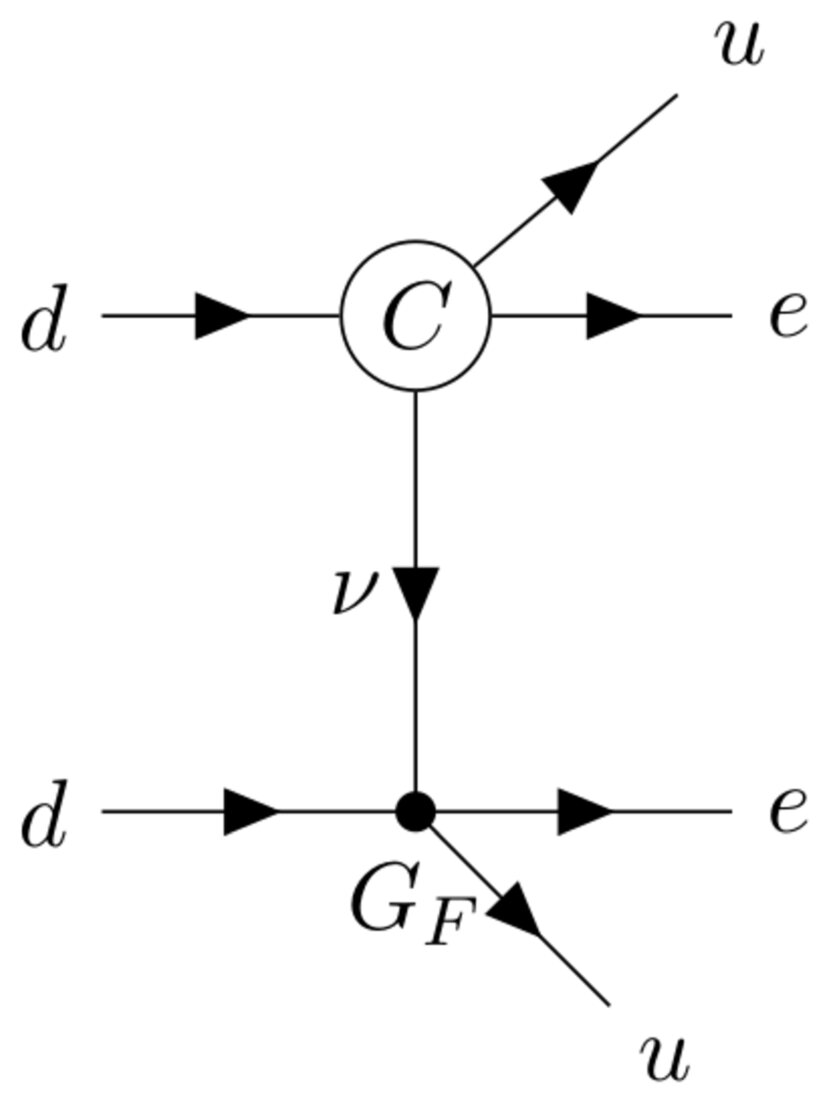
- Tours the low-energy laboratory. They review and update constraints from 0νββ (KamLAND-Zen), coherent elastic neutrino–nucleus scattering (COHERENT), long-baseline neutrino oscillations (MINOS, KamLAND), rare meson decays (K⁺→π⁺νν at NA62, KL→π⁰νν, B→Kνν), charged-lepton-flavor-violating decays, non-standard muon decay and the neutrino magnetic moment.
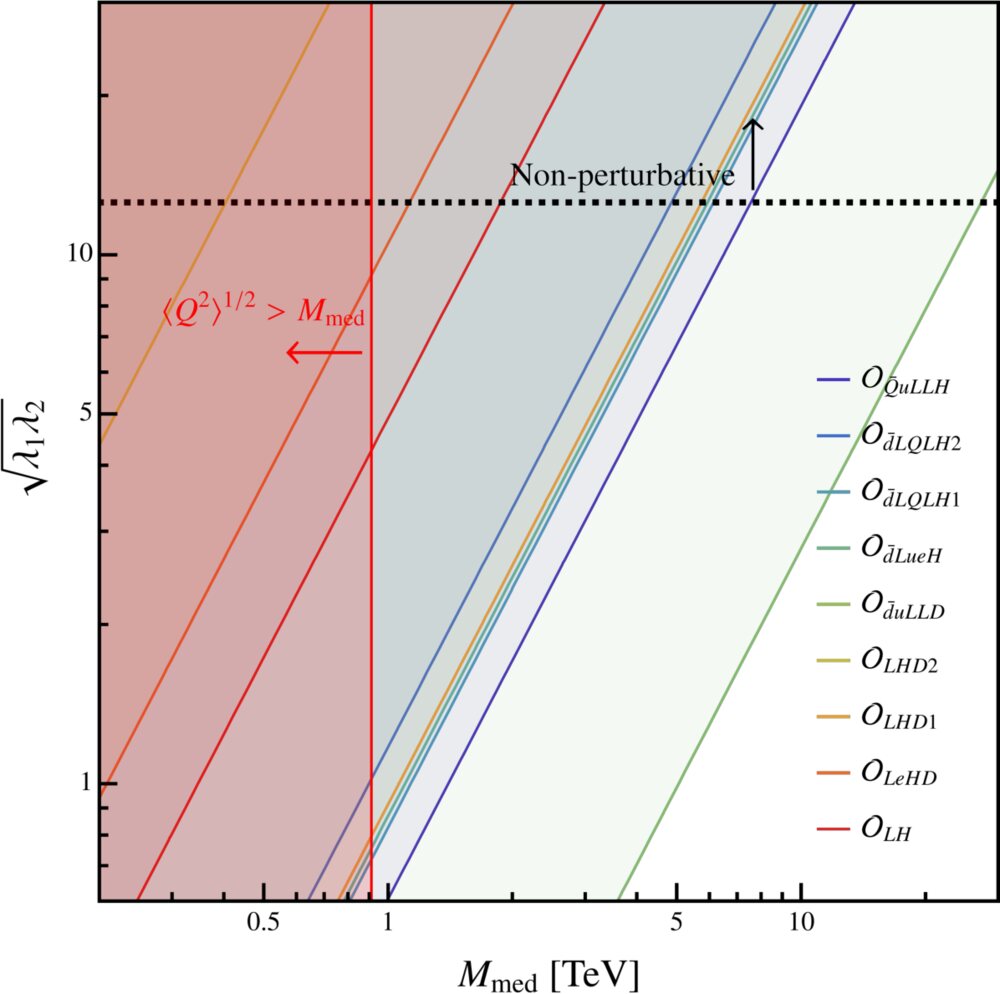
- Checks when the effective theory can be trusted. An effective description is valid only when the momentum exchanged in a process is smaller than the mass of the heavy particle that was integrated out. At the LHC the typical momentum transfer is about 900 GeV, so the collider limits make sense only for heavier mediators; the limits for the lightest operators are therefore marked as indicative rather than strict.
What they found
0νββ owns the electron flavor
Using the KamLAND-Zen bound on the ¹³⁶Xe half-life (2.3 × 10²⁶ years), neutrinoless double beta decay constrains electron-flavor operators far beyond any other probe: the new-physics scale reaches about 240 TeV for Od̄LQLH1 and about 300 TeV for OQ̄uLLH. Scalar operators drive the largest rates.
The LHC covers the muon flavor
The same-sign dimuon search already excludes Od̄uLLD up to about 5 TeV, and the FCC-hh projection pushes that to 19 TeV. Other operators sit at order 1 TeV today — for example OQ̄uLLH at 1.4 TeV, Od̄LQLH1 and Od̄LueH at 1.1 TeV — improving to several TeV at FCC-hh.
Mesons and neutrinos fill the gaps
The NA62 measurement of K⁺→π⁺νν constrains Od̄LQLH1 to 21.8 TeV (31.5 TeV in the future) and is sensitive to all three lepton flavors. COHERENT's neutrino–nucleus scattering reaches 0.4 TeV on the same operator, and long-baseline oscillation data bound five operators at the sub-TeV scale.
Three operators need special tools
OēLLLH, OLHB and OLHW do not give the collider signal at leading order, and the first two also skip 0νββ. They are caught instead by non-standard muon decay (OēLLLH, bound to 0.4 TeV) and by the neutrino magnetic moment (OLHB and OLHW, about 11 TeV).
One operator stands out for a different reason: OLH can generate neutrino mass directly, so the requirement that it does not spoil the observed neutrino masses pushes its scale above 10¹² TeV — twelve orders of magnitude beyond collider reach. For the others, the limits are a patchwork: each operator is best probed by a different combination of experiments, and several are constrained today at only the sub-TeV level, leaving room for upcoming experiments to make a discovery.
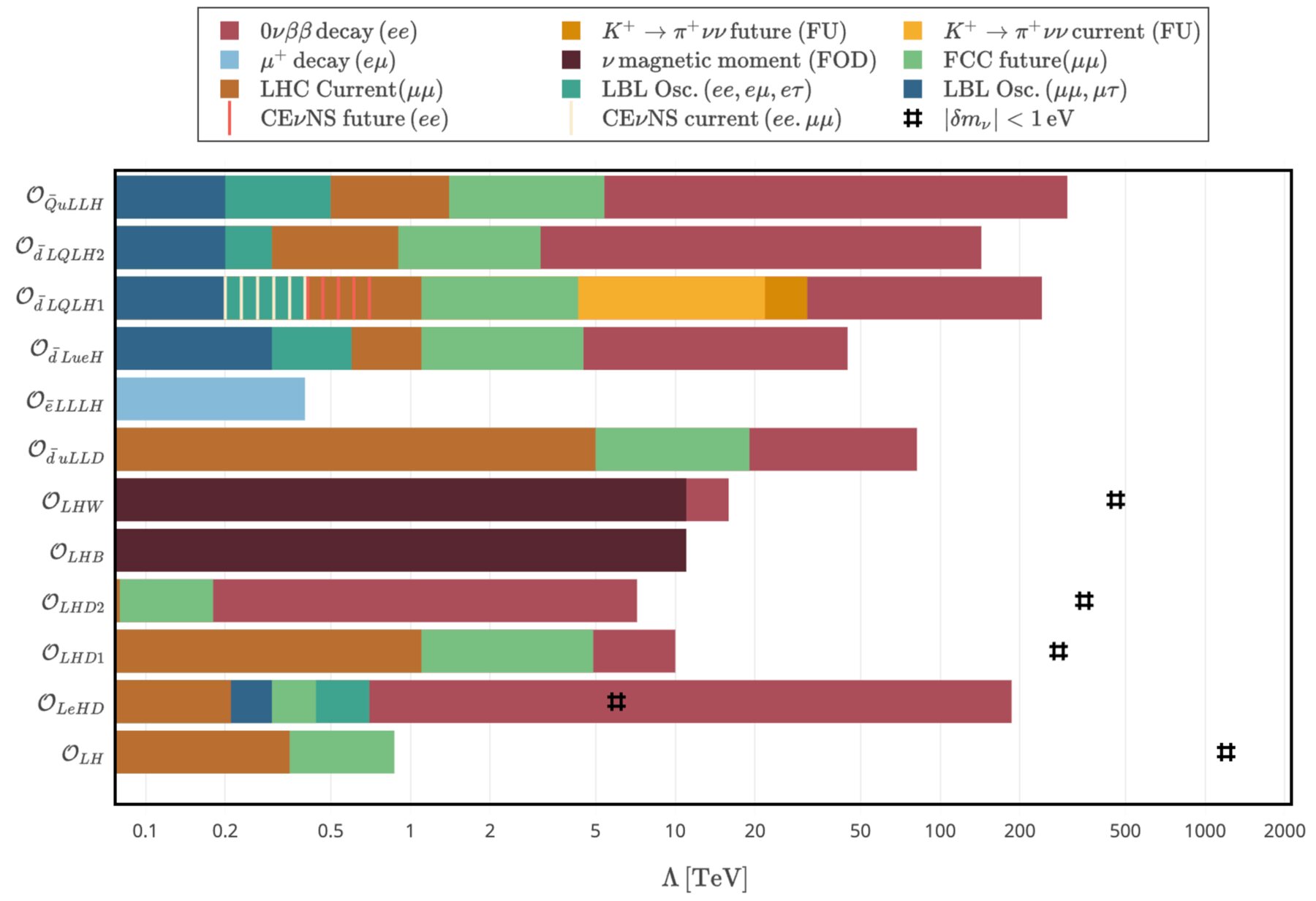
In one line: The twelve dimension-7 lepton-number-violating operators are invisible to any single experiment, but the combination of double beta decay, colliders, meson decays and neutrino experiments can cover them all — and the pattern of signals can reveal which operator is at work.
Why it matters
If lepton number is broken only in the muon or tau sector, a search program based solely on neutrinoless double beta decay could run for decades and see nothing. This survey maps which current and planned experiments cover which operator, and — more usefully — shows that combining the frontiers is diagnostic. A signal in muon decay without 0νββ would point to OēLLLH; a neutrino magnetic moment without 0νββ would point to OLHB, and with 0νββ to OLHW. If the new physics is muon-flavored, the LHC, meson factories or oscillation experiments may see it first. The map tells experimentalists where the gaps are — and model builders which operators their ideas must reproduce.
Key concepts
- Lepton number
- A bookkeeping rule: each lepton counts +1 and each antilepton −1. It is conserved by every Standard Model interaction, but a Majorana neutrino mass would break it by two units (ΔL = 2).
- Majorana particle
- A particle that is its own antiparticle. If neutrinos are Majorana, lepton number is not conserved, and neutrinoless double beta decay becomes possible.
- Neutrinoless double beta decay (0νββ)
- A hypothetical nuclear decay emitting two electrons and no neutrinos. Its observation would prove that neutrinos are Majorana particles.
- Effective field theory (SMEFT)
- A systematic way to describe unknown heavy physics at accessible energies: heavy particles are “integrated out” and their effects written as operators built from known fields, each weighted by a Wilson coefficient suppressed by powers of the new-physics scale.
- Operator dimension
- Operators with higher dimension are more suppressed at low energy. Lepton-number violation appears at odd dimensions; dimension 7 is the first step beyond the minimal (dimension-5) neutrino-mass operator.
- Multi-frontier complementarity
- Different experiments — colliders, nuclear decays, meson factories, neutrino detectors — are sensitive to different operators and different lepton flavors. Comparing their results is what allows the underlying interaction to be identified.
Citation
Kåre Fridell, Lukáš Gráf, Julia Harz, Chandan Hati, Probing lepton number violation: a comprehensive survey of dimension-7 SMEFT, Journal of High Energy Physics 05 (2024) 154. arXiv:2306.08709 [hep-ph] · doi:10.1007/JHEP05(2024)154. Published open access under CC BY 4.0; figures reproduced from the paper. This page is a plain-language summary and any simplification is the fault of the summary, not the authors.