2022 · Proceedings of Science · Conference proceedings
Distinguishing Dirac vs Majorana Neutrinos at CEνNS experiments
If a neutrino has a transition magnetic moment, it can flip into a heavy sterile partner when it bounces off a nucleus. This short conference contribution looks at what happens when that sterile partner decays inside the detector and emits a photon: the recoil-plus-photon coincidence opens up unexplored regions of the coupling–mass plane, and the photon’s energy spectrum can tell whether the sterile neutrino is Dirac or Majorana.
Published in: P. D. Bolton, F. F. Deppisch, K. Fridell, J. Harz, C. Hati, S. Kulkarni, Distinguishing Dirac vs Majorana Neutrinos at CEνNS experiments, PoS(EPS-HEP2021)225 (2022). doi:10.22323/1.398.0225 · publisher page
This is a short write-up of a talk at the EPS-HEP2021 conference; the full analysis appears in the companion paper, which has its own page: Neutrino transition magnetic moments from CEνNS photons.
Background: catching a neutrino with a gentle nudge
A coherent elastic neutrino-nucleus scattering (CEνNS) event is about as gentle as a neutrino interaction gets. Instead of smashing a nucleus apart, the neutrino scatters off the whole nucleus at once, and the nucleus quietly recoils with a tiny amount of energy. The process was proposed by D. Z. Freedman in 1974, and the COHERENT collaboration reported its first observation in 2017 with a significance of 6.7σ.
Since that first sighting, several new experiments have been proposed with upgraded detectors. Future-generation experiments aim to sense nuclear recoil energies as small as eV using only gram-scale detectors. That precision is interesting in itself, but it also makes these experiments sensitive to new physics beyond the Standard Model — for example, new interactions between neutrinos and nuclei.
Background: a magnetic door to sterile neutrinos
A sterile neutrino is a hypothetical heavy partner of the known neutrinos that does not feel the weak nuclear force. It can still interact through a transition magnetic moment μνN: an effective coupling that lets an active neutrino of flavour α (να) turn into a sterile neutrino N by interacting with a photon.
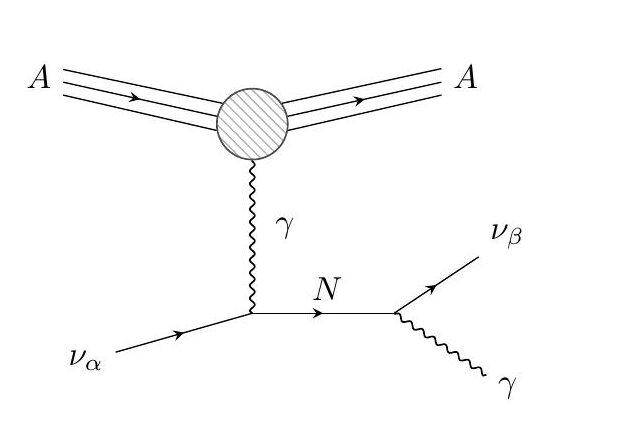
This coupling enables Primakoff upscattering: an incoming active neutrino scatters off the electric field of a target nucleus through photon exchange and emerges as a sterile neutrino, να A → N A. The only visible signal is the nuclear recoil. Crucially, the differential cross section for this process is identical for a Dirac or a Majorana outgoing neutrino. So the recoil alone can set limits on μνN as a function of the sterile mass mN — but it can never reveal the nature of the sterile state.
What the paper does
The contribution focuses on a different final state. If the sterile neutrino produced in the upscattering decays inside the detector, again through a dipole portal interaction, it can emit a real photon on the way: να A → νβ A γ. The outgoing light neutrino νβ can be active or another, lighter sterile state. The authors call this radiative upscattering.
The idea has several appealing features:
- A cleaner signature — the nuclear recoil and the outgoing photon arrive together. Requiring this coincidence avoids the standard backgrounds that plague the recoil-only Primakoff search, which makes up for the fact that the radiative rate is suppressed relative to Primakoff by one extra power of μνN.
- Resonant production — if the intermediate sterile state can be produced on shell, the radiative rate is resonantly enhanced.
- New parameter space — if the sterile state decays into another light sterile neutrino through a sterile-to-sterile transition dipole moment, which is much less constrained by terrestrial experiments, the radiative mode can reach parts of the μeνN–mN plane that other experiments cannot probe.
- A flavour factory — a reactor such as Chooz produces mostly electron antineutrinos, but the outgoing light neutrino can be of muon or tau flavour, so the process probes products of different flavour couplings, μeνN μμνN and μeνN μτνN.
As a case study, the paper discusses the NUCLEUS experiment at the Chooz reactor facility, whose planned setup and future upgrade could realistically detect the outgoing photon and study its energy and angular distributions. The full calculation, presented in the companion paper, gives double differential cross sections in the photon energy and the photon angle (measured with respect to the incoming neutrino beam). Integrated over the reactor neutrino spectrum, these become single event-rate distributions in photon energy and angle.
What they found
Recoil-only searches are blind to the question
The Primakoff upscattering cross section is identical for a Dirac and a Majorana outgoing sterile neutrino, so limits from the recoil alone contain no information about its nature.
The decay photon breaks the tie
Once the sterile state decays inside the detector, the differential distributions of the outgoing photon look significantly different for the two cases, so the radiative mode can actually distinguish them.
Majorana: symmetric energy spectrum
A Majorana sterile state gives an outgoing-photon energy distribution that is symmetric about a central energy, with almost equal numbers of events above and below it.
Dirac: lopsided energy spectrum
A Dirac sterile state gives an asymmetric distribution, clearly preferring low photon energies and with fewer events at higher photon energy.
Forward and energetic means Majorana
In the double differential cross section, the Majorana case predicts significantly more events at high photon energy for small outgoing photon angles than the Dirac case.
An extra sterile state unlocks new space
Sterile-to-sterile dipole transitions are much less constrained than active-to-sterile ones, so a decay into a lighter sterile neutrino lets the radiative mode reach currently unexplored regions of the μeνN–mN plane.
In one line: a nuclear recoil accompanied by a photon from a decaying heavy sterile neutrino would let CEνNS experiments probe new magnetic-moment territory and read off whether neutrinos are Dirac or Majorana.
Why it matters
Whether neutrinos are Dirac or Majorana — distinct particles and antiparticles, or each its own antiparticle — is one of the biggest open questions in particle physics, tied to lepton-number violation and to how neutrinos get their masses. Most probes of the transition dipole portal can measure its size but not this property. Reactor-based CEνNS experiments are special: their beams are purely neutrino or antineutrino, unlike astrophysical or collider probes, so a measured photon-energy spectrum from radiative upscattering could provide a clean discrimination. The flip side is that the radiative rate is rare, suppressed by an extra power of the magnetic moment; the reward is a signal that standard backgrounds cannot fake. As CEνNS detectors improve, the paper argues, this mode becomes a realistic way to learn not just that new physics is there, but what kind of neutrino is behind it.
Key concepts
- Coherent elastic neutrino-nucleus scattering (CEνNS)
- A neutrino bounces off an entire atomic nucleus at once and the nucleus recoils gently. Because the neutrino couples to all protons and neutrons coherently, the rate is relatively large. Proposed in 1974 and first observed by COHERENT in 2017.
- Sterile neutrino
- A hypothetical heavy partner of the known neutrinos that does not feel the weak force. It can still be produced and decay through its transition magnetic moment.
- Transition magnetic moment
- An effective coupling μνN that lets an active neutrino convert into a sterile one by interacting with a photon. It is the “dipole portal” through which this paper’s new physics is accessed.
- Primakoff upscattering
- The conversion of an active neutrino into a heavier sterile neutrino by exchanging a photon with a nucleus, να A → N A. The only visible signal is the nuclear recoil.
- Radiative upscattering
- The same process, but the sterile neutrino decays inside the detector into a lighter neutrino plus a real photon, να A → νβ A γ. The recoil and photon together form a nearly background-free coincidence signal.
- Dirac vs. Majorana fermions
- A Dirac particle has a distinct antiparticle, while a Majorana particle is its own antiparticle. For the sterile neutrino, this choice changes the energy and angular distributions of the photon emitted in its decay — the fingerprint this paper proposes to measure.
Citation
Patrick D. Bolton, Frank F. Deppisch, Kåre Fridell, Julia Harz, Chandan Hati, Suchita Kulkarni, Distinguishing Dirac vs Majorana Neutrinos at CEνNS experiments, Proceedings of Science PoS(EPS-HEP2021)225 (2022). doi:10.22323/1.398.0225 · free PDF at pos.sissa.it. Conference contribution to the European Physical Society Conference on High Energy Physics (EPS-HEP2021), 26–30 July 2021. Figures reproduced from the paper, which is published open access under CC BY-NC-ND 4.0; this page is a plain-language summary and any simplification is the fault of the summary, not the authors.