2022 · Physical Review D · Open access
Probing active-sterile neutrino transition magnetic moments with photon emission from CEνNS
If the neutrino has a tiny magnetic moment, an experiment watching neutrinos bounce off atomic nuclei could see something extra: a nuclear recoil accompanied by a photon, produced when the neutrino briefly turns into a heavier sterile partner that decays again. This paper shows that such a recoil-plus-photon coincidence is nearly background-free, competes with existing magnetic-moment limits already at the planned NUCLEUS detector, and can even reveal whether the sterile neutrino is its own antiparticle.
Published in: P. D. Bolton, F. F. Deppisch, K. Fridell, J. Harz, C. Hati, S. Kulkarni, Probing active-sterile neutrino transition magnetic moments with photon emission from CEνNS, Phys. Rev. D 106 (2022) 035036. doi:10.1103/PhysRevD.106.035036 · free preprint on arXiv
Background: how do you catch almost nothing?
Neutrinos are famous for passing through matter as if it were not there. One of the few ways to catch them is coherent elastic neutrino-nucleus scattering (CEνNS): a neutrino hits an entire atomic nucleus at once, without breaking it apart, and the nucleus recoils with a tiny amount of energy. Because the neutrino couples to all the protons and neutrons together, the probability of this “bounce” is much larger than for scattering off a single nucleon. The COHERENT experiment first observed CEνNS in 2017 with a significance of 6.7σ, and a new generation of experiments, such as NUCLEUS at the Chooz reactor, now aims to detect recoil energies as low as 10 eV.
These experiments are also sensitive to physics beyond the Standard Model. One example relevant here: if a neutrino has a transition magnetic moment, it can convert into a hypothetical heavy partner — a sterile neutrino that does not feel the weak force. The conversion can happen when the neutrino scatters off the electric field of the nucleus, a process called Primakoff upscattering. In that case the only visible signal is the nuclear recoil. Non-observation of extra recoils then sets a bound on the size of the magnetic moment.
The twist in this paper is that the sterile neutrino does not have to escape unnoticed. If it is heavy enough, it can decay back before leaving the detector, and the transition magnetic moment that produced it also lets it emit a real photon. That photon can be seen separately, giving a coincidence signal: one nuclear recoil plus one photon.
What the paper does
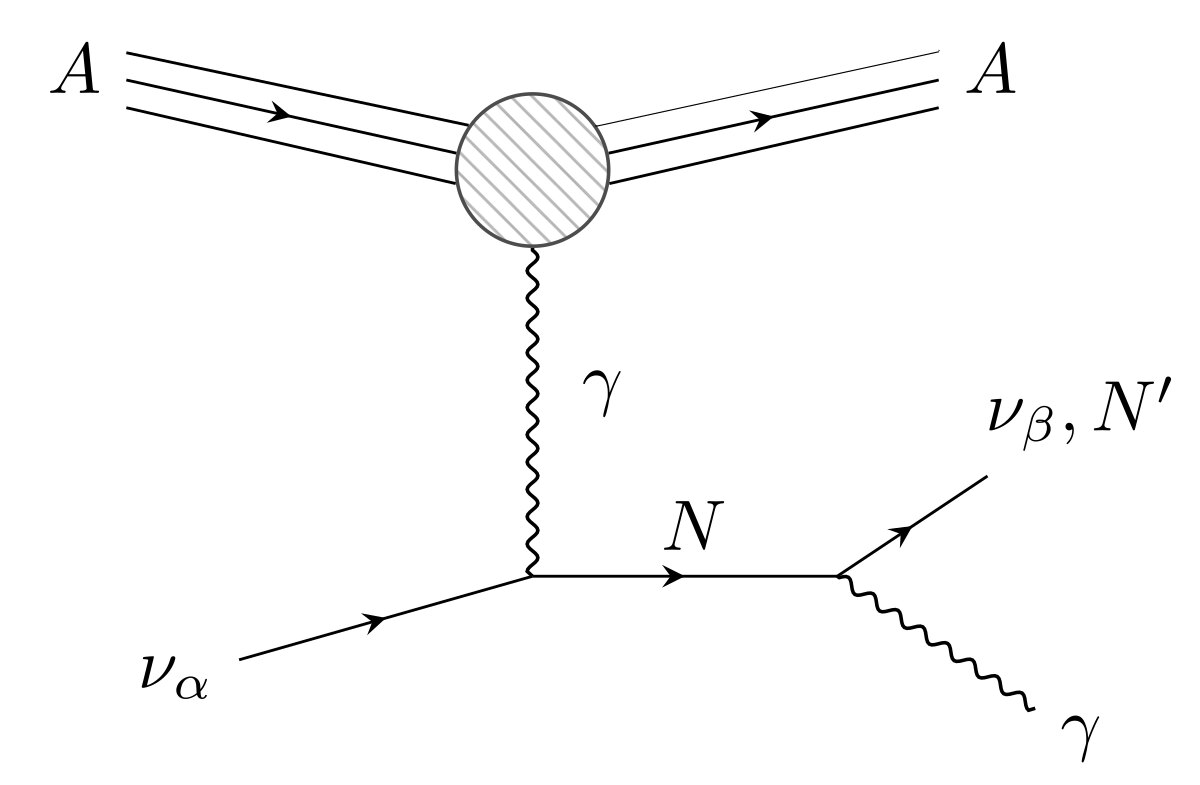
The authors calculate the rate for this radiative upscattering, να A → X A γ, where a neutrino of flavour α scatters off a nucleus A and turns into a heavier sterile neutrino N, which then decays inside the detector into a photon γ plus a lighter neutrino X — either an active neutrino νβ or an even lighter sterile state N′. The photon adds an extra handle on the event, and the coincidence between recoil and photon can reject backgrounds very effectively.
Because the process needs both the upscattering and the decay, its rate is proportional to |μανN μXN|2. If the decay proceeds through the same active-sterile magnetic moment, the coincidence rate is suppressed by two extra powers of the coupling compared to the recoil-only Primakoff process — but the authors argue the much smaller background can compensate.
As a case study they use the future NUCLEUS experiment at the Chooz nuclear reactor:
- Neutrino source — the Chooz reactor provides an electron-antineutrino flux of about 1012 cm−2 s−1, with a known energy spectrum peaking around a few MeV.
- Phase I — a 10 g Al2O3/CaWO4 detector of about 5 cm length, sensitive to nuclear recoils and to photons with energies between 1 keV and 10 MeV.
- Phase II — a 1 kg 73Ge detector of about 25 cm length.
They then set 90% confidence-level projections for a two-year run, both from the recoil-only Primakoff search and from the absence of recoil-photon coincidences, and compare with existing limits from reactors, the COHERENT experiment and other probes.
Dirac or Majorana? The photon knows
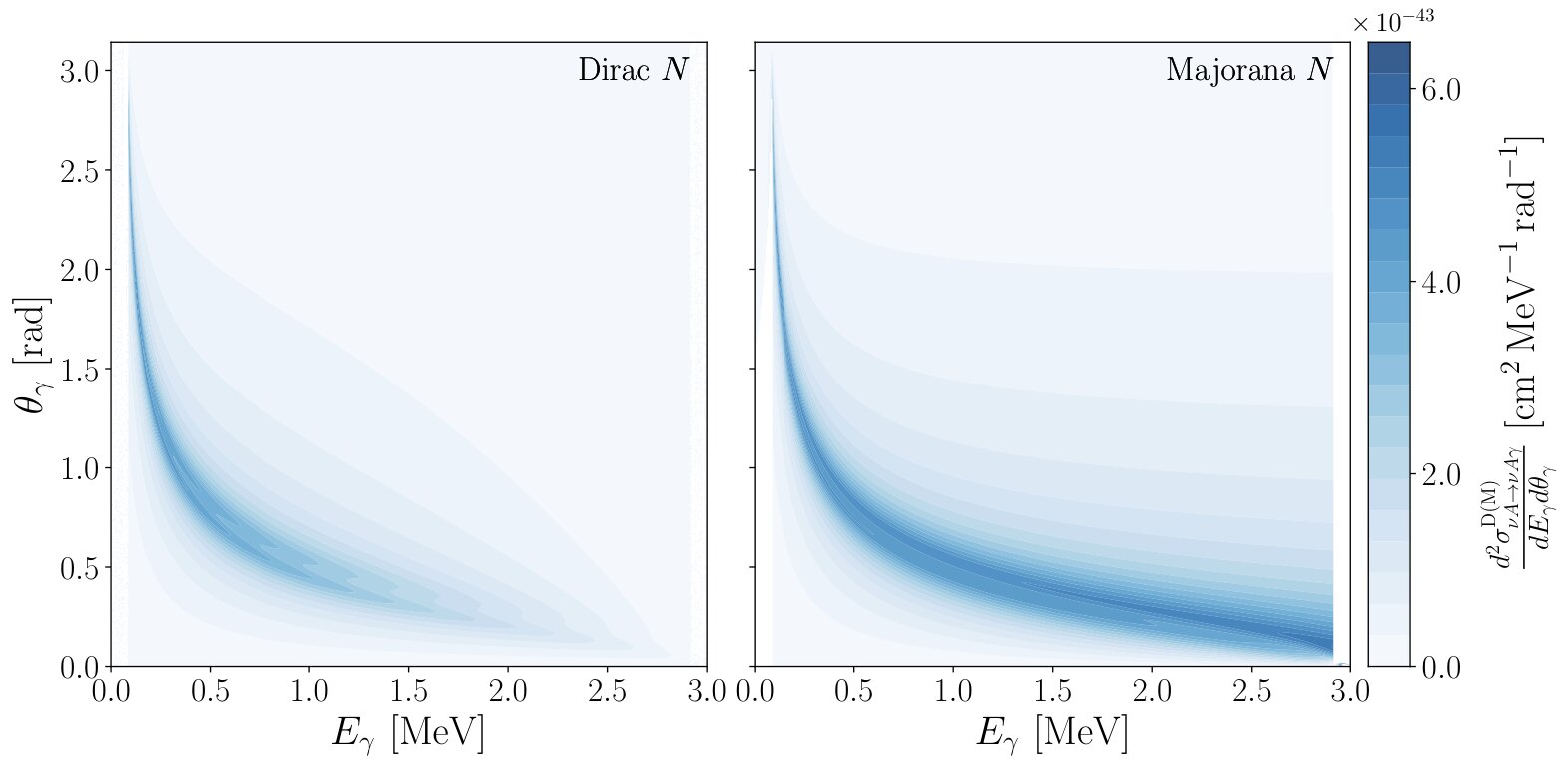
A particle can be a Dirac fermion (like the electron, with a distinct antiparticle) or a Majorana fermion (its own antiparticle). For the sterile neutrino, this choice changes the decay N → X γ: the Majorana decay rate is twice as large as the Dirac one, ΓM = 2ΓD = mN3|μXN|2/(4π). More importantly, it changes the shape of the emitted photon’s distribution. In the lab frame, between the minimum and maximum photon energies, Eγ± ≈ (Eν/2)(1 ± √(1 − mN2/Eν2)), the Dirac spectrum falls linearly from the lowest to the highest photon energy, while the Majorana spectrum is flat. The angular distribution also peaks at slightly lower angles for a Majorana sterile neutrino.
What they found
Signal peaks at 1–5 MeV
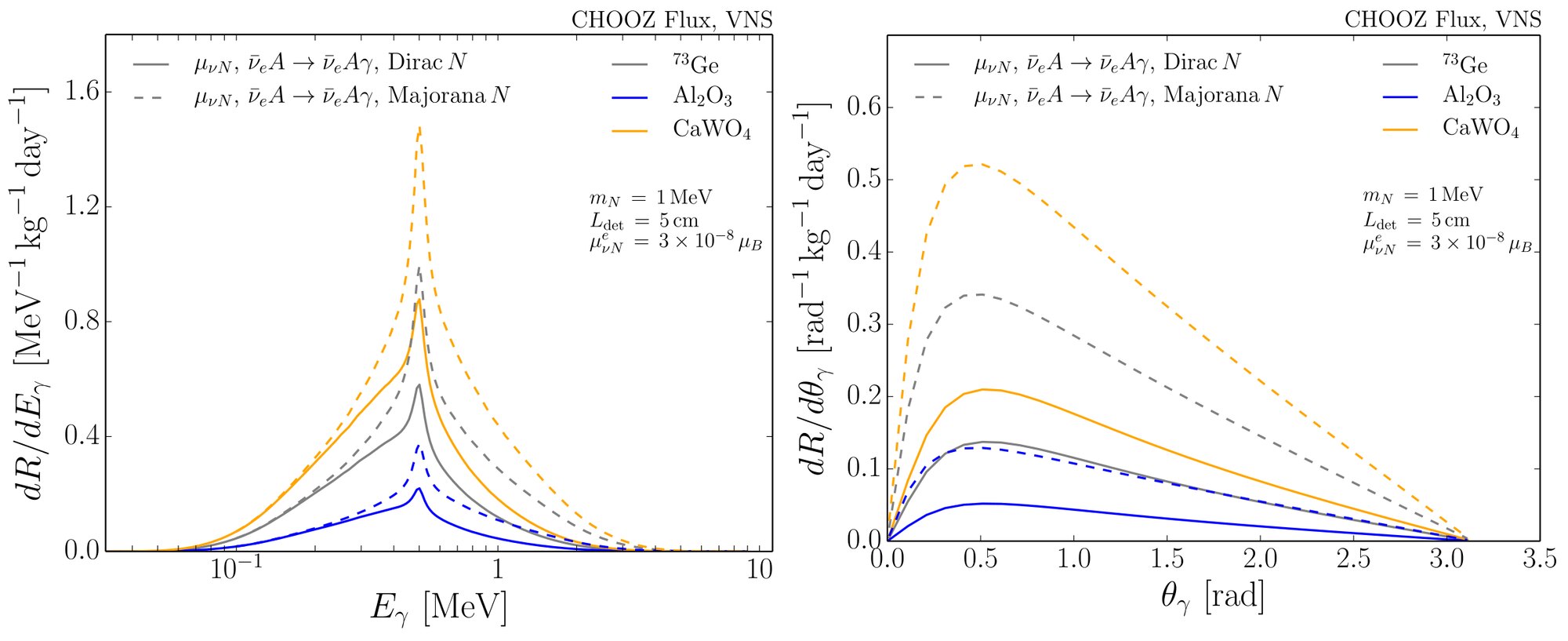
For the Chooz reactor flux, the largest number of radiative events is expected for sterile neutrino masses mN around 1–5 MeV.
Competitive despite |μ|4
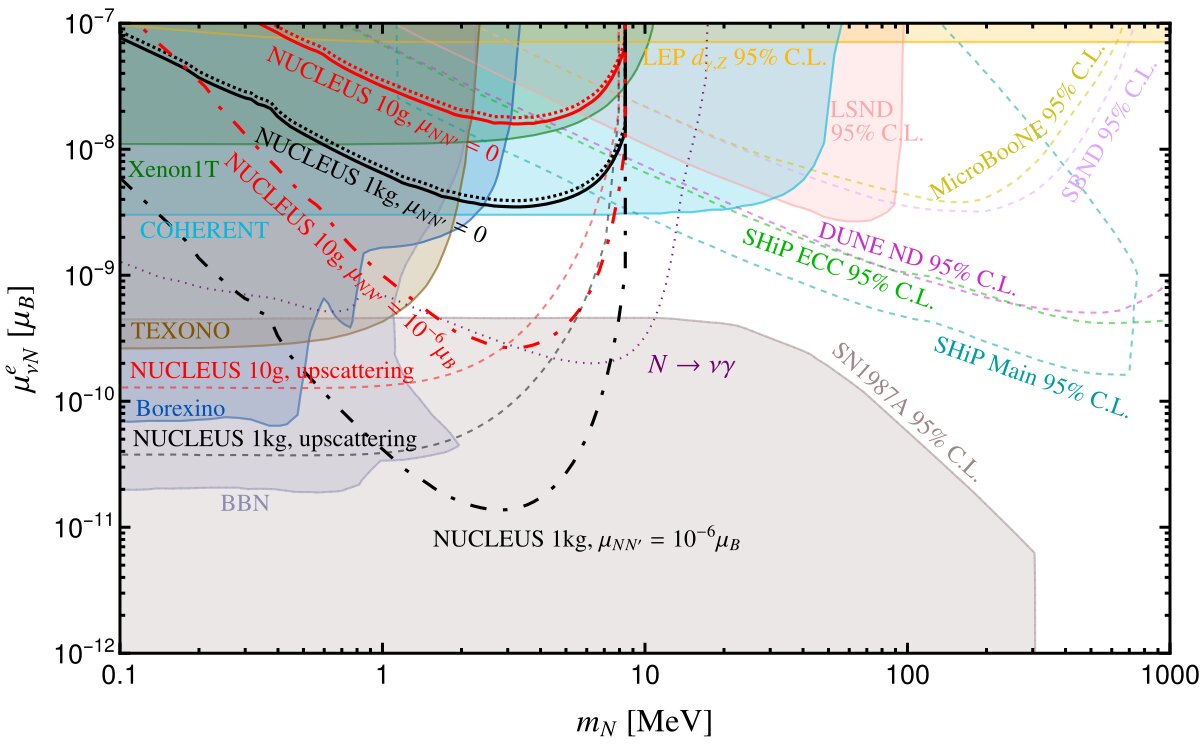
Even though the coincidence rate is doubly suppressed by the coupling, the negligible background gives NUCLEUS sensitivities similar to the existing XENON1T and COHERENT limits on the electron-flavour magnetic moment.
A second sterile state helps
If N can also decay to a lighter sterile neutrino N′ through a sterile-sterile magnetic moment μN′N = 10−6 μB, then for mN ≳ 1 MeV the coincidence search constrains smaller magnetic moments than the recoil-only Primakoff search, and stays competitive for μN′N ≳ 10−7 μB.
Invisible decays: little effect
Adding an invisible decay width up to Γinv = βγ/Ldet does not appreciably change the sensitivity; larger invisible widths, however, weaken the bounds.
Matches today’s best lab limits
The current COHERENT constraint from Primakoff upscattering almost coincides with the projected sensitivity of the 1 kg NUCLEUS upgrade in the photon-coincidence channel.
A window on neutrino nature
If the photon distributions matched a Majorana sterile neutrino, that would imply the light active neutrinos are Majorana too — a signal of lepton-number violation and a clue for how neutrinos get their masses.
In one line: a nuclear recoil plus a photon from the decay of a heavy sterile neutrino would give CEνNS experiments a nearly background-free probe of neutrino transition magnetic moments — and of whether neutrinos are Dirac or Majorana.
Why it matters
Transition magnetic moments are a “dipole portal” to new physics: a small, low-energy window onto heavy particles and the mechanism that gives neutrinos their mass. This work shows that the same data that CEνNS experiments are already collecting can be used to look for it in two complementary ways — recoil-only and recoil-plus-photon — and that the photon channel, though rarer, brings unique information. It also gives the NUCLEUS collaboration a concrete target: if the Primakoff search sees a signal, a search for coincidences in the upgraded detector becomes worthwhile. And since a Majorana sterile neutrino would imply Majorana active neutrinos, a future photon measurement could touch on lepton-number violation and the origin of the matter–antimatter asymmetry of the universe.
Key concepts
- Coherent elastic neutrino-nucleus scattering (CEνNS)
- A neutrino bounces off an entire atomic nucleus, which recoils gently without being torn apart. Because the neutrino couples to all the protons and neutrons at once, the process has a large, calculable rate. Predicted in 1974 and first observed by COHERENT in 2017.
- Sterile neutrino
- A hypothetical neutrino that does not feel the weak nuclear force. It would be invisible to ordinary detectors except through its mixing with, or magnetic-moment coupling to, the known neutrinos.
- Transition magnetic moment
- An effective coupling μ between an active and a sterile neutrino that lets the active neutrino flip into the sterile one by interacting with a photon. It is measured in Bohr magnetons μB, the unit of the electron’s magnetic moment; the projections in this paper reach down to about 10−11 μB.
- Primakoff upscattering
- The conversion of an active neutrino into a heavier sterile neutrino by exchanging a photon with the electric field of a nucleus: ν A → N A. The only visible signal is the nuclear recoil.
- Radiative upscattering
- The same process, but the produced sterile neutrino decays inside the detector into a lighter neutrino and a real photon: ν A → X A γ. The recoil and the photon together form a coincidence signal.
- Dirac vs. Majorana fermion
- A Dirac particle has a distinct antiparticle; a Majorana particle is its own antiparticle. For the sterile neutrino, this choice changes the decay rate and the energy and angular distributions of the emitted photon.
Citation
Patrick D. Bolton, Frank F. Deppisch, Kåre Fridell, Julia Harz, Chandan Hati, Suchita Kulkarni, Probing active-sterile neutrino transition magnetic moments with photon emission from CEνNS, Physical Review D 106 (2022) 035036. arXiv:2110.02233 [hep-ph] · doi:10.1103/PhysRevD.106.035036. Figures reproduced from the paper, which is published open access under CC BY 4.0. This page is a plain-language summary; any simplification is the fault of the summary, not the authors.