2018 · Journal of Cosmology and Astroparticle Physics · Open access on arXiv
Direct detection of fermionic and vector dark matter with polarised targets
Direct detection experiments look for dark matter bumping into atomic nuclei deep underground. Almost all of them treat the nucleus as an unpolarised target. This paper asks what changes when the nuclear spins are lined up — and shows that a polarised target would give a new, spin-sensitive handle on dark matter, enough in principle to tell fermionic dark matter from vector dark matter.
Published in: R. Catena, K. Fridell, V. Zema, Direct detection of fermionic and vector dark matter with polarised targets, JCAP 11 (2018) 018 [erratum: JCAP 08 (2021) E01]. doi:10.1088/1475-7516/2018/11/018 · free preprint on arXiv
Background: catching dark matter with nuclear recoils
Everything we know about dark matter is gravitational: it pulls on stars, galaxies and light, but no one has seen it in a laboratory. The leading guess is that it is made of new particles. If so, a dark matter particle passing through the Earth could occasionally hit an atomic nucleus, making the nucleus recoil with a tiny energy — a few keV. Direct detection experiments are built to catch exactly those recoils, in low-background detectors placed deep underground.
Interactions between dark matter and nuclei are usually sorted into two families. Spin-independent scattering is coherent: the dark matter particle interacts with the whole nucleus at once, so the rate grows quickly with the number of nucleons. Spin-dependent scattering couples to the nuclear spin instead, so only unpaired protons or neutrons contribute. In an ordinary detector the nuclear spins point in random directions and this spin information is averaged away.
A polarised target changes that: the nuclear spins are aligned along a chosen axis. For interactions that violate parity (the mirror symmetry of nature), the scattering rate then depends on the angle between the incoming dark matter direction and the nuclear spin, and it can change when the polarisation is flipped. Earlier work, cited by the paper, found that a polarised helium-3 detector could reject solar-neutrino-induced recoils with 98% efficiency when the polarisation axis points away from the Sun; helium-3 also has low radioactive background and a clean neutron-rejection signature. Techniques to polarise large samples of helium, argon and xenon have been studied too.
What the paper does
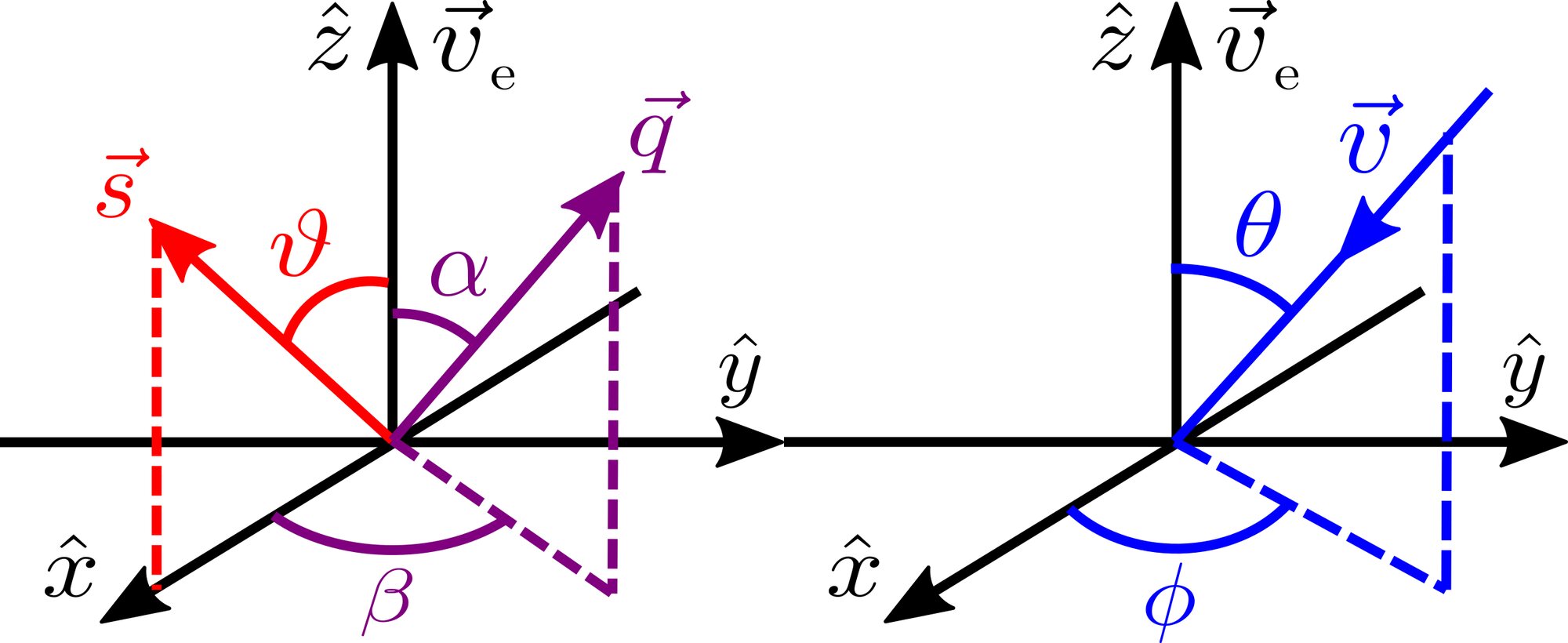
The authors work with simplified models: a dark matter particle (a fermion, spin 1/2, or a vector particle, spin 1), a mediator particle that carries the force between dark matter and nuclei, and a handful of couplings. The nuclei are treated as point-like particles of spin 1/2, and the mediator is taken to be heavy. Two cases are studied, a mediator that couples like a vector or like a pseudo-vector (the parity-violating option that makes polarisation matter).
For each model the team computes the triple differential rate — scattering events per unit detector mass, per nuclear recoil energy and per recoil direction — using the standard dark matter velocity distribution of the Milky Way (with a most probable speed of 220 km s⁻¹, an escape speed of 544 km s⁻¹, Earth moving at 232 km s⁻¹ and a local dark matter density of 0.4 GeV cm⁻³). Keeping the recoil direction makes it possible to track how the rate changes when the polarisation points one way or the opposite way.
To isolate the new effect, the paper defines the purely polarisation dependent rate: half the difference between the rate with polarisation s and the rate with polarisation −s. Anything that does not depend on the nuclear spin cancels out. For fermionic dark matter the authors redo a calculation from the literature, correcting two sign errors in the earlier cross section and checking the result with an independent derivation. For vector dark matter they compute the polarised cross section for the first time. All the numerical results use a benchmark with all masses equal to 100 GeV and couplings chosen to maximise parity violation, arranged so that the unpolarised rate is identical for fermionic and vector dark matter — a fair comparison.
What they found
Two results in one paper
The fermionic polarised cross section is refined — two sign errors in the earlier literature result are corrected, and the new expression is validated by an independent calculation. The vector dark matter cross section is computed for the first time.
Parity violation is essential
The rate only depends on the polarisation direction when the interaction violates parity. The polarisation vector then breaks the symmetry of the scattering, creating a dependence on the azimuthal angle β that would otherwise be impossible.
Spin 1/2 vs spin 1 look different
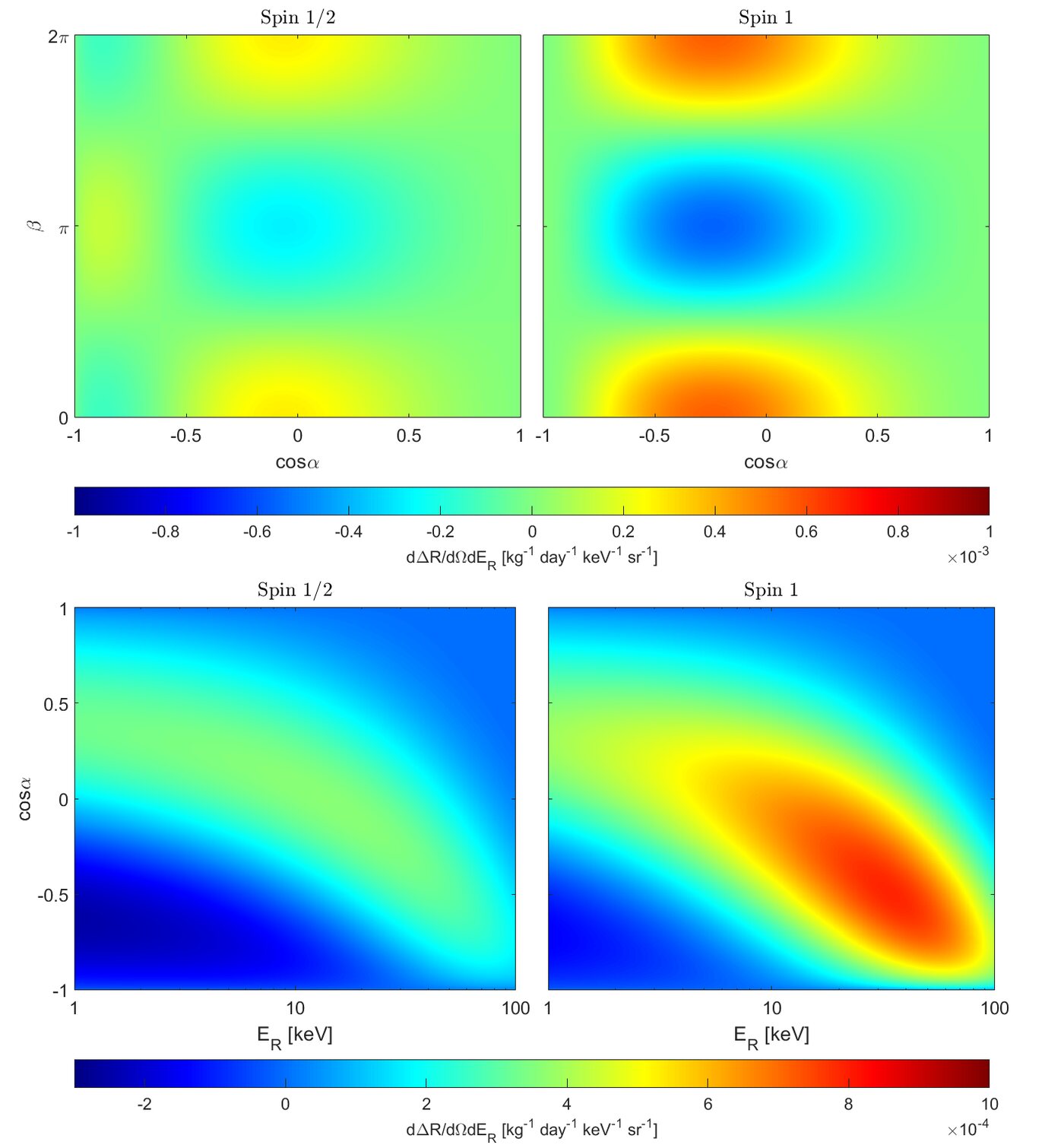
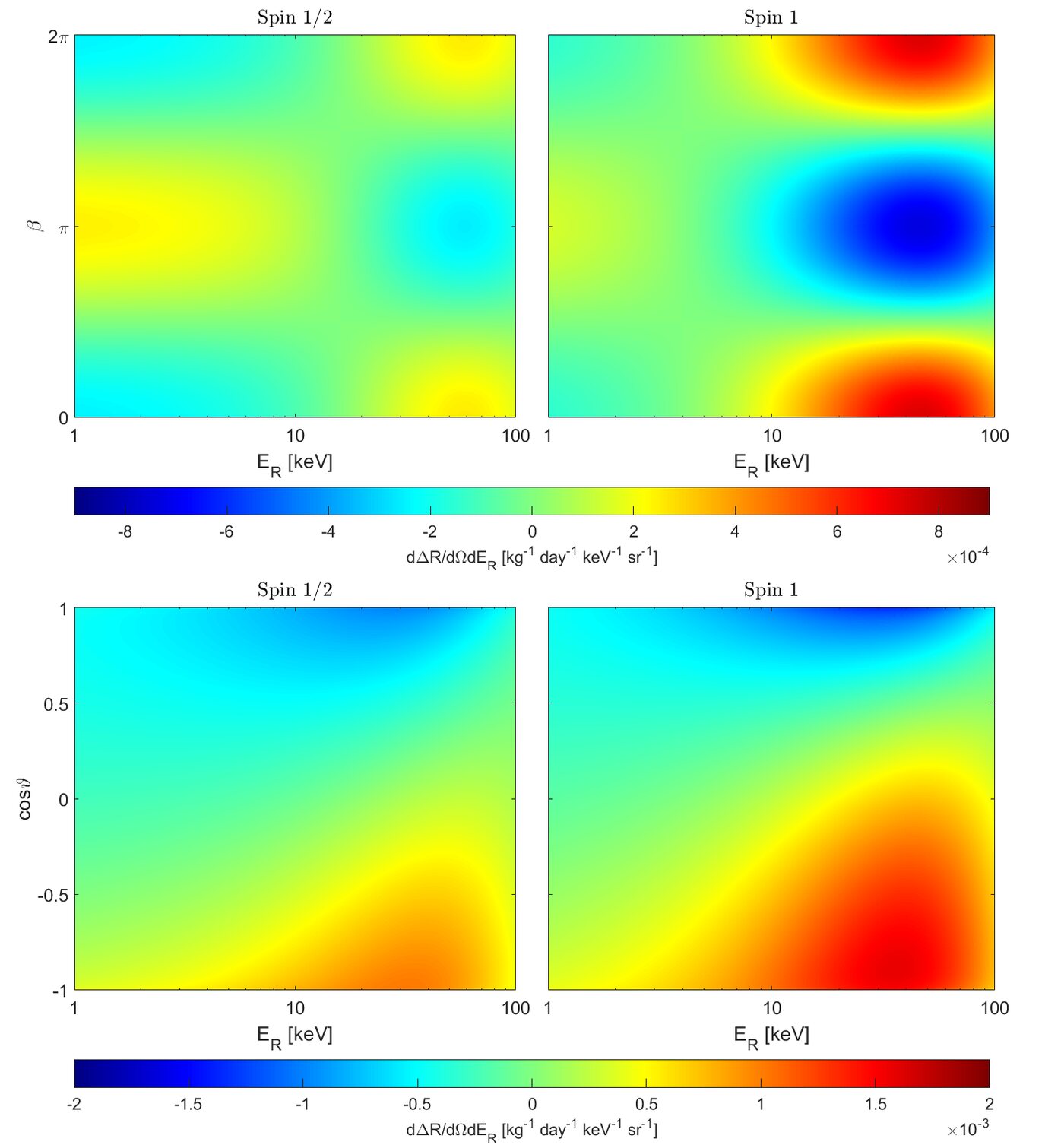
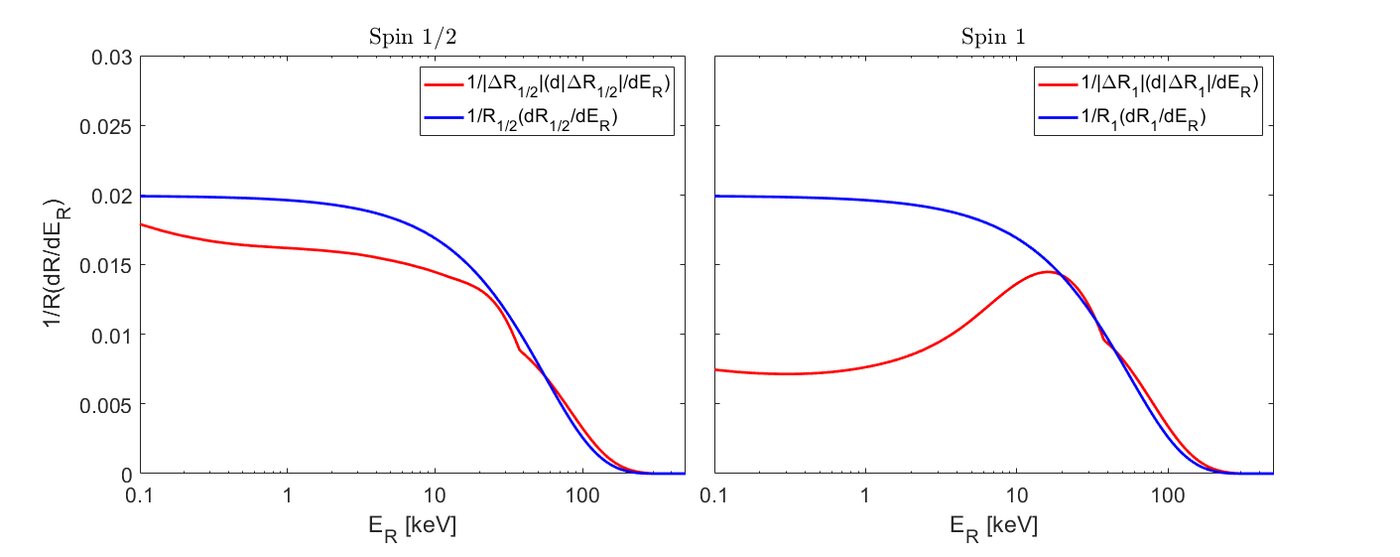
The polarisation-dependent part of the rate has a different shape for fermionic and vector dark matter. For spin 1/2 it is largest at low recoil energy, while for spin 1 it peaks around 20 keV — so, in principle, polarised data could identify the dark matter spin.
The effect is small but not hopeless
The polarisation-dependent part is only about 10⁻³ of the total rate. A 3σ detection without directional information would need roughly 3×10⁶ events — comparable to the total number of nuclear recoils seen by DAMA — but the number drops significantly if the recoil direction is also measured.
In one line: polarising a detector's nuclei turns the direction of nuclear spin into an experimental knob, and the small polarisation-dependent signal it creates could in principle reveal whether dark matter is a fermion or a vector particle.
Why it matters
Direct detection experiments mostly count recoils without asking about spin. This paper shows what extra information becomes available when the target nuclei are polarised, and it provides the full set of equations needed to assess a future polarised detector. One attractive use is fighting backgrounds: the paper recalls that a polarised helium-3 target could discriminate dark matter recoils from solar-neutrino recoils with high efficiency. Another is particle identification: the shape of the polarisation-dependent energy spectrum differs between spin-1/2 and spin-1 dark matter, so measuring it would probe the spin of the dark matter particle itself. The catch is statistics — the effect is about a thousand times smaller than the total rate — so the authors conclude that either a very large exposure or a detector that also measures recoil directions would be needed, and they note that their equations set the ground for that assessment. They also point out that one model parameter, the imaginary part of the coupling ℑ(b6), appears only in the polarisation-dependent rate, so it could be constrained directly by such a measurement.
Key concepts
- Direct detection
- Searching for dark matter particles by looking for the tiny recoils they produce when they scatter off atomic nuclei in a low-background underground detector.
- Spin-independent vs spin-dependent
- Two ways dark matter can couple to a nucleus: coherently to all its nucleons (spin-independent, grows with nuclear size) or through the nuclear spin, where only unpaired nucleons matter (spin-dependent).
- Spin polarisation
- Aligning the spins of the target nuclei along a chosen direction, so that the detector has a preferred axis rather than a random mixture of spin directions.
- Parity violation
- An interaction that is not the same as its mirror image. Here it is what allows the scattering rate to depend on the direction of the nuclear polarisation relative to the incoming dark matter.
- Simplified model
- A minimal toy model of dark matter: a dark matter particle, a mediator particle and a few couplings, used to study signals without committing to a full theory.
- Nuclear recoil energy
- The kinetic energy a nucleus receives in a scattering event, typically a few keV for dark matter in the Milky Way. It is the main quantity direct detection experiments measure.
Citation
Riccardo Catena, Kåre Fridell, Vanessa Zema, Direct detection of fermionic and vector dark matter with polarised targets, Journal of Cosmology and Astroparticle Physics 11 (2018) 018; erratum JCAP 08 (2021) E01 (correcting Eq. (2.8); results quantitatively unchanged). arXiv:1810.01515 [hep-ph] · doi:10.1088/1475-7516/2018/11/018 · erratum doi:10.1088/1475-7516/2021/08/E01. Figures reproduced from the paper; this page is a plain-language summary and any simplification is the fault of the summary, not the authors.