2024 · Preprint · arXiv:2408.08361
Impact of Bound State Formation on Baryogenesis
The Universe is made of matter, not antimatter — and nobody knows why. This paper is the first to work out how bound states, pairs of heavy particles held together by long-range forces, change the generation of the baryon asymmetry in the early Universe. Depending on the scenario, they can remove more than 90% of the asymmetry, or boost it by a factor of a few.
arXiv preprint: Mathias Becker, Kåre Fridell, Julia Harz, Chandan Hati, Impact of Bound State Formation on Baryogenesis, arXiv:2408.08361 [hep-ph] (2024), report numbers MITP-24-067 and KEK-TH-2642. Free preprint on arXiv
Background: a Universe that chose matter
Every observation says the Universe contains far more matter than antimatter. The Standard Model of particle physics cannot explain how that baryon asymmetry was generated, so it must come from new physics. In 1967 Sakharov listed the three ingredients any mechanism needs: processes that violate baryon number, a departure from thermal equilibrium, and CP violation — a small difference in how the laws of physics treat particles and their antiparticles.
A popular way to get all three is to introduce heavy new particles, out of equilibrium, with baryon- or lepton-number-violating interactions. When these particles decay, or when they scatter with each other, they can leave behind a tiny excess of matter over antimatter. Well-known examples include type-II and type-III seesaw leptogenesis and “WIMPy” baryogenesis.
Now the twist. If those heavy particles carry a gauge charge and become non-relativistic, slow-moving pairs feel a long-range attraction. Two things can happen. The first is the Sommerfeld enhancement: the attraction focuses the quantum wavefunctions of the two particles towards each other, making them more likely to interact than a naive estimate suggests. The second is that they can form a bound state — the particle-physics analogue of a hydrogen atom, with two heavy particles held together by a light force carrier. A bound state forms when the pair radiates away a force carrier, and it can later annihilate back into force carriers or other particles.
Both effects are standard tools in dark matter calculations. They had never been included in a baryogenesis calculation — until this paper.
What the paper does
The authors write down, for the first time, the Boltzmann equations — the standard bookkeeping for how particle abundances evolve in the early Universe — with bound states included as a new species. They then apply them to two simplified models that represent the two most common ways to make a baryon asymmetry:
- Decay-dominated baryogenesis. A heavy scalar X, charged under a new non-abelian interaction, decays slightly differently into matter and antimatter. Bound states of two X particles form and annihilate into force carriers, removing X particles before they can decay. These decays conserve baryon number, so they only affect how many asymmetry-making particles are left.
- Scattering-dominated baryogenesis. Two scalars φ collide and annihilate slightly differently into matter and antimatter b pairs. Here the bound states themselves have CP-violating decays, so they can produce the asymmetry directly, and they can also mediate new “washout” processes that erase it.
Because bound states interact much faster than the Universe expands, their abundance tracks its equilibrium value, and their effect can be folded into the equations for everything else. The team then integrates the equations with and without bound-state effects — and with and without the Sommerfeld effect — to isolate what each one does.
What they found
More than 90% gone
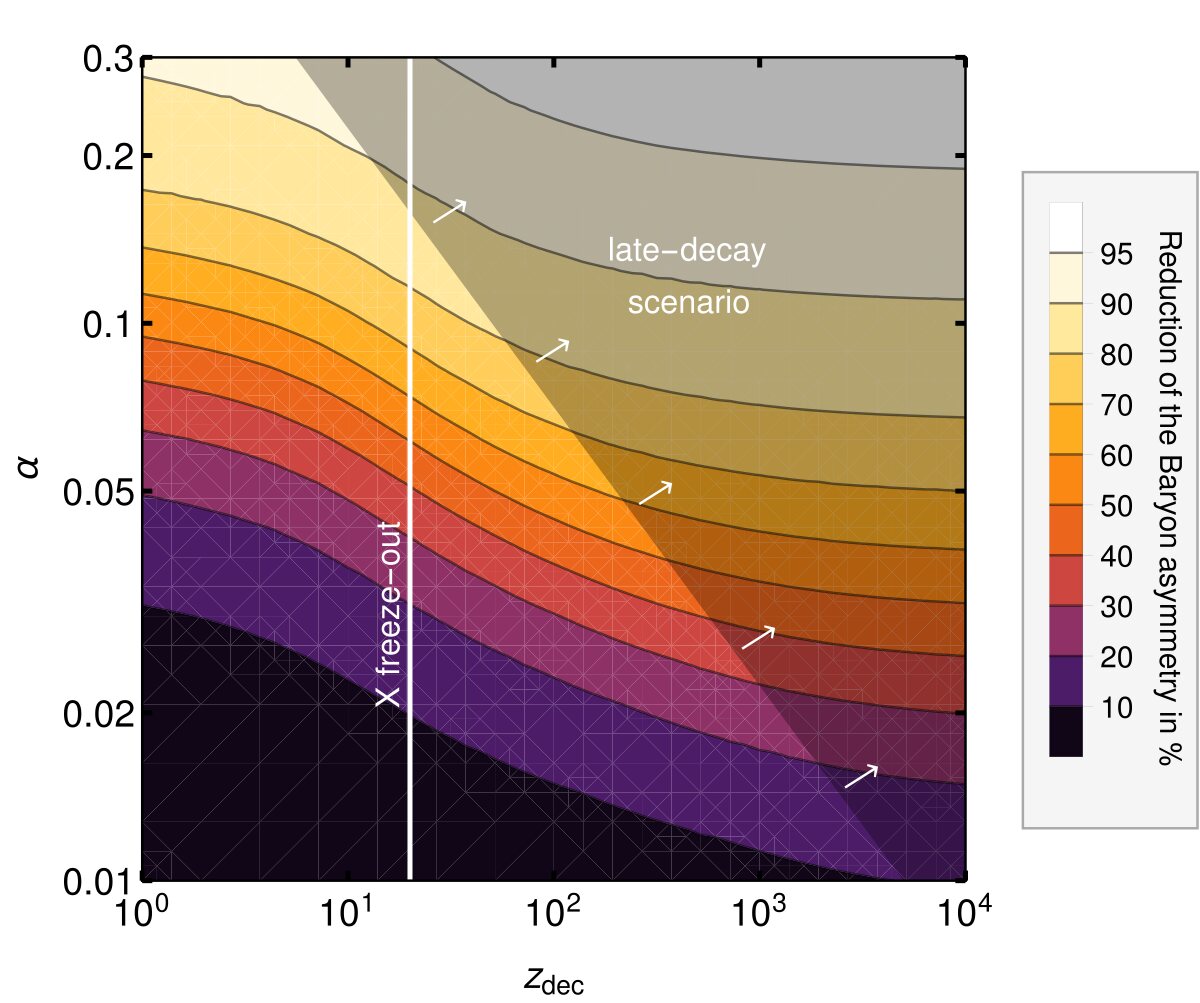
In decay-dominated baryogenesis with late decays and strong interactions, bound states reduce the asymmetry by more than an order of magnitude. Early decays only suffer corrections of order 1–10%, mostly from the Sommerfeld effect rather than bound states themselves.
A rule for when it matters
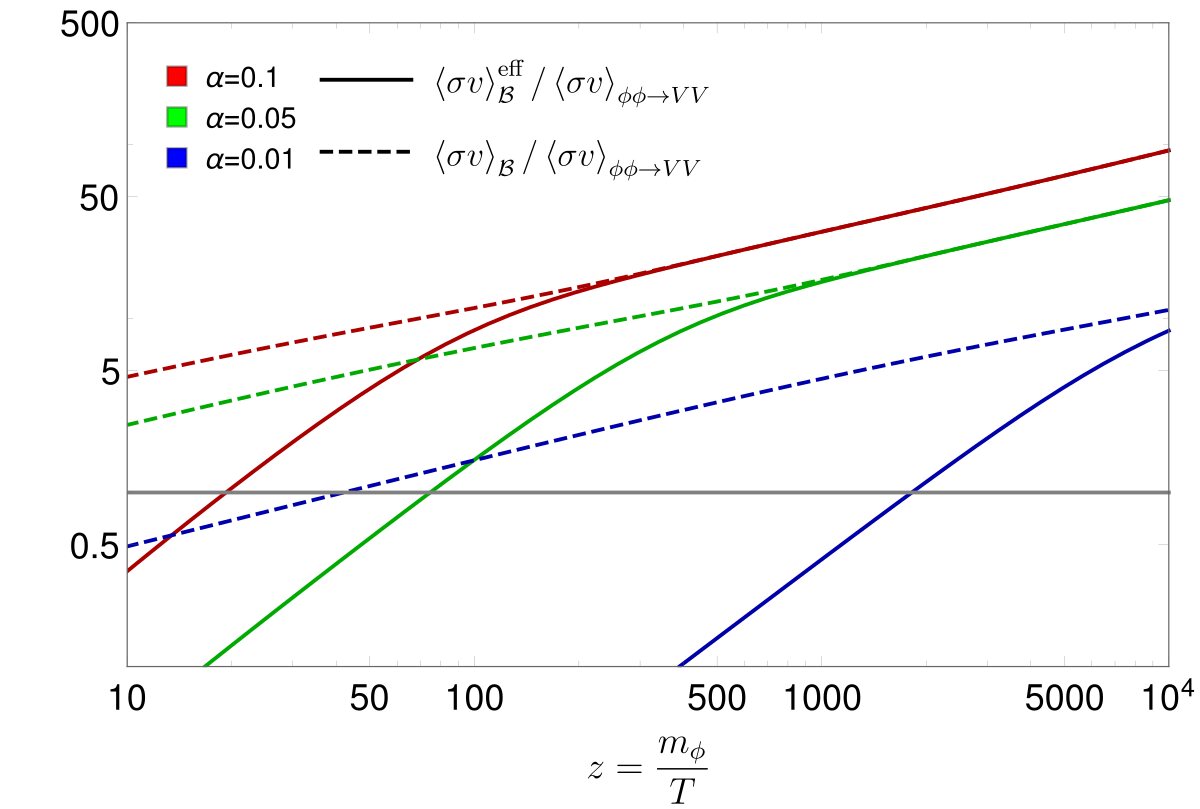
Bound states become the dominant annihilation channel once the temperature drops below their binding energy. The paper estimates this happens after zBSF ≈ 0.2 α−2, so bound states matter whenever the asymmetry is generated later than that.
Cuts and boosts
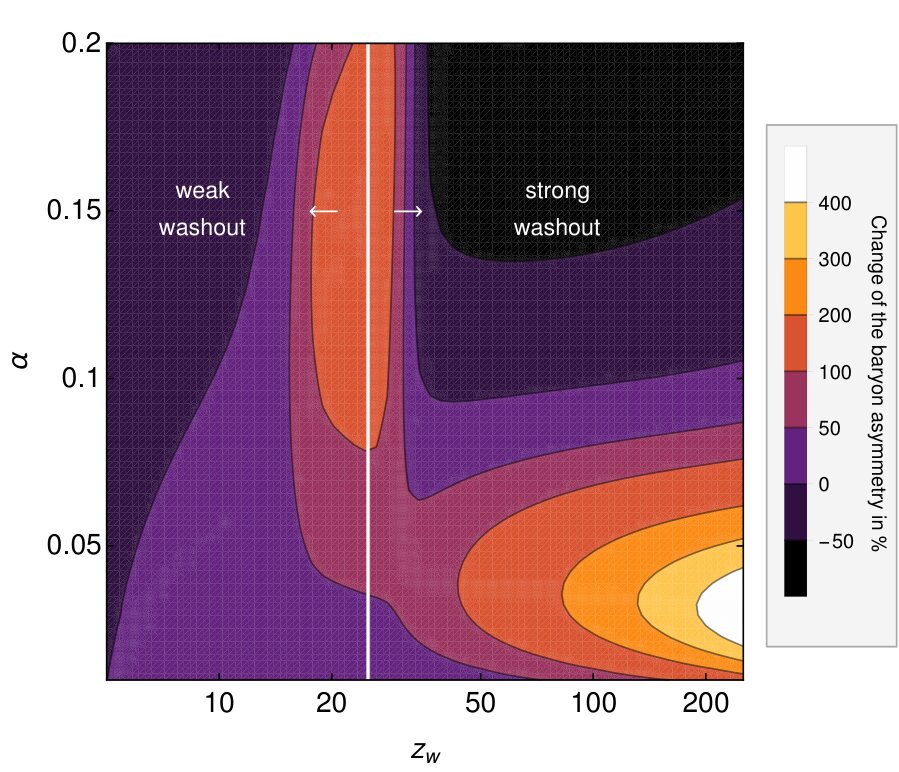
In scattering-dominated scenarios the change can go either way. Strong washout with α ≈ 0.1 reduces the asymmetry by up to about 70%; one special interference pattern can increase it by up to 500%, though this is typically not enough to rescue an underproduced asymmetry. In the weak-washout case, Sommerfeld enhancement raises it by up to about 100%.
Real models shift too
Type-II and type-III seesaw models, whose coupling is similar to the weak interaction (α ≈ 0.03), lose less than about 10% in early decays; late decays shift the parent mass needed for success by a factor of order one. For strongly interacting particles (α ≳ 0.1), late-decay scenarios need parent masses about ten times larger.
The paper also identifies three distinct ways bound states enter the story:
- Depletion: forming and decaying into force carriers removes the particles that would have sourced the asymmetry — and keeps them closer to equilibrium.
- Source: if bound states have CP- and (B−L)-violating decays, the formation-and-decay sequence directly creates asymmetry.
- Washout: the same decays can mediate new baryon- and lepton-number-violating scatterings that erase asymmetry, and can even interfere destructively with the ordinary washout channels.
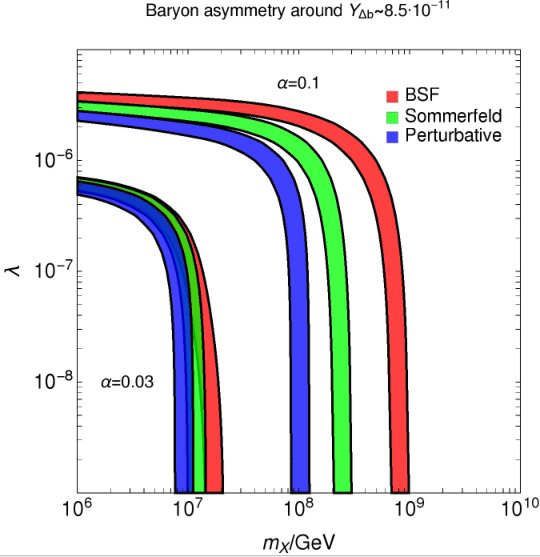
In one line: including bound states can change the predicted baryon asymmetry from a factor-of-a-few increase to a more-than-tenfold decrease, so baryogenesis calculations that ignore them can get the wrong answer.
Why it matters
Baryogenesis is one of the biggest open questions in particle cosmology, and many of the most studied answers — seesaw leptogenesis, WIMPy baryogenesis — rely on exactly the ingredients that make bound states form: heavy, non-relativistic particles with long-range interactions. This paper shows that those models’ predictions can move by an order of magnitude once bound states are included, which reshapes the mass ranges and couplings that model-builders and experimentalists should care about. It also provides the equations, so the effect can now be included in future studies instead of neglected.
Key concepts
- Baryon asymmetry of the Universe (BAU)
- The small excess of matter over antimatter left over from the early Universe — the reason stars, planets and people exist at all.
- Bound state
- Two heavy particles held together by a long-range force, like a hydrogen atom made of new particles. It forms when the pair radiates away a force carrier, and can later annihilate.
- Sommerfeld enhancement
- A long-range attraction focuses slow particles towards each other, raising their interaction rate above the naive, non-attractive estimate.
- CP violation
- A difference between the laws of physics for particles and antiparticles. Without it, any process would create matter and antimatter in equal amounts.
- Washout
- Processes that violate baryon or lepton number and erase an asymmetry after it has been created.
- Freeze-out
- The moment when a particle’s interactions become too slow to keep it in equilibrium with the surrounding plasma; its abundance then stays roughly fixed.
Citation
Mathias Becker, Kåre Fridell, Julia Harz, Chandan Hati, Impact of Bound State Formation on Baryogenesis, arXiv preprint arXiv:2408.08361 [hep-ph] (2024), report numbers MITP-24-067 and KEK-TH-2642. arXiv:2408.08361. Figures reproduced from the paper, which is distributed under the arXiv.org perpetual non-exclusive license; this page is a plain-language summary and any simplification is the fault of the summary, not the authors.