2022 · Journal of Physics: Conference Series · Open access conference proceedings
Neutron-antineutron oscillations as a probe of baryogenesis
Would a neutron ever turn into its own antineutron? A signal of such n–n̄ oscillations at the Deep Underground Neutrino Experiment or the European Spallation Source would be direct evidence that baryon number is violated. This short TAUP 2021 conference write-up — based on the authors’ full-length companion paper — explains how an observed oscillation rate can be converted into the strength of early-Universe washout processes, tying baryogenesis at high and low scales to the reach of collider searches.
Published in: K. Fridell, J. Harz, C. Hati, Neutron-antineutron oscillations as a probe of baryogenesis, J. Phys. Conf. Ser. 2156 (2022) 012015, proceedings of TAUP 2021. doi:10.1088/1742-6596/2156/1/012015 · free PDF via INSPIRE
This is a short five-page conference contribution summarising the authors’ full analysis. For the complete study and results, see the companion paper Probing baryogenesis with neutron-antineutron oscillations (JHEP 11 (2021) 185) and its plain-language page.
Background: a flipping neutron as a window on the origin of matter
The Universe contains matter but almost no antimatter. Explaining this asymmetry requires baryon number to be violated, and one of the cleanest possible signs would be a neutron spontaneously turning into an antineutron — an n–n̄ oscillation. This is a |ΔB| = 2 process: baryon number changes by two units, which is exactly the kind of violation a successful baryogenesis mechanism needs. Many well-motivated, ultraviolet-complete extensions of the Standard Model predict it.
Nobody has seen the transition yet, but experiments are closing in. The current best limit on the oscillation lifetime comes from Super-Kamiokande, and the best free-neutron bound from the ILL experiment; DUNE, Hyper-Kamiokande and the NNBAR experiment at the European Spallation Source are expected to improve these limits by orders of magnitude:
| Experiment | Status | Oscillation lifetime |
|---|---|---|
| Super-Kamiokande | current best limit | τ ≥ 4.7 × 10⁸ s |
| ILL | best free-neutron limit today | τ ≥ 0.86 × 10⁸ s |
| DUNE | projected sensitivity | τ ≥ 7 × 10⁸ s |
| NNBAR (ESS) | projected sensitivity | τ ≥ 3 × 10⁹ s |
Meanwhile, lattice-QCD calculations of the transition matrix elements — the numbers that encode how the six quarks in a neutron rearrange into an antineutron — have improved enormously. That makes it timely to ask what a future n–n̄ signal would actually mean for the origin of matter, because n–n̄ oscillations are among the very few observables that can directly probe baryogenesis mechanisms and help distinguish new-physics scenarios together with other low- and high-energy experiments.
What the paper does
The authors pursue the question along two complementary routes — a model-independent EFT and a concrete simplified model — and this short proceedings contribution reports both.
- A model-independent effective field theory (EFT). Any heavy new particles that could make a neutron flip into an antineutron can be described at low energies by six-quark contact operators. The paper works in a chiral basis of 14 independent operators — seven plus their parity partners — and identifies the four (O1, O2, O3 and O5) that matter for the oscillation rate. That rate is a sum over each operator’s Wilson coefficient times its hadronic matrix element, with the matrix elements taken from lattice QCD in the MS-bar renormalisation scheme at μ = 2 GeV.
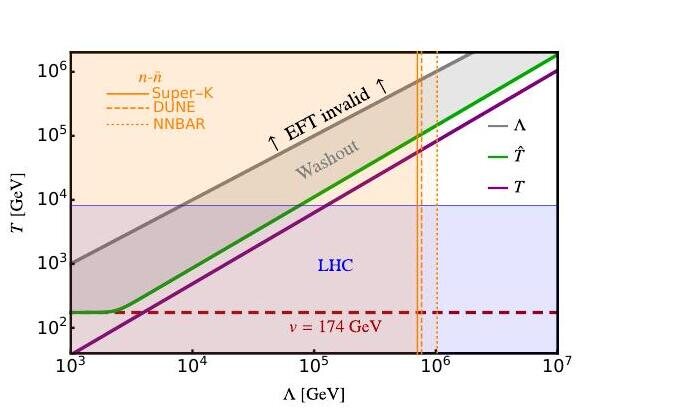
- Washout in the early Universe. The same operators that allow the oscillation also allow reactions that destroy a baryon asymmetry. The authors track this with generalised Boltzmann equations, keeping the 3 ↔ 3 scatterings and dropping the 2 ↔ 4 ones, which are phase-space suppressed. Integrating the equations gives T̂, the temperature below which the washout switches off and an asymmetry can survive — including the entropy-dilution factor drec ≈ 1/27. The result is figure 1 below: an observed oscillation rate fixes how strong the washout was.
- A concrete model with CP violation. Real baryogenesis also needs a source of CP violation and mass hierarchies among the new fields. The paper therefore studies a simplified model — two colour-sextet scalar diquarks, Xdd and Xud, plus a scalar ξ that breaks the B − L symmetry. Once ξ acquires its vacuum expectation value, the trilinear coupling λξXddXudXud violates baryon number by two units. Two mass patterns are explored: a high-scale scenario (mXud ∼ O(TeV), mXdd ∼ O(1013–14 GeV), motivated by gauge-coupling unification in SO(10) grand unified theories) and a low-scale scenario (both diquarks close to O(TeV), within reach of future colliders).
What they found
A signal pins down the washout
For new physics at Λ ≈ 106 GeV, the washout stays strong down to T̂ ≈ 1.4 × 10⁵ GeV. Assuming a pre-existing asymmetry, anything surviving to today must have been generated below this scale — a scale that future colliders can reach.
High-scale scenario stays viable
With the heavy states around 1013–14 GeV and the light diquark at the TeV scale, successful baryogenesis remains possible. Today the LHC constrains this scenario more tightly than n–n̄ experiments do; a signal in either would let the other test whether this mechanism explains the observed asymmetry.
Low-scale scenario washes itself out
When both diquarks sit near a TeV — where future colliders could find them — and mXdd is a few times mXud but below O(108) GeV, the washout is so strong that no sizeable asymmetry can build up, even with maximal CP violation. Post-sphaleron baryogenesis is suggested as an alternative.
Two methods, one conclusion
The model-independent EFT estimate and the concrete simplified model agree: if the new physics behind a future n–n̄ signal is within current or future collider reach, its washout would have erased any asymmetry generated above it.
In one line: a future n–n̄ signal would be a smoking gun for baryon number violation, and its rate would tell us how low the scale of successful baryogenesis must have been — directly linking oscillation experiments to collider searches.
Why it matters
A discovery of n–n̄ oscillations would not be just another new particle — it would be a clue about where the matter in the Universe came from. As the authors stress, the interpretation depends on the new-physics spectrum: a signal from particles within collider reach would imply that the washout was very strong, forcing the observed asymmetry to be generated below that scale and perhaps favouring post-sphaleron baryogenesis; a high-scale scenario with a large hierarchy between the decaying new fields and their decay products remains a viable way to generate the observed asymmetry, with upcoming n–n̄ experiments and future collider searches probing new parts of its parameter space. Either way, oscillation experiments and colliders are most powerful when used together.
Key concepts
- Neutron–antineutron oscillation (n–n̄)
- A neutron spontaneously converting into its antineutron. It changes baryon number by two units and has never been observed; Super-Kamiokande, DUNE and the European Spallation Source’s NNBAR experiment are searching for it.
- Baryon number and |ΔB| = 2
- Quarks carry baryon number 1/3, so a neutron has baryon number 1 and an antineutron −1. An n–n̄ oscillation changes baryon number by two units — the violation any baryogenesis mechanism needs.
- Effective field theory (EFT)
- A way to describe unknown heavy particles through the low-energy interactions they produce, organised in powers of an energy scale Λ. It works only below that scale — the grey line in figure 1 marks where it breaks down.
- Washout
- Baryon-number-violating reactions that erase an existing asymmetry. When their rate exceeds the expansion rate of the Universe, they push the asymmetry back toward zero — the central obstacle studied here.
- Diquark
- A hypothetical scalar particle that couples to two quarks at once. The simplified model uses two colour-sextet diquarks, Xdd and Xud, combining to mediate the |ΔB| = 2 oscillation.
- CP violation
- A genuine difference in behaviour between matter and antimatter. Together with baryon number violation and a departure from thermal equilibrium, it is required for any mechanism that generates a net baryon asymmetry.
Citation
Kåre Fridell, Julia Harz, Chandan Hati, Neutron-antineutron oscillations as a probe of baryogenesis, in Journal of Physics: Conference Series 2156 (2022) 012015 — proceedings of the 17th International Conference on Topics in Astroparticle and Underground Physics (TAUP 2021). doi:10.1088/1742-6596/2156/1/012015 · INSPIRE record · free PDF. The article is open access (CC BY 3.0). Figures reproduced from the paper; this page is a plain-language summary and any simplification is the fault of the summary, not the authors. The complete analysis is in the companion paper, summarised on its own page.