2021 · Journal of High Energy Physics · Open access
Probing baryogenesis with neutron-antineutron oscillations
Why does the Universe contain matter but almost no antimatter? A neutron quietly turning into its own antineutron would change baryon number by two units, and future experiments are about to become sensitive to it. This paper shows what such a discovery would mean: if the new particles responsible have widely separated masses, the observed matter–antimatter asymmetry can be generated through the very same interaction, while staying testable by colliders and oscillation searches; if their masses are close together, the interaction erases any asymmetry it could have created, even with maximal CP violation.
Published in: K. Fridell, J. Harz, C. Hati, Probing baryogenesis with neutron-antineutron oscillations, JHEP 11 (2021) 185. doi:10.1007/JHEP11(2021)185 · free preprint on arXiv
Background: a missing-antimatter problem and a flipping neutron
Every proton and electron in the Universe today has essentially no antimatter partner: only about one extra proton survived for every billion photons left over from the hot early Universe. The measured baryon-to-photon ratio is ηB = (6.20 ± 0.15) × 10−10. The Standard Model alone cannot explain how this imbalance arose. Already in 1967 Sakharov identified what any mechanism needs: a violation of baryon number (more precisely of B − L, baryon number minus lepton number), a difference between matter and antimatter (C and CP violation), and a departure from thermal equilibrium.
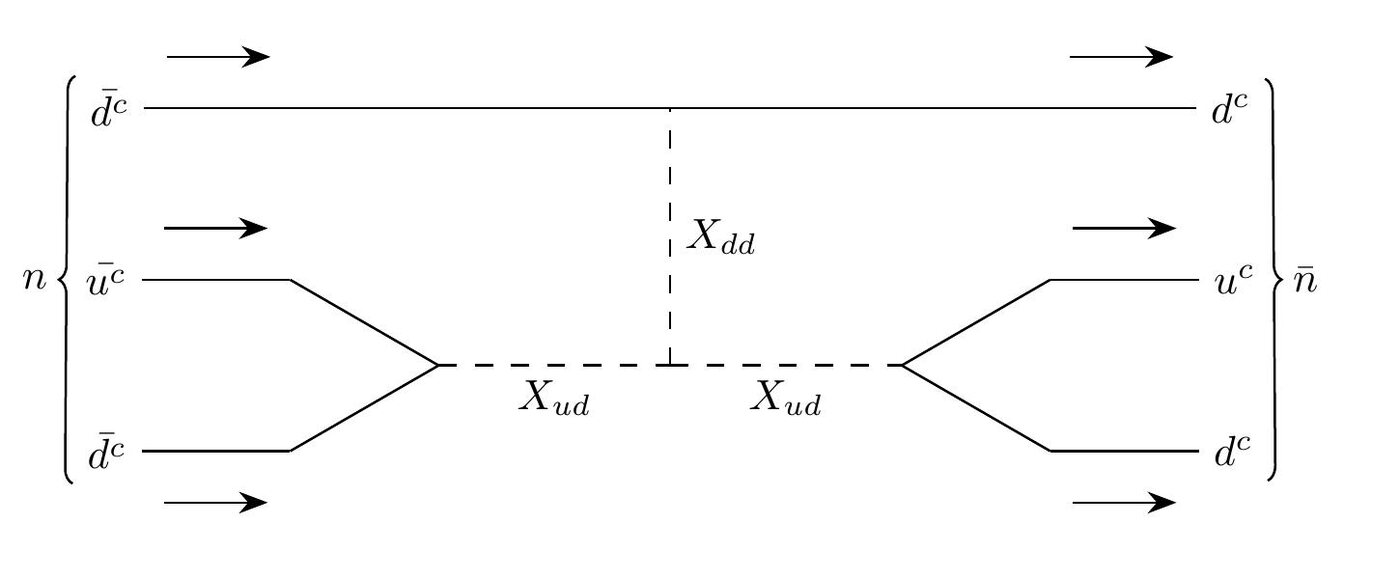
A neutron is made of three quarks (udd) and an antineutron of three antiquarks. In many theories beyond the Standard Model, a neutron can spontaneously transform into an antineutron — an n–n̄ oscillation. This process violates baryon number by two units, |ΔB| = 2, and it violates B − L by two units as well. Since such a process also violates exactly the symmetry that a successful baryogenesis mechanism must break, watching for n–n̄ oscillations is one of the few ways to directly probe the origin of the matter–antimatter asymmetry. Nobody has seen the transition yet. The current best limits on the oscillation lifetime are τ ≥ 4.7 × 10⁸ s from Super-Kamiokande and τ ≥ 0.86 × 10⁸ s for free neutrons from the ILL experiment. The near-future experiments DUNE and the European Spallation Source’s NNBAR aim for τ ≥ 7 × 10⁸ s and τ ≥ 3 × 10⁹ s respectively — up to an order of magnitude beyond what has been probed so far.
What the paper does
The authors study the consequences of a future n–n̄ signal for baryogenesis in two steps — first in a model-independent way, then with a concrete particle model — and confront both with all relevant experimental constraints.
- Model-independent effective field theory (EFT). At low energies, any new heavy particles mediating n–n̄ oscillations can be described by six-quark operators of dimension nine, built out of the quark fields uudddd and suppressed by a new-physics scale Λ. Using modern lattice-QCD input for the hadronic matrix element and renormalisation-group running, the authors translate the current n–n̄ limits into Λ ≥ 2.4 × 10⁵ GeV, and compute how strongly the same operator washes out a pre-existing baryon asymmetry.
- A simplified model with CP violation and a mass hierarchy. Two scalar diquarks, Xud and Xdd, couple to quarks, and a scalar field ξ breaks the B − L symmetry by acquiring a vacuum expectation value, producing a trilinear coupling λξXddXudXud. After this breaking, Xdd can decay in a baryon-number-violating way, and a second, heavier diquark X′dd running in a loop makes the decay rate differ from its matter–antimatter conjugate — a new source of CP violation.
- Boltzmann equations. The team derives the full set of Boltzmann equations describing the out-of-equilibrium decay of Xdd, its CP asymmetry and every relevant washout (asymmetry-destroying) scattering process, and numerically tracks the baryon asymmetry as the Universe cools.
- Experimental constraints. The predicted parameter space is confronted with LHC dijet searches for the diquarks, neutral-meson oscillations, dinucleon decay, and the requirement that the theory’s vacuum preserve the colour symmetry of the Standard Model.
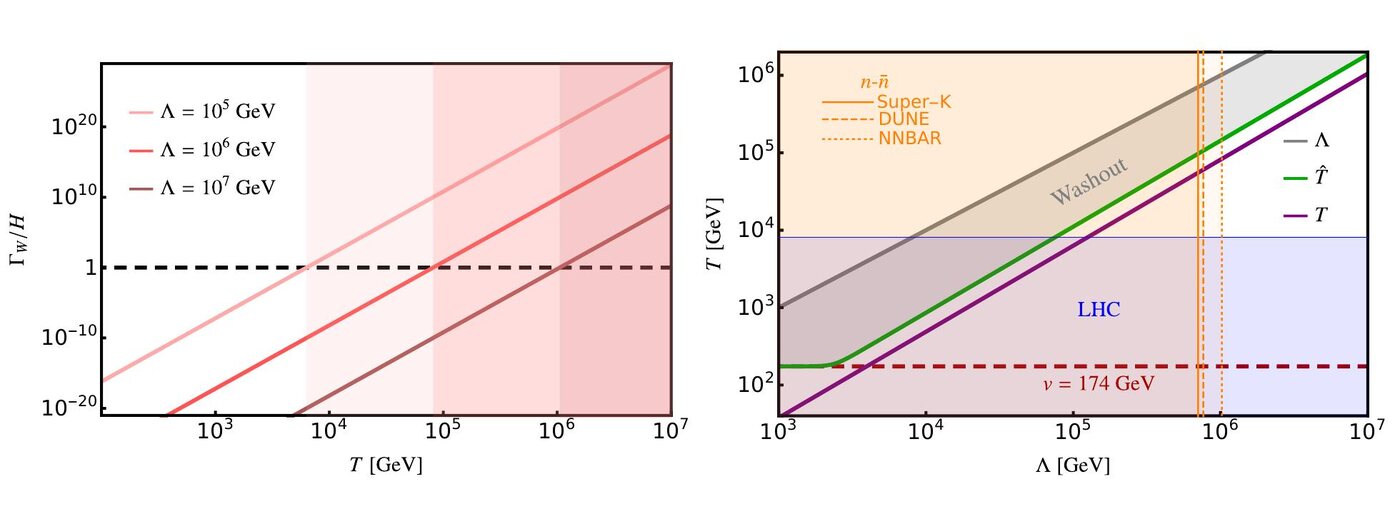
Washout deserves a plain explanation. Baryon-number-violating reactions do not only create an asymmetry — run in the wrong direction, they destroy one. In the early Universe, whether they win is a race against cosmic expansion: if their rate is faster than the Hubble rate, they hold the baryon asymmetry in equilibrium with zero, erasing any asymmetry that existed while they were active. The paper computes this ratio precisely. Because the six-quark interaction rate grows extremely fast with temperature (roughly as T9) and falls with the new-physics scale, even a rather high new-physics scale buys only a modest thermal window.
With the simplified model, the mass arrangement can be varied, and two limiting cases are studied:
- High-scale scenario: Xdd is extremely heavy, mXdd ≈ 1013–14 GeV (near the scale of grand unification), while Xud sits at the TeV scale. This split is naturally motivated by grand unified theories such as SO(10), and the light Xud is what makes the oscillation observable despite the gigantic mass of Xdd.
- Low-scale scenario: the two diquarks have comparable masses, mXdd = 3 mXud, both not far above the electroweak scale — the case where both particles might be discovered at colliders.
What they found
A future signal implies strong washout below ~100 TeV
Today’s n–n̄ limits already require Λ ≥ 2.4 × 10⁵ GeV. A future observation at Λ ≈ 106 GeV would mean the washout stayed in equilibrium down to T̂ ≈ 1.4 × 10⁵ GeV, so the observed asymmetry must have been generated below roughly 100 TeV — new physics between 10 and 100 TeV, in the range of a future 100 TeV collider.
Large hierarchy: baryogenesis works
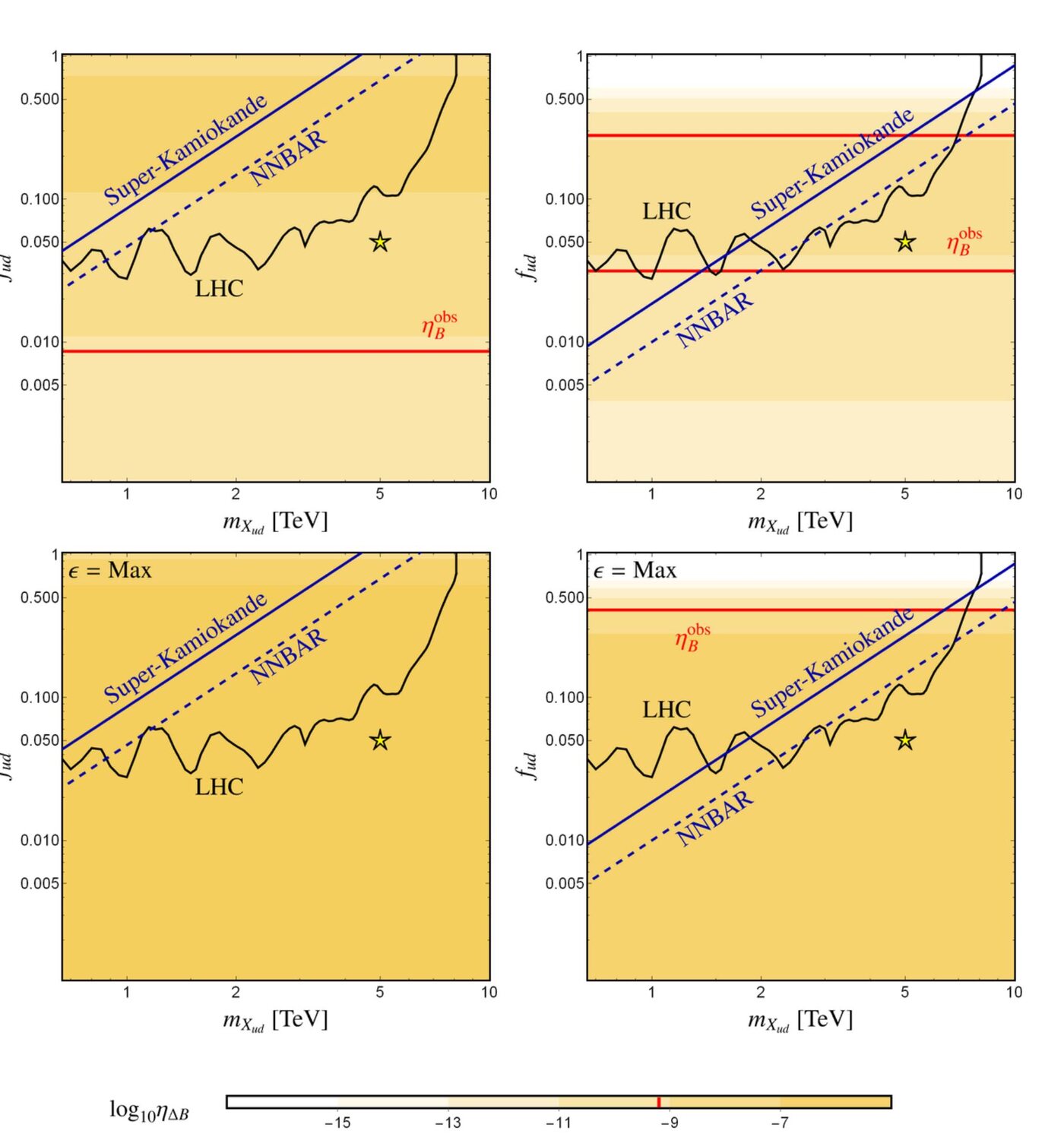
In the high-scale scenario, successful baryogenesis occurs over a large part of the parameter space. For benchmark masses, the observed asymmetry is reproduced with diquark couplings fud = fdd ≈ 0.3 for a CP-violation parameter ε = 0.01, or ≈ 0.4 if CP violation is maximal (ε = 2r).
Small hierarchy: washed out completely
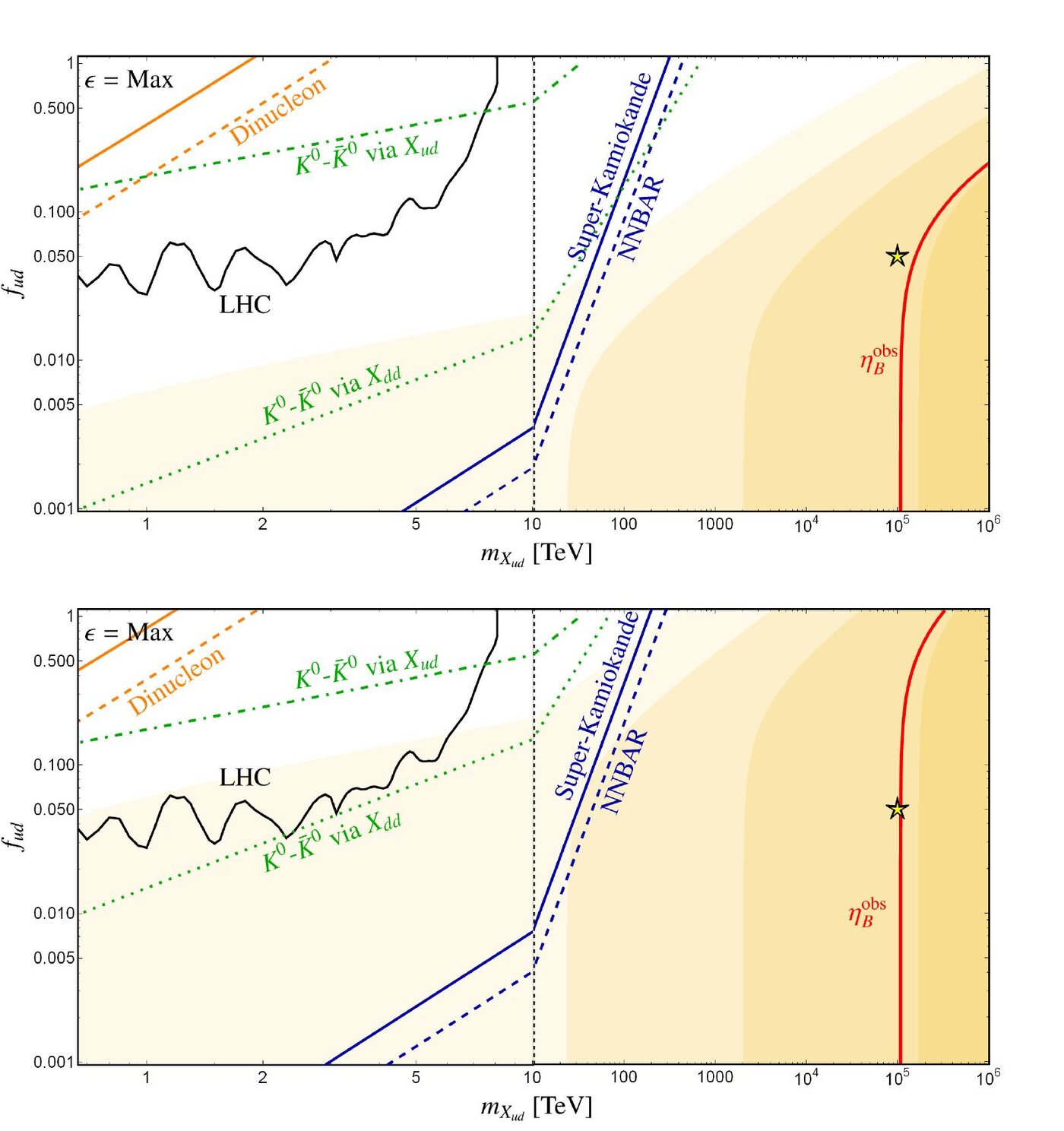
If the diquark masses are within a few times of each other and below O(108) GeV, the washout is too strong to generate any sizeable asymmetry, even with the theoretically maximal CP violation. The observed asymmetry is only reachable with the light diquark mass around 105 TeV — far out of experimental reach, and with couplings so small they cannot be probed.
Experiments can close in from both sides
The LHC already excludes colour-sextet diquarks with order-one couplings up to roughly 10 TeV, while NNBAR is projected to probe couplings from fud = fdd = 1 at mXud ≈ 700 TeV down to 0.001 at ≈ 10 TeV. Dinucleon decay (nn → π0π0, currently bounded at a partial lifetime of 4.04 × 1032 years by Super-Kamiokande) and neutral-meson oscillations bite into the TeV-scale corner as well.
In one line: whether a future neutron–antineutron signal can be tied to the origin of matter hinges on the mass hierarchy of the new particles — a large hierarchy allows successful baryogenesis within experimental reach, a small one drowns it in its own washout.
Why it matters
n–n̄ oscillations are one of the very few observables that could connect a laboratory discovery directly to the mechanism that created the matter–antimatter asymmetry. This paper shows that the interpretation of such a signal is not ambiguous: it depends sharply on the spectrum of new particles. In the favourable case, the same TeV-scale diquark that makes the oscillation observable can be produced at the LHC, so collider data and oscillation searches complement each other and can test whether this mechanism is really responsible for the asymmetry. In the unfavourable case, the interaction is self-defeating — it would have wiped out the asymmetry it should explain — and the observation would instead point to new physics somewhere between the LHC reach and about 100 TeV. Either way, a discovery would be a clue rather than a verdict, and the paper lays out exactly which follow-up measurements would settle the question.
Key concepts
- Neutron–antineutron oscillation (n–n̄)
- A neutron spontaneously converting into its antineutron. It changes baryon number by two units and has never been observed; current and planned experiments at Super-Kamiokande, DUNE and the European Spallation Source search for it.
- Baryon number and B − L
- Quarks carry baryon number 1/3 each, so a proton or neutron has baryon number 1 and an antinucleon has −1. B − L is baryon number minus lepton number; a surviving matter–antimatter asymmetry requires it to be violated.
- Baryogenesis
- Any mechanism that generated more matter than antimatter in the early Universe. The Sakharov conditions require baryon-number (or B − L) violation, C and CP violation, and a departure from thermal equilibrium.
- Washout
- Baryon-number-violating reactions that erase an existing asymmetry. When their rate exceeds the expansion rate of the Universe, they push the asymmetry back to zero — the central obstacle studied in this paper.
- Diquark
- A hypothetical new scalar particle that couples to two quarks at once. Different diquarks, such as Xud (up + down) and Xdd (down + down), can combine to mediate a neutron–antineutron oscillation.
- CP violation
- A genuine difference in behaviour between matter and its mirror image (charge-conjugation times parity). Without it, decays and their conjugates proceed at equal rates and no net asymmetry can build up.
Citation
Kåre Fridell, Julia Harz, Chandan Hati, Probing baryogenesis with neutron-antineutron oscillations, Journal of High Energy Physics 11 (2021) 185. arXiv:2105.06487 [hep-ph] · doi:10.1007/JHEP11(2021)185. The article is open access (CC BY 4.0). Figures reproduced from the paper; this page is a plain-language summary and any simplification is the fault of the summary, not the authors.