2022 · PhD thesis, TU Munich · Free PDF
Phenomenology of Baryogenesis and Neutrino Physics: From Effective Field Theory to Simplified Models
Why does the Universe contain matter but almost no antimatter — and what can laboratory experiments tell us about it? This doctoral thesis connects the violation of lepton and baryon number to observables at both the highest and the lowest accessible energies. Along the way it shows that the usual estimate of the neutrino mass generated by new interactions can be wrong by orders of magnitude, and that models of neutron–antineutron oscillation can explain the matter asymmetry while staying within reach of future experiments.
PhD thesis: Kåre Fridell, Phenomenology of Baryogenesis and Neutrino Physics: From Effective Field Theory to Simplified Models, PhD thesis, Technical University of Munich (2022). Supervisor: Prof. Dr. Julia Harz; defended 15 September 2022. Landing page on mediaTUM · free PDF
The question: where did all the matter come from?
Every proton in your body has essentially no antimatter partner in the Universe — only about one extra proton survived for every billion photons left over from the hot Big Bang. The measured baryon-to-photon ratio is ηB = (6.20 ± 0.15) × 10−10. The Standard Model alone cannot explain this imbalance, and any successful mechanism must satisfy the Sakharov conditions: it has to violate baryon number, distinguish matter from antimatter (C and CP violation), and act out of thermal equilibrium. Because the Standard Model violates B + L through sphalerons, the conserved quantity that really matters for the surviving asymmetry is B − L.
Neutrinos are the link. Their tiny, non-zero masses prove there is new physics beyond the Standard Model, and the simplest explanation makes them Majorana particles — their own antiparticles — which means lepton number is violated by two units, ΔL = 2. The same interactions that give neutrinos masses could have been active in the early Universe and helped create the asymmetry. But such processes typically happen at energies far beyond any collider, so the thesis looks for their low-energy footprints instead: rare kaon decays, neutrino scattering, and neutron–antineutron oscillations.
The thesis grew out of nine research works — journal articles, a study that was later published, and conference proceedings — and asks how lepton- and baryon-number violation can be constrained with current and near-future experiments. It moves in two complementary languages: effective field theory, which describes unknown heavy physics without committing to a model, and simplified models, which spell out the concrete new particles that could be doing the job.
The thesis, chapter by chapter
Chapters 2 and 3 set the stage with the Standard Model, modern cosmology and the theory of baryogenesis. The five research chapters then form a guided tour of the thesis.
Chapter 4 — Lepton-number violation in effective field theory
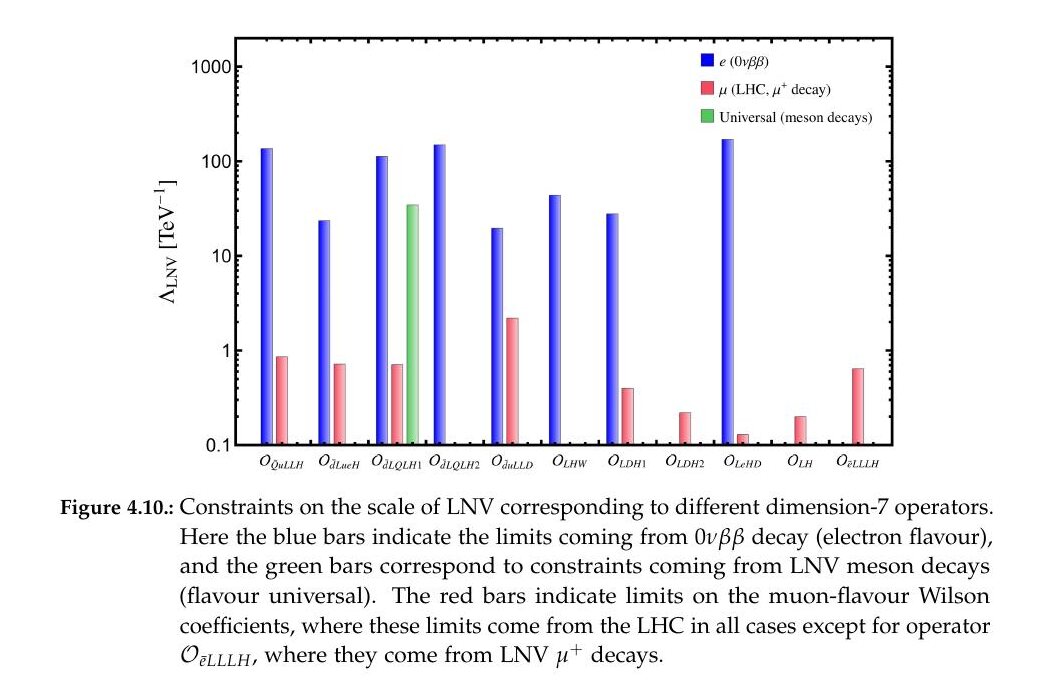
At energies far below the new-physics scale, unknown heavy particles can be described by effective operators added to the Standard Model. This chapter systematically studies the twelve dimension-7 operators that violate lepton number by two units — the class that can give neutrinos Majorana masses — and compiles the constraints from a wide menu of experiments: neutrinoless double beta decay, rare meson decays, lepton-flavour-violating muon processes, and proton–proton collisions.
New collider limits are derived from LHC searches for two same-sign leptons plus jets, giving the strongest bounds on the muon-flavour components of these operators, between roughly 0.1 and 2.2 TeV. Neutrinoless double beta decay pushes the electron-flavour scale as high as about 170 TeV, and rare meson decays — for the one operator they can reach — give a limit near 22 TeV, with K+ → π+νν the most powerful of them. The chapter also checks where the effective description itself stops being valid, and how these operators could wash out a baryon asymmetry. This survey and its new collider limits were later published as Probing lepton number violation: a comprehensive survey of dimension-7 SMEFT (JHEP 2024) — see the plain-language page.
Chapter 5 — Beyond the effective theory: simplified models
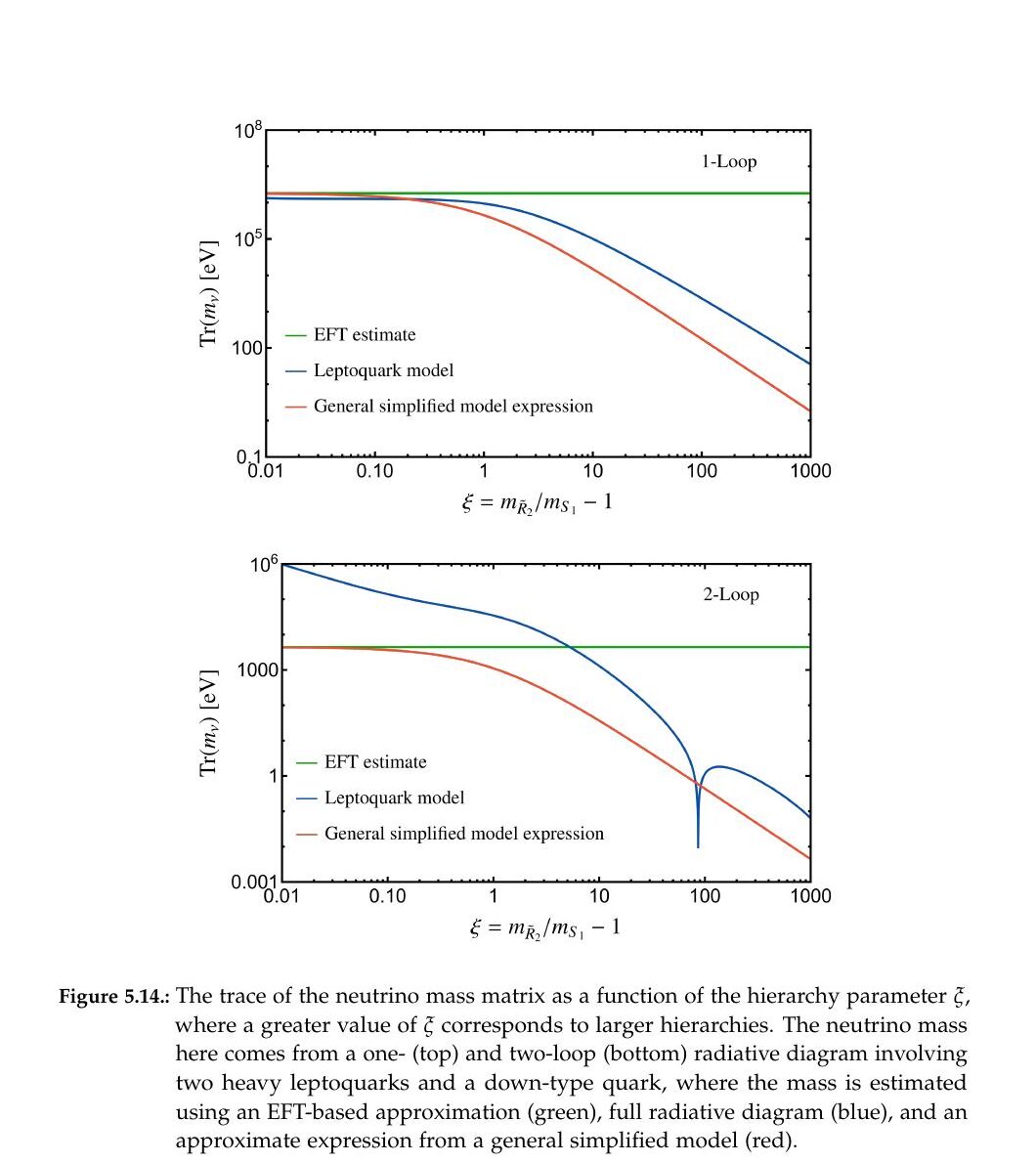
Effective operators hide which new particles actually do the work. This chapter “explodes” all twelve dimension-7 operators into their possible tree-level realisations, finding 26 new fields that can combine in 56 pairs, and maps out how each combination could generate a neutrino mass. The headline result concerns a subtlety: when a model contains two new particles with very different masses, the conventional effective-field-theory estimate of the neutrino mass misses the effect of this internal hierarchy entirely. As the hierarchy grows, the true neutrino mass can lie orders of magnitude below the estimate, reopening regions of parameter space that had wrongly been declared excluded. The chapter also confronts the models with global fits of experimental data and works through a concrete leptoquark example at one and two loops. The multi-scale analysis was later published as Radiative neutrino masses from dim-7 SMEFT: a simplified multi-scale approach (JHEP 2025) — see the plain-language page.
Chapter 6 — Rare kaon decays: the pion knows
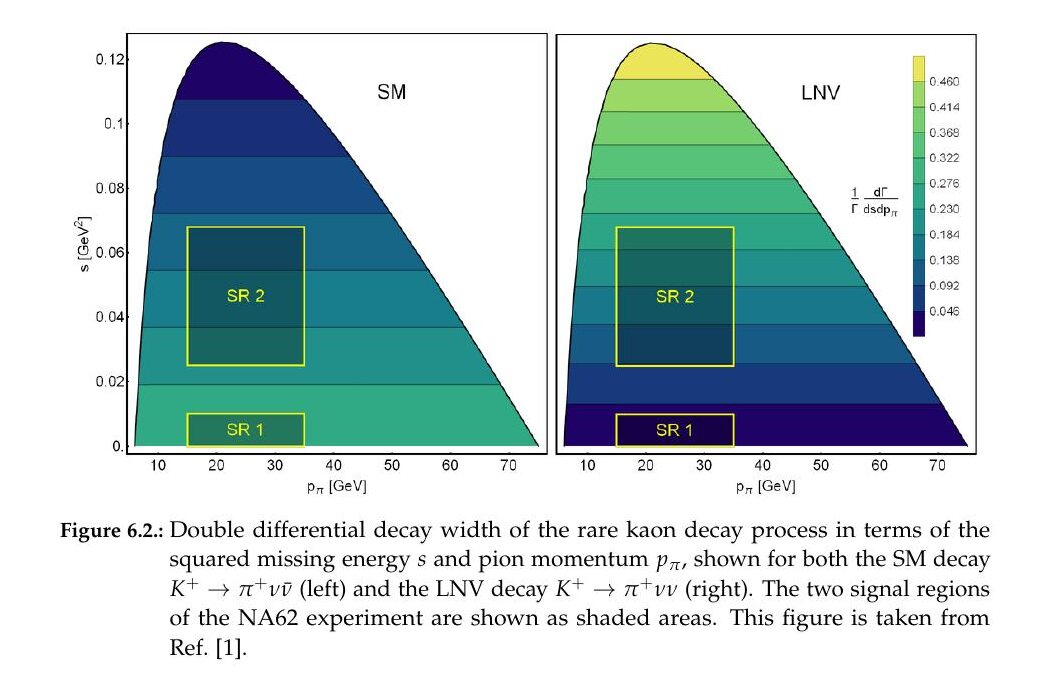
The decay K+ → π+νν̄ (a neutrino–antineutrino pair) is one of the cleanest processes in physics. Its lepton-number-violating twin, K+ → π+νν (two neutrinos), would look identical in a detector, because the neutrinos escape unseen. This chapter shows the two can be told apart anyway: the Standard Model decay proceeds through a vector current, the lepton-number-violating one through a scalar current, and that difference reshapes the momentum of the visible pion. The Standard Model events pile up at small missing energy, while the lepton-number-violating events vanish there and peak at larger values — a pattern that can be extracted from the E949, NA62 and KOTO data once enough events are collected. The work was published in JHEP 12 (2020) 186; see the rare kaon decays page.
Chapter 7 — A photon in CEνNS: the Dirac/Majorana question
Coherent elastic neutrino–nucleus scattering (CEνNS) — a neutrino bouncing off an entire nucleus without breaking it apart — was discovered in 2017 and is now a tool for testing new physics. This chapter studies a novel signature: a neutrino with a transition magnetic moment can upscatter into a heavy sterile neutrino, which then decays and emits a photon inside the detector (radiative CEνNS). Focusing on the NUCLEUS experiment, 100 metres from the Chooz reactor and equipped with gram-scale Al2O3/CaWO4 targets followed by a planned 1 kg 73Ge phase, the chapter computes the expected photon energy and angular distributions. These differ between Dirac and Majorana sterile neutrinos: a Majorana neutrino yields more high-energy photons at small angles and a photon-energy spectrum symmetric around half its mass, while a Dirac neutrino prefers lower photon energies. The work was published in Physical Review D 106 (2022) 035036; see the CEνNS transition moments page.
Chapter 8 — Neutron–antineutron oscillation and baryogenesis
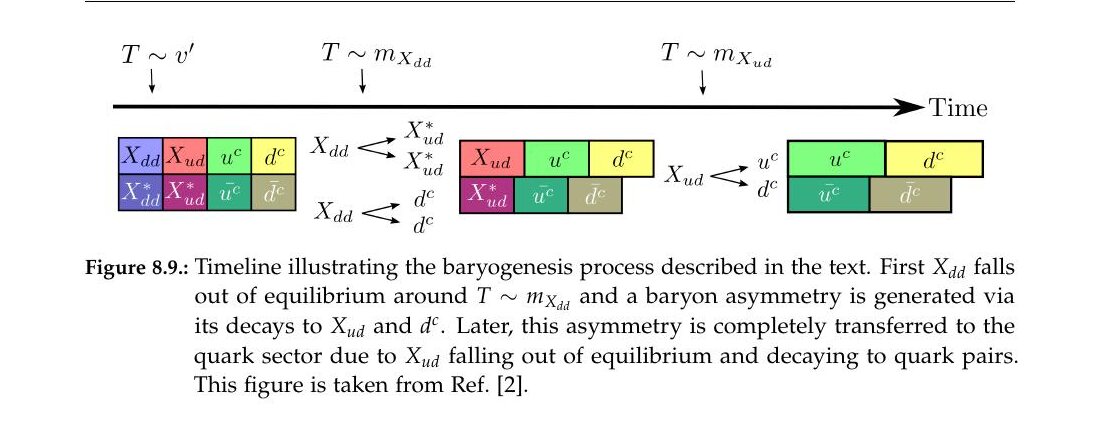
The final research chapter turns to baryon number. A neutron can, in many theories, convert into an antineutron — a ΔB = 2 process searched for at Super-Kamiokande (lifetime above 4.7 × 10⁸ s) and soon at DUNE and NNBAR, which aim for 7 × 10⁸ s and 3 × 10⁹ s. In effective field theory the current limit corresponds to a new-physics scale above about 7 × 10⁵ GeV. The chapter then builds a complete model in which scalar “diquarks” mediate the oscillation and their CP-violating decays generate the baryon asymmetry, described by a new set of Boltzmann equations. Two regimes emerge: if the two diquarks have very different masses — one near 1013–1014 GeV, the other at the TeV scale — successful baryogenesis happens over wide regions that the LHC and future n–n̄ experiments can actually probe; if the masses are close together, the same interactions wash the asymmetry away, and the successful region lies beyond every planned experiment. A model-independent analysis adds a striking forecast: if the asymmetry was generated at a high scale, a future oscillation signal would point to new physics between the LHC’s reach and about 100 TeV — the energy of the proposed FCC collider. The work was published in JHEP 11 (2021) 185; see the neutron–antineutron baryogenesis page.
What the thesis found
Every corner of dimension-7 lepton-number violation
All twelve ΔL = 2 effective operators were surveyed; their tree-level completions involve 26 possible new fields in 56 two-field combinations. New LHC limits, between about 0.1 and 2.2 TeV, are the strongest for the muon flavour — a region no other experiment reaches.
Neutrino masses can be far lighter
When two new particles in a model have widely different masses, the true neutrino mass can lie orders of magnitude below the standard effective-field-theory estimate — reopening parameter space that had been considered excluded.
Invisible neutrinos, visible fingerprints
Rare kaon decays and radiative CEνNS show that the shapes of the observed particles carry the message: the pion spectrum distinguishes lepton-number violation from its absence, and the photon spectrum distinguishes Majorana from Dirac sterile neutrinos.
Baryogenesis that experiments can reach
In the high-scale diquark scenario (mXdd ~ 1013–1014 GeV), the observed asymmetry ηB = 6.2 × 10⁻¹⁰ is reproduced over wide regions that the LHC and future n–n̄ experiments can probe. With comparable masses, washout destroys the asymmetry instead.
In one line: by combining effective field theory with concrete simplified models, the thesis maps how lepton- and baryon-number violation can be hunted with rare kaon decays, neutrino scattering and neutron–antineutron experiments — and shows that a future oscillation signal could point straight at the origin of matter.
Why it matters
The nature of neutrino masses and the origin of the matter–antimatter asymmetry are two of the biggest open questions in physics, and this thesis builds the bridge between them and the experiments that are actually running or funded: neutrinoless double beta decay, NA62 and KOTO, the NUCLEUS neutrino experiment, DUNE, NNBAR and a possible 100 TeV collider.
Its results are not only statements about models — they are practical tools. The complete catalogue of simplified models tells experimentalists what to look for and how to tell different explanations apart if a signal appears, while the new Boltzmann equations can be reused for other models of baryogenesis. And by showing where a signal can, and cannot, be interpreted cleanly, the thesis helps ensure that the next discovery is understood correctly the first time.
Key concepts
- Lepton number and ΔL = 2
- Lepton number counts electrons, muons, taus and neutrinos as +1 and their antiparticles as −1. A ΔL = 2 process — such as two neutrinos turning into two antineutrinos — is the hallmark of a neutrino that is its own antiparticle.
- Dimension-7 operator (SMEFT)
- A way to write down the effects of unknown heavy particles without knowing them, by adding to the Standard Model every interaction allowed by its symmetries, organised by “dimension”. Higher dimension means more particle legs and stronger suppression by the new-physics scale.
- Simplified model
- A minimal extension of the Standard Model with just a few new particles, designed to capture the physics of one phenomenon. The thesis classifies all simplified models that can generate dimension-7 lepton-number violation at tree level.
- Majorana vs Dirac neutrino
- Dirac neutrinos, like electrons, have separate antiparticles; Majorana neutrinos are their own antiparticles, which requires lepton number to be violated. Which one neutrinos are is still unknown.
- Coherent elastic neutrino–nucleus scattering (CEνNS)
- A neutrino scattering off an entire nucleus at once, without breaking it apart. Discovered in 2017, it is a clean low-energy probe of neutrino properties — and of LNV, if an extra photon is emitted.
- Baryogenesis and washout
- Baryogenesis is any mechanism that produced more matter than antimatter in the early Universe. Washout is its enemy: baryon-number-violating reactions erase an asymmetry whenever they run faster than the expansion of the Universe.
Citation
Kåre Fridell, Phenomenology of Baryogenesis and Neutrino Physics: From Effective Field Theory to Simplified Models, PhD thesis, Technical University of Munich (2022). Submitted 11 August 2022; defended 15 September 2022. Supervisor: Prof. Dr. Julia Harz. Landing page on mediaTUM · free PDF. The thesis is based on the author’s journal articles and conference proceedings; figures reproduced from the thesis; this page is a plain-language summary and any simplification is the fault of the summary, not the author.