2025 · Journal of High Energy Physics · Open access
Radiative neutrino masses from dim-7 SMEFT: a simplified multi-scale approach
Neutrinos are millions of times lighter than the electron, and the Standard Model offers no explanation. If the usual seesaw particles are absent, the leading lepton-number violation may come from dimension-7 operators of the Standard Model Effective Field Theory — but the standard way of estimating the neutrino mass they generate can be wrong by many orders of magnitude. This paper catalogues all minimal models of this kind and provides a simple recipe that closely matches exact calculations, reopening viable regions of parameter space within reach of neutrinoless double beta decay and the LHC.
Published in: K. Fridell, L. Gráf, J. Harz, C. Hati, Radiative neutrino masses from dim-7 SMEFT: a simplified multi-scale approach, JHEP 09 (2025) 050. doi:10.1007/JHEP09(2025)050 · free preprint on arXiv
Background: tiny masses, heavy new physics
Neutrino oscillations prove that neutrinos have nonzero masses — something the Standard Model cannot explain. The most popular explanation is the seesaw mechanism: very heavy new particles generate tiny masses for the light neutrinos. If the neutrino is its own antiparticle (a Majorana particle), the underlying interactions must also break lepton number by two units (ΔL = 2) — a rare effect worth hunting for.
To organise that hunt without betting on one specific model, physicists use the Standard Model Effective Field Theory (SMEFT): below some heavy scale Λ, the effects of new physics can be written as extra operators built out of the known particles. Each operator has a dimension, and higher dimensions carry more powers of 1/Λ, so they are more suppressed. Lepton-number violation first appears at dimension 5 — the famous Weinberg operator, produced by the standard seesaw fields — and then at dimension 7.
If none of the seesaw fields exists at accessible energies, dimension-7 operators become the leading source of lepton-number violation. That scenario naturally points to radiative neutrino masses — masses generated by loops rather than by a direct coupling — and it is the one this paper maps out.
What the paper does
- Finds all minimal completions. Starting from the full basis of twelve independent ΔL = 2 dimension-7 operators, the authors focus on the seven that can be generated at tree level without extra derivatives, and systematically identify every UV completion that uses just two new fields — scalars, fermions or vectors, including familiar leptoquarks.
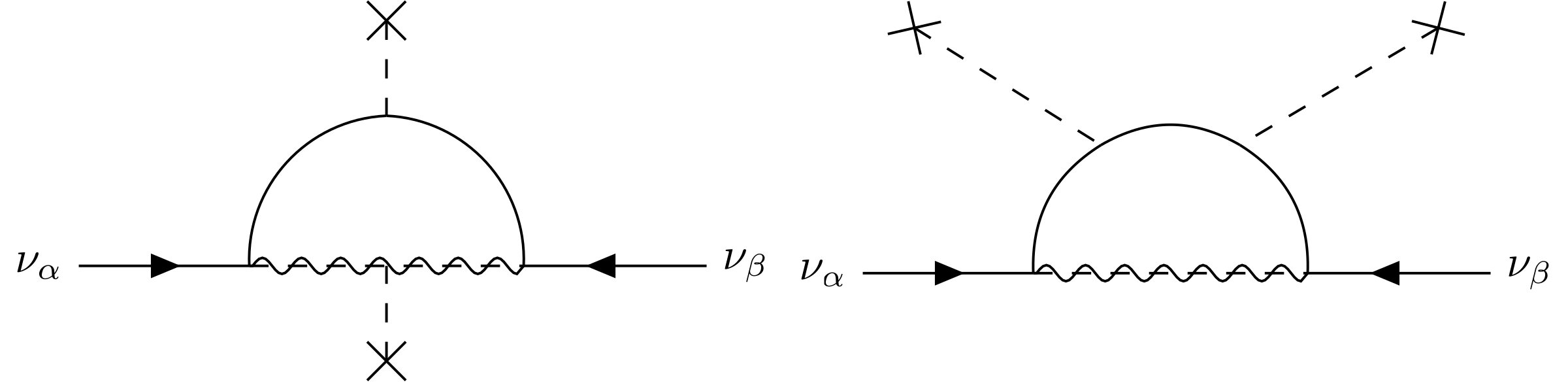
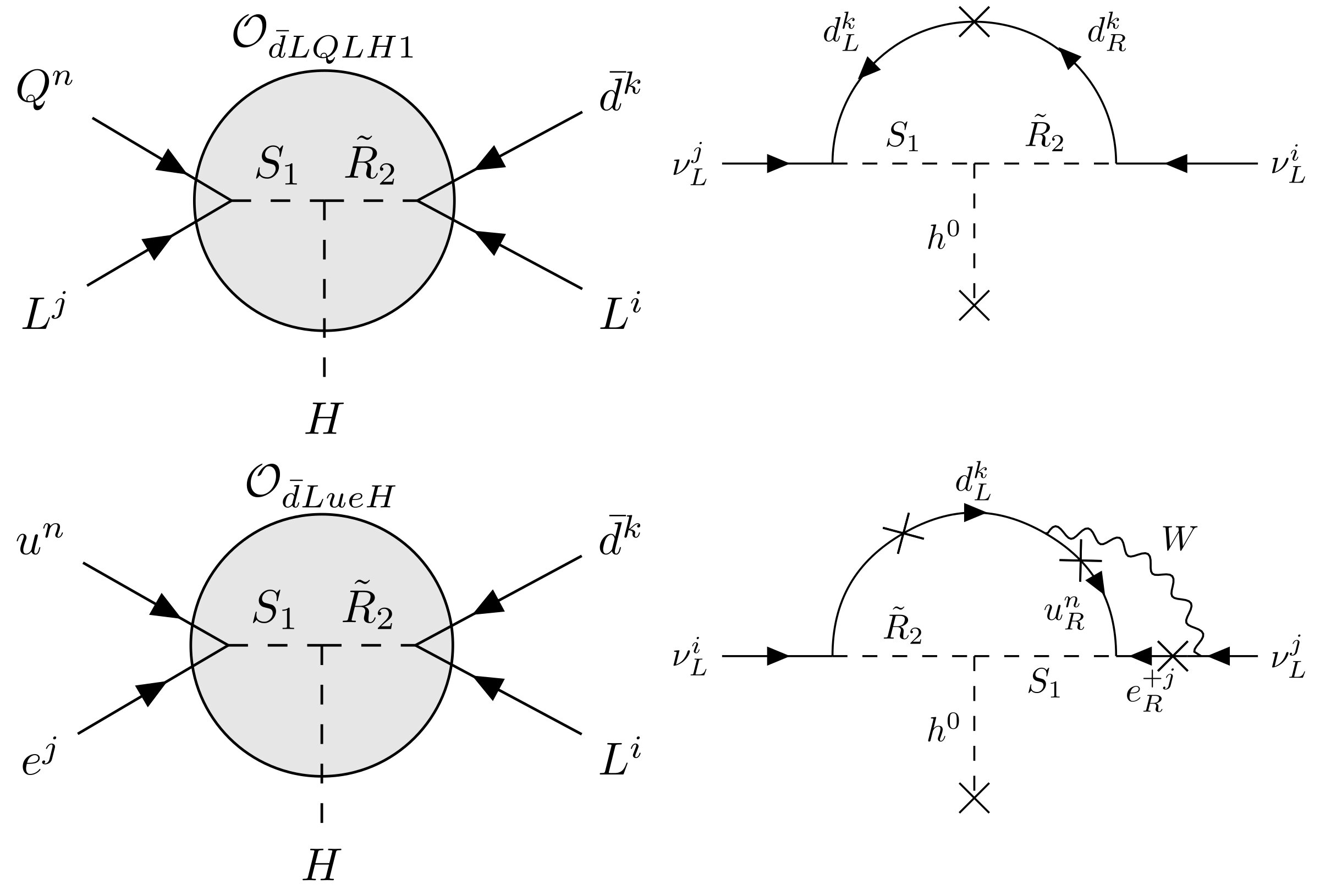
- Draws the mass topologies. Because these operators contain four fermions, two of them must be closed into a loop to make a neutrino mass. The paper classifies the possible one-loop diagrams (topology I: two new bosons mixing through the Higgs; topology II: one boson plus one fermion) and the tree-level and two-loop variants.
- Tests the standard estimate. The literature often estimates loop masses with a single cut-off scale. In an explicit model with two scalar leptoquarks, R̃₂ and S₁, the authors compare that estimate with the exact loop calculation — and with the full two-loop result.
- Introduces a multi-scale recipe. Their alternative uses dimensional regularisation and matching: integrate out the heaviest new particle first, describe the rest with an intermediate effective theory, and split the loop integral into the regions dominated by the heavy and the light scales. The result reproduces the exact mass and depends on log(m₁²/m₂²) — the logarithm of the mass ratio.
What they found
A complete minimal catalogue
Every tree-level UV completion of the seven dimension-7 operators by two new fields is identified and matched to five possible neutrino-mass diagrams — two of them one-loop, three of them tree-level for the special operator made of only two fermions.
The standard estimate can fail badly
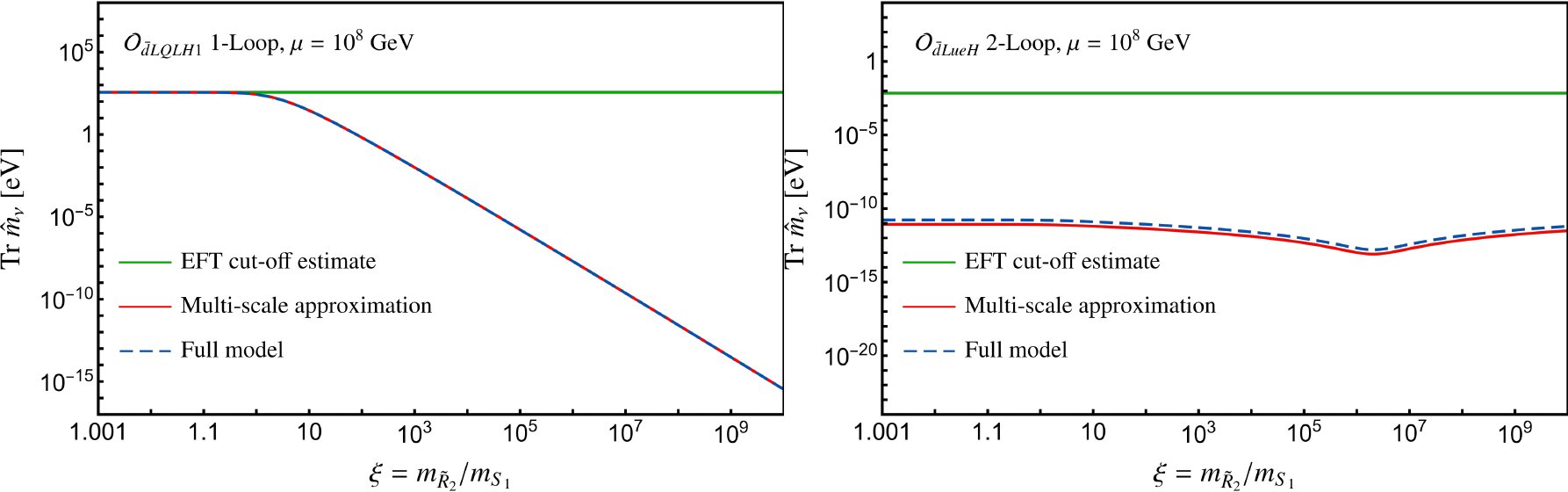
The widely used cut-off estimate predicts a neutrino mass that stays constant as the two new-particle masses are pulled apart, while the true mass drops logarithmically. At two loops it is wrong by about ten orders of magnitude, because the leading diagrams cancel.
A simple fix that works
The multi-scale recipe reproduces the exact one-loop and two-loop masses across ten orders of magnitude in the mass hierarchy, as verified in the two-leptoquark model.
New viable territory
With the corrected bounds, most operators have regions that generate the observed neutrino masses while sitting close to the sensitivity of 0νββ decay and the LHC (leptoquark searches already exclude R̃₂ below 3.4 TeV and S₁ below 4.6 TeV).
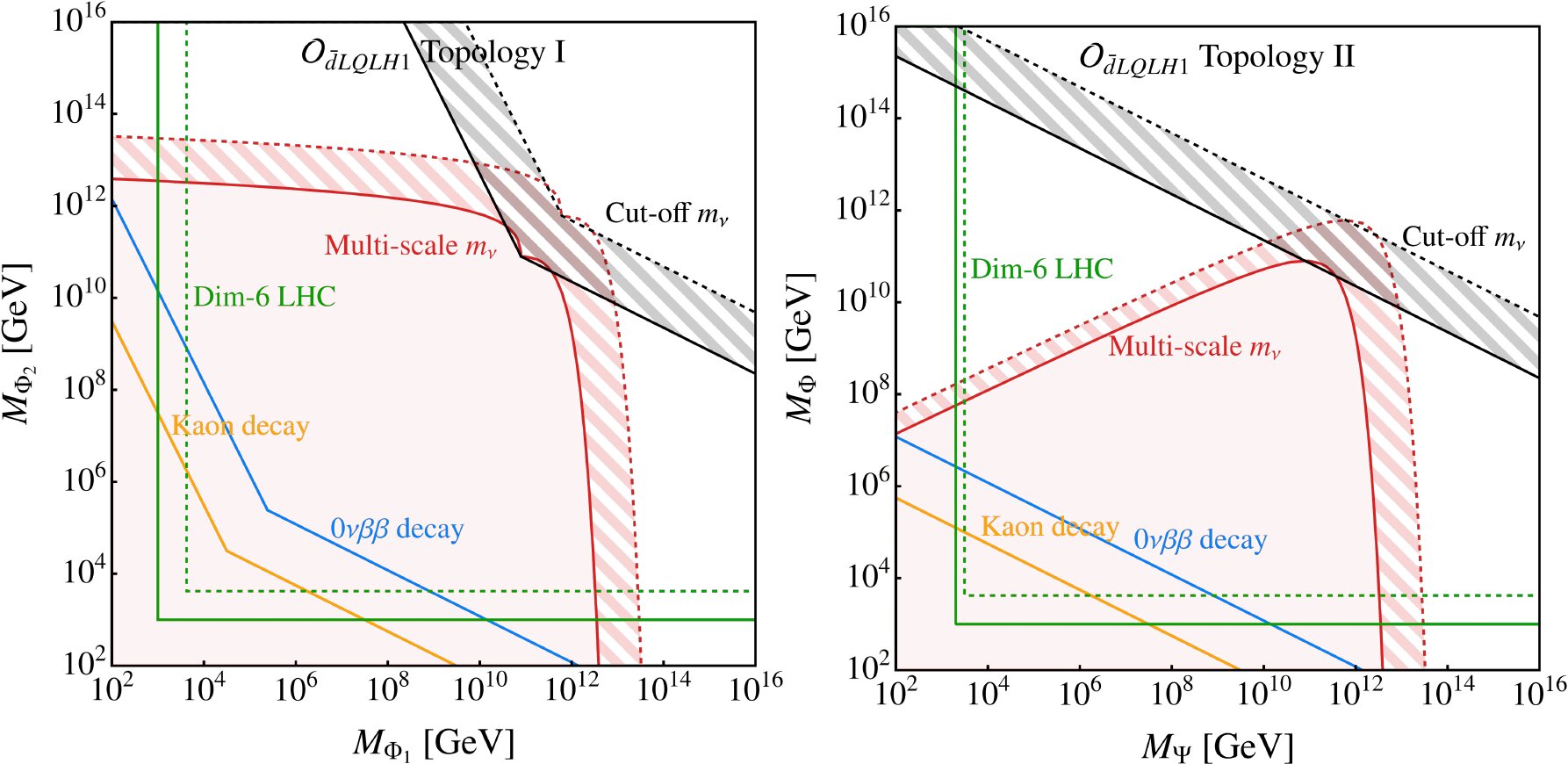
In one line: The conventional one-scale estimate of loop-generated neutrino masses can miss the mark by orders of magnitude; a simple multi-scale recipe matches the exact result and reopens parameter space within reach of 0νββ decay and the LHC.
Why it matters
Neutrino masses are the only confirmed laboratory evidence of physics beyond the Standard Model, and how they arise is still unknown. If nature did not choose the standard seesaw, lepton-number violation at dimension 7 with loop-induced masses is a natural alternative — so it matters that we estimate those masses correctly. This paper shows that a once-standard shortcut can fail dramatically, provides a simple replacement, and identifies new corners of parameter space where these models survive and could be probed by the next generation of neutrinoless double beta decay and LHC analyses.
Key concepts
- Dimension-7 operator
- In the Standard Model Effective Field Theory, new physics below a heavy scale Λ is described by extra operators built from known particles. Higher dimension means more powers of 1/Λ and stronger suppression. Lepton-number-violating operators first appear at dimension 5 (the Weinberg operator) and then at dimension 7 — the subject of this paper.
- UV completion
- A full, renormalisable theory with new particles that reproduces a given effective operator once the heavy fields are integrated out. The paper identifies all minimal completions — those with only two new fields — of the dimension-7 operators.
- One-loop (radiative) mass
- A neutrino mass generated by a closed loop of virtual particles rather than by a direct tree-level coupling. Loops bring suppression factors such as 1/(16π²), which is why the resulting masses are naturally small.
- Cut-off estimate
- A quick way to estimate a loop effect by cutting the loop integral off at a single scale Λ. It works when all new particles have similar masses, but fails for strong mass hierarchies or when leading diagrams cancel.
- Multi-scale hierarchy
- New particles with very different masses (M ≫ m). The paper's method handles this by integrating them out one at a time; the neutrino mass then depends on log(M²/m²) instead of just on the heaviest scale.
- 0νββ decay
- Neutrinoless double beta decay, in which a nucleus emits two electrons and no neutrinos. Observing it would prove that neutrinos are Majorana particles and that lepton number is violated; it gives the most stringent low-energy limits in this paper.
Citation
Kåre Fridell, Lukáš Gráf, Julia Harz, Chandan Hati, Radiative neutrino masses from dim-7 SMEFT: a simplified multi-scale approach, Journal of High Energy Physics 09 (2025) 050. arXiv:2412.14268 [hep-ph] · doi:10.1007/JHEP09(2025)050 · publisher page. Figures reproduced from the paper, which is published open access under a CC BY 4.0 licence; this page is a plain-language summary and any simplification is the fault of the summary, not the authors.