2020 · Journal of High Energy Physics · Open access
Probing lepton number violating interactions in rare kaon decays
The decays K⁺ → π⁺νν and KL → π⁰νν are among the rarest processes known, which makes them beautiful probes of new physics. If neutrinos are their own antiparticles, the same decays could also proceed through a lepton-number-violating interaction with a distinctive scalar-current fingerprint. This paper shows that existing data from E949, NA62 and KOTO already push the scale of such new physics above roughly 11 TeV — with the next round of NA62 data expected to reach about 20 TeV.
Published in: Frank F. Deppisch, Kåre Fridell, Julia Harz, Probing lepton number violating interactions in rare kaon decays, JHEP 12 (2020) 186. doi:10.1007/JHEP12(2020)186 · free preprint on arXiv
Background: are neutrinos their own antiparticles?
Neutrino oscillations prove that neutrinos have tiny masses, but not how they get them. In one of the most popular explanations, neutrinos are Majorana particles: each neutrino is its own antiparticle. That would mean that lepton number — a bookkeeping rule that counts leptons minus antileptons — is not strictly conserved. The gold-standard test is neutrinoless double beta decay, but as a nuclear process it only involves first-generation particles: electrons and up and down quarks.
Rare kaon decays offer a complementary window. The “golden modes” K⁺ → π⁺νν̄ and KL → π⁰νν̄ are loop- and GIM-suppressed in the Standard Model, giving predicted branching ratios of only (8.4 ± 1.0) × 10⁻¹¹ and (3.4 ± 0.6) × 10⁻¹¹, respectively — yet the theory is exceptionally clean. In the Standard Model the two neutrinos are a neutrino–antineutrino pair produced by a vector current. If neutrinos are Majorana, the very same decay can instead be driven by a new interaction that emits two neutrinos (or two antineutrinos): a process that violates lepton number by two units.
What the paper does
Working in the Standard Model effective field theory with only light active Majorana neutrinos, the authors identify the single dimension-7 operator that can generate K → πνν at tree level:
O3b = h⁰ dc sL νL νL
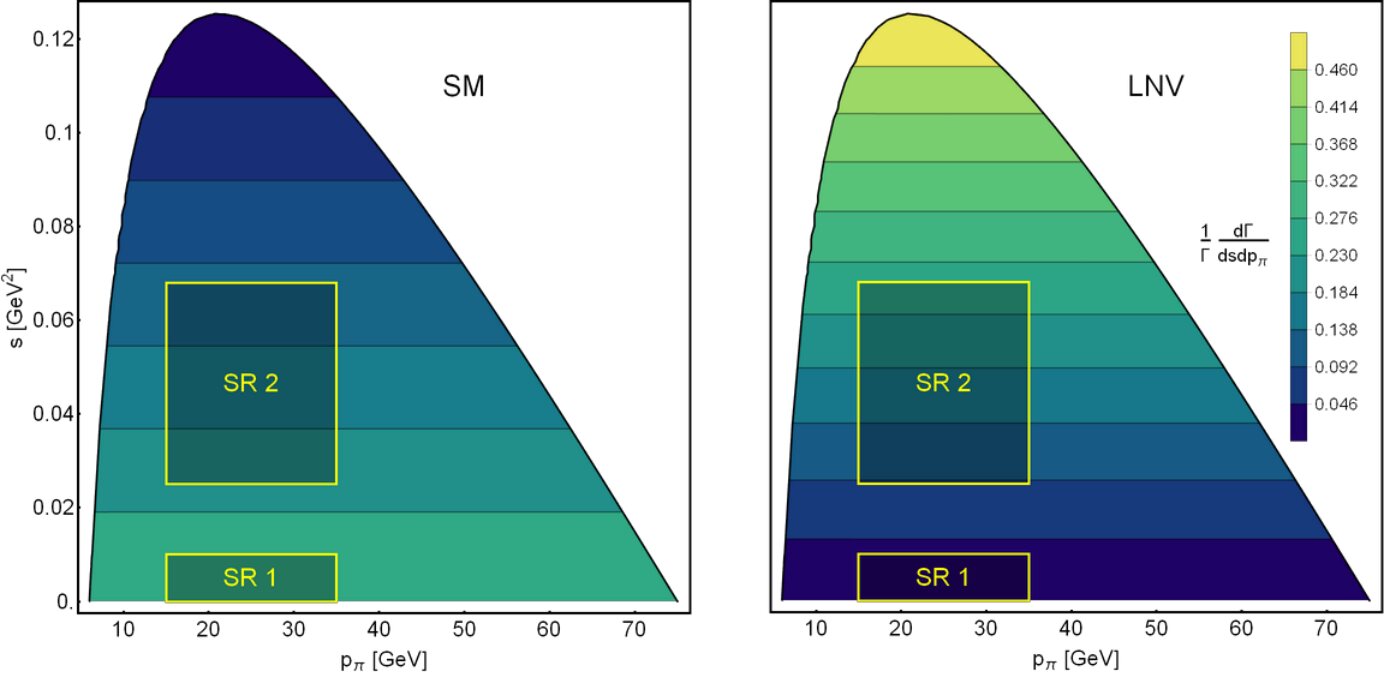
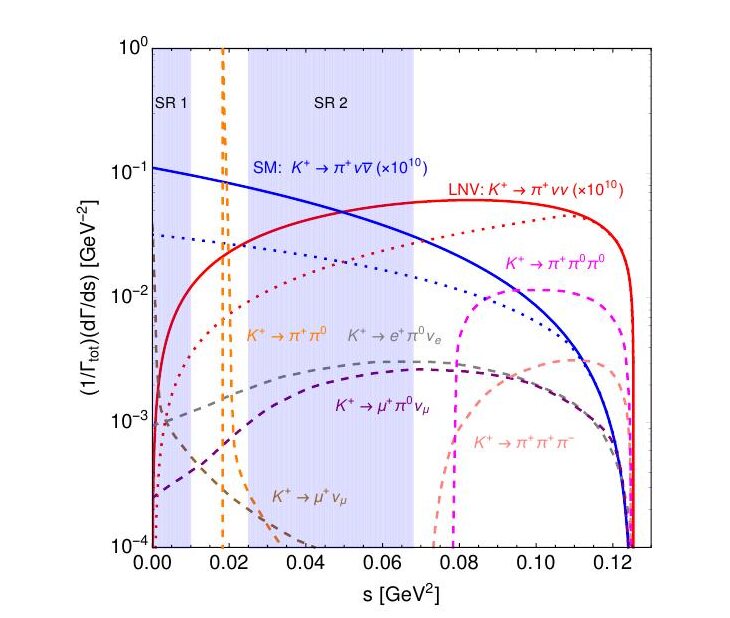
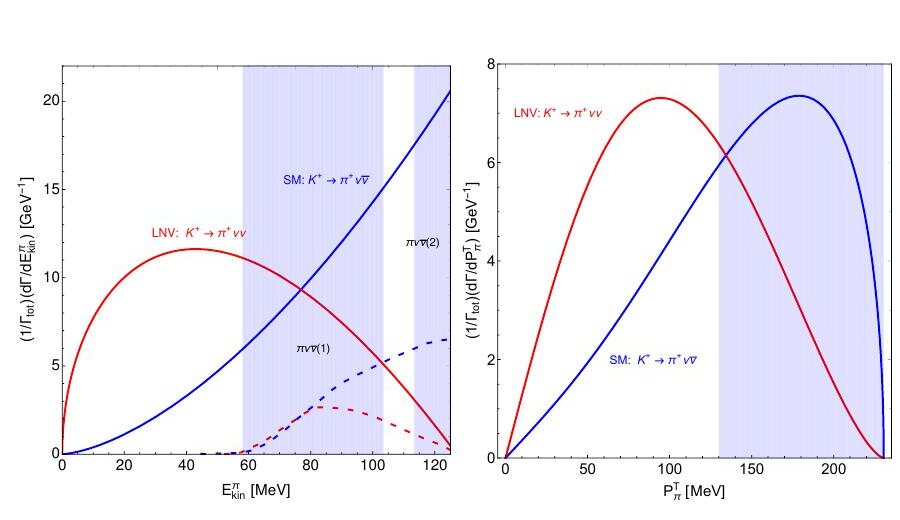
Its key feature is a scalar leptonic current, versus the vector current of the Standard Model. That changes the kinematics: the Standard Model decay rate peaks when the neutrino pair carries away little energy, while the LNV decay peaks at the maximum. Because experiments select only part of the phase space, they sample the two hypotheses differently — so the authors compute the pion momentum distributions for K⁺ → π⁺νν and KL → π⁰νν, integrate them over the signal regions of E949 (BNL), NA62 (CERN) and KOTO (J-PARC), and turn published limits into bounds on the LNV operator scale Λ.
What they found
For the dimension-7 operator, the LNV branching ratios are fixed in terms of the new-physics scale Λ:
- BRLNV(K⁺ → π⁺νiνj) = 10⁻¹⁰ (19.2 TeV / Λijsd)⁶
- BRLNV(KL → π⁰νiνj) = 10⁻¹⁰ (24.9 TeV / Λijsd)⁶
Comparing these with the measured limits (and, where available, the experiments' relative acceptance for scalar versus vector currents) gives the bounds below. E949 remains the only experiment with a dedicated scalar-current limit.
| Experiment | Mode | Limit used (90% CL) | Implied scale |
|---|---|---|---|
| E949 (BNL) | K⁺ → π⁺νν | < 21 × 10⁻¹⁰ (scalar current) | > 11.5 TeV |
| NA62 (CERN) | K⁺ → π⁺νν | < 1.78 × 10⁻¹⁰ (vector) | > 17.2 TeV (estimated) |
| KOTO (J-PARC) | KL → π⁰νν | < 3.0 × 10⁻⁹ (vector) | > 12.3 TeV (estimated) |
| NA62 (future) | K⁺ → π⁺νν | ≈ 1.11 × 10⁻¹⁰ (projected) | ≈ 19.6 TeV |
NA62 and KOTO have not published dedicated scalar-current limits, so the corresponding scale estimates come from folding the paper's LNV distributions into each experiment's signal regions. The authors stress that dedicated scalar searches are needed to make these limits conclusive.
Scalar currents hide in SR 2
NA62 accepts about 23% of a Standard Model signal but only about 15% of an LNV signal — and almost none of it in the low-momentum region SR 1 (6% versus 0.3%). Most of the LNV reach comes from SR 2 alone (17% versus 15%).
A ratio to tell them apart
The predicted event ratio between the two NA62 signal regions is about 0.35 for the Standard Model but only about 0.02 for LNV. If a signal appears, comparing the two regions is a direct handle on the nature of the current.
Pushing on the neutrino mass
Every one of these operators also generates neutrino mass at loop level. For O3b with generic couplings, saturating the neutrino-mass bound (mν ≈ 0.1 eV) would push the scale to about 5 × 10⁴ TeV — far above any kaon reach — unless nature arranges a special flavour pattern.
A leptoquark escape hatch
The authors build a UV-complete example with two leptoquarks (masses 4 TeV and 2 TeV, mixing coupling 10 GeV) whose flavour-specific couplings give a tiny neutrino mass of about 0.08 eV while placing the kaon signal at Λ ≈ 18.6 TeV — right where NA62 is looking.
In one line: Existing rare-kaon data already push lepton-number-violating new physics above roughly 11 TeV — complementary to neutrinoless double beta decay — and the scalar-current shape of the signal gives experiments a fingerprint to look for.
Why it matters
Whether neutrinos are Majorana particles is one of the biggest open questions in particle physics, and neutrinoless double beta decay, powerful as it is, can only test first-generation quarks and electrons. Rare kaon decays reach other quark and neutrino flavours, and this paper shows how far that reach already extends: KOTO and E949 data alone imply Λ above 11–12 TeV, and NA62 — still far from its final sensitivity — already points toward about 17 to 20 TeV. The catch is that K → πνν cannot strictly prove that lepton number is violated, because the neutrinos escape undetected; the scalar kinematic fingerprint is the best available clue, and it will only pay off if experiments publish dedicated scalar-current selections.
The consequences would be dramatic. An observed LNV interaction at these scales would act as a washout process for a pre-existing lepton asymmetry in the early Universe, over a temperature range extending up to the operator scale — putting high-scale leptogenesis scenarios under tension. It would also feed, radiatively, into neutrino masses, unless the underlying model has a flavour structure that suppresses this (as the leptoquark example demonstrates). In short: kaon decays are not just a check of the Standard Model — they are a window on why the universe contains matter at all.
Key concepts
- Lepton number (L)
- A conserved bookkeeping number in the Standard Model: leptons count +1, antileptons −1. Neutrino oscillations and the possibility of Majorana masses suggest it may be violated by two units (ΔL = 2).
- Majorana neutrino
- A neutrino that is identical to its own antiparticle. If true, lepton number is not a fundamental symmetry, and processes such as K → πνν can emit two neutrinos instead of a neutrino–antineutrino pair.
- Effective operator
- When heavy unknown particles are out of experimental reach, their effects can be described by contact interactions — operators — suppressed by powers of a new-physics scale Λ. Higher dimension means more suppression.
- Scalar vs. vector current
- The Standard Model decay uses a vector current (like a moving arrow), while the LNV operator produces a scalar current (like a ruler). This changes how the pion momentum is distributed, even though the visible final state — a pion plus nothing — looks the same.
- Signal region and acceptance
- Experiments count events only in carefully chosen kinematic windows where background is low. The fraction of a given signal that falls inside is its acceptance; it depends on the shape of the signal distribution.
- Leptogenesis
- A scenario in which the matter–antimatter asymmetry of the Universe is generated first in the lepton sector. LNV interactions that are too strong can wash out such an asymmetry.
Citation
Frank F. Deppisch, Kåre Fridell, Julia Harz, Probing lepton number violating interactions in rare kaon decays, Journal of High Energy Physics 12 (2020) 186. arXiv:2009.04494 [hep-ph] · doi:10.1007/JHEP12(2020)186. Figures reproduced from the paper; this page is a plain-language summary and any simplification is the fault of the summary, not the authors.