2025 · Journal of High Energy Physics · Open access
Leptogenesis and neutrino mass with scalar leptoquarks
Two of the biggest open questions in particle physics are why the universe contains matter but almost no antimatter, and why neutrinos have tiny, non-zero masses. This paper shows that one family of hypothetical particles — scalar leptoquarks — can account for both at the same time, while staying clear of every experiment that has looked for them so far.
Published in: Kåre Fridell, Leptogenesis and neutrino mass with scalar leptoquarks, JHEP 05 (2025) 096. doi:10.1007/JHEP05(2025)096 · free preprint on arXiv
Background: two cosmic puzzles, one connection
The Big Bang should have produced matter and antimatter in equal amounts, and yet today's universe is made almost entirely of matter. How much matter is left over is measured very precisely from the cosmic microwave background: the baryon asymmetry, the excess of baryons (protons and neutrons) over antibaryons divided by the number of photons, is ηB = (6.20 ± 0.15) × 10−10. That is one leftover baryon for roughly every billion photon pairs — a tiny number that still needs explaining.
Neutrinos pose a second puzzle. Neutrino oscillations prove that at least two of the three neutrino types have non-zero mass, but the Standard Model predicts that neutrinos are exactly massless. One option is that neutrinos are like ordinary matter particles (Dirac), which would need absurdly tiny Yukawa couplings of order 10−12. The other option is that neutrinos are Majorana particles — their own antiparticles — in which case their mass is tied to a process that violates lepton number, the quantity that counts electrons, muons, taus and neutrinos. The classic realization is the type-I seesaw, whose new heavy neutrinos would need masses above about 109 GeV — far out of reach of any experiment.
The connection between the two puzzles is a process called leptogenesis. In the hot early universe, certain interactions (sphalerons) change the sum of baryon and lepton number, B + L, while conserving their difference. So a theory that violates lepton number and generates more leptons than antileptons can have part of that lepton asymmetry converted into the observed excess of matter. In this way, the same new physics could explain both the baryon asymmetry and the smallness of neutrino masses.
What the paper does
The paper studies a concrete model built from scalar leptoquarks: hypothetical particles that interact with both quarks and leptons, and which have been searched for at the LHC and in rare-decay experiments. Three of them are added to the Standard Model — S1, R̃2 and S3. All three are scalars (spin-0 particles) that couple directly to a lepton and a quark, and all three carry lepton number L = −1.
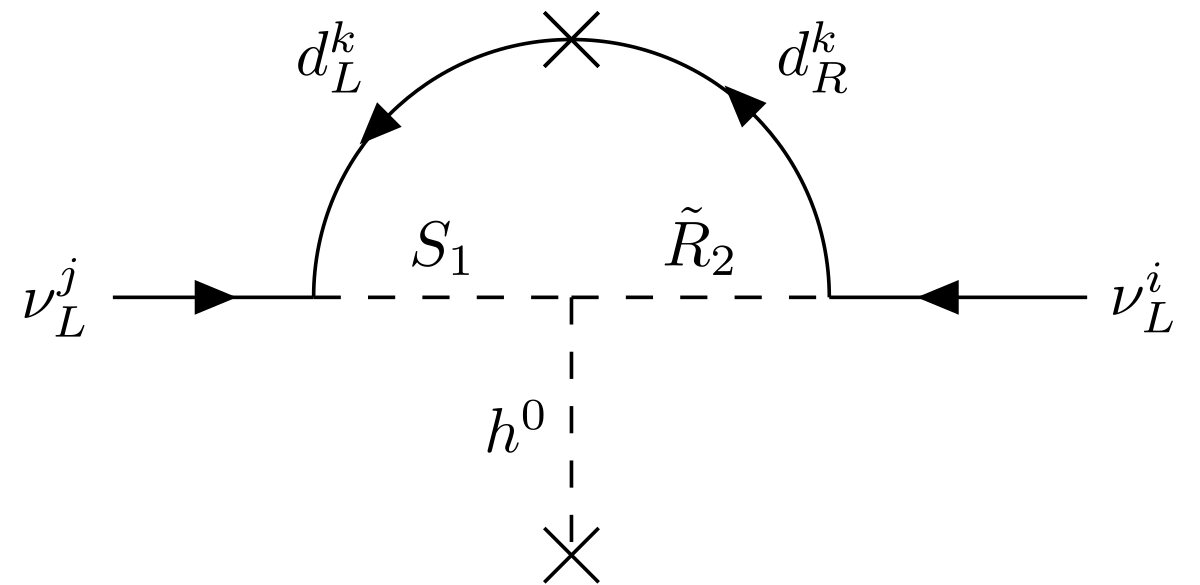
The key ingredients are two so-called tri-scalar couplings. Each lets two leptoquarks and the Higgs field interact in a way that changes lepton number by two units — what physicists call a ΔL = 2 interaction. That single source of lepton-number violation is enough to do two jobs at once:
- Generate neutrino masses. The ordinary neutrinos start out massless, but the ΔL = 2 couplings let them acquire mass through a quantum loop, as shown in figure 1 below. No right-handed neutrinos or other new fermions are needed.
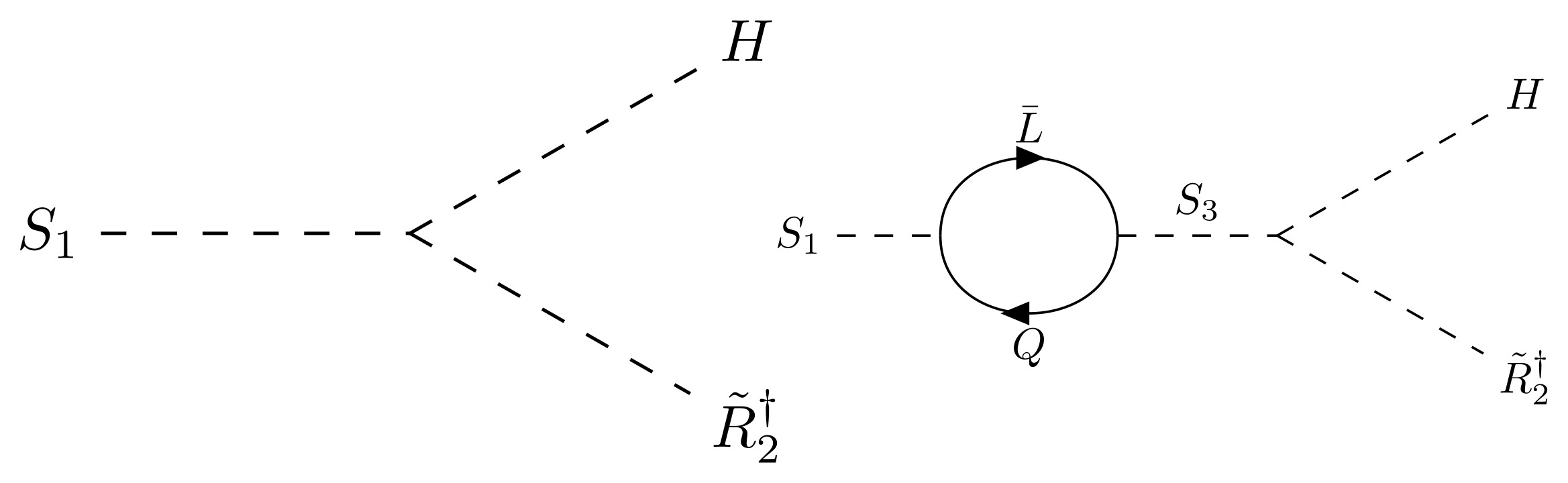
- Generate the matter–antimatter asymmetry. The heaviest leptoquark, S3, is assumed to be heavier than S1; the S1 particles then decay out of equilibrium in the early universe. Quantum interference between two decay paths gives these decays a slight preference for matter over antimatter — the CP violation that leptogenesis requires (figure 2 below).
The model is designed with a clear hierarchy: S3 is heavier than S1, and both are much heavier than R̃2. In this limit the neutrino mass and the final asymmetry become almost independent of the lightest leptoquark, R̃2 — which is convenient, because R̃2 is the only one that current experiments could realistically produce.
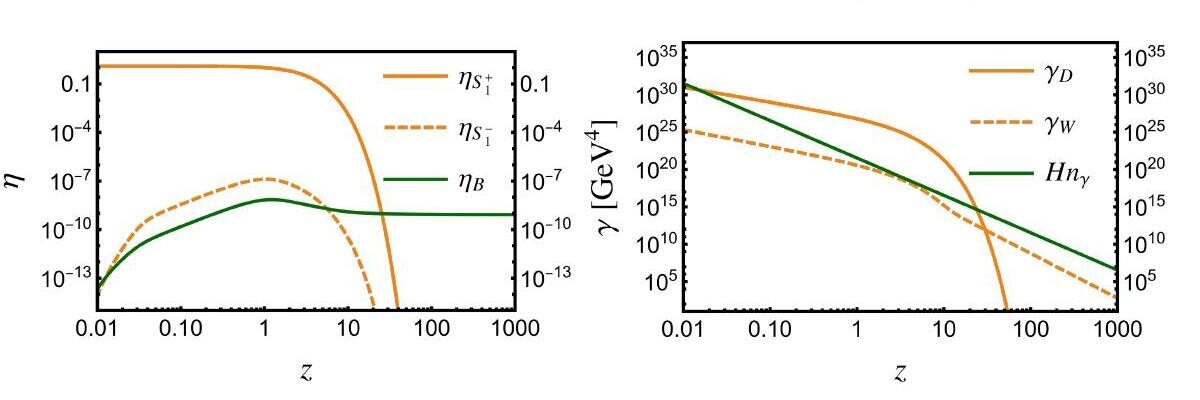
The central technical point of the paper is the washout: processes in the early universe that can erase a freshly generated asymmetry before it freezes in. The author shows that the relevant ΔL = 2 washout rate is proportional to the size of the neutrino mass. That means neutrino mass generation and the erasure of the asymmetry are controlled by the same couplings, and they must be treated together to know whether leptogenesis can succeed. The paper then solves the set of Boltzmann equations — the bookkeeping that tracks how many of each particle exist as the universe cools — together with the neutrino-mass calculation, and checks the result against a long list of experimental constraints.
What they found
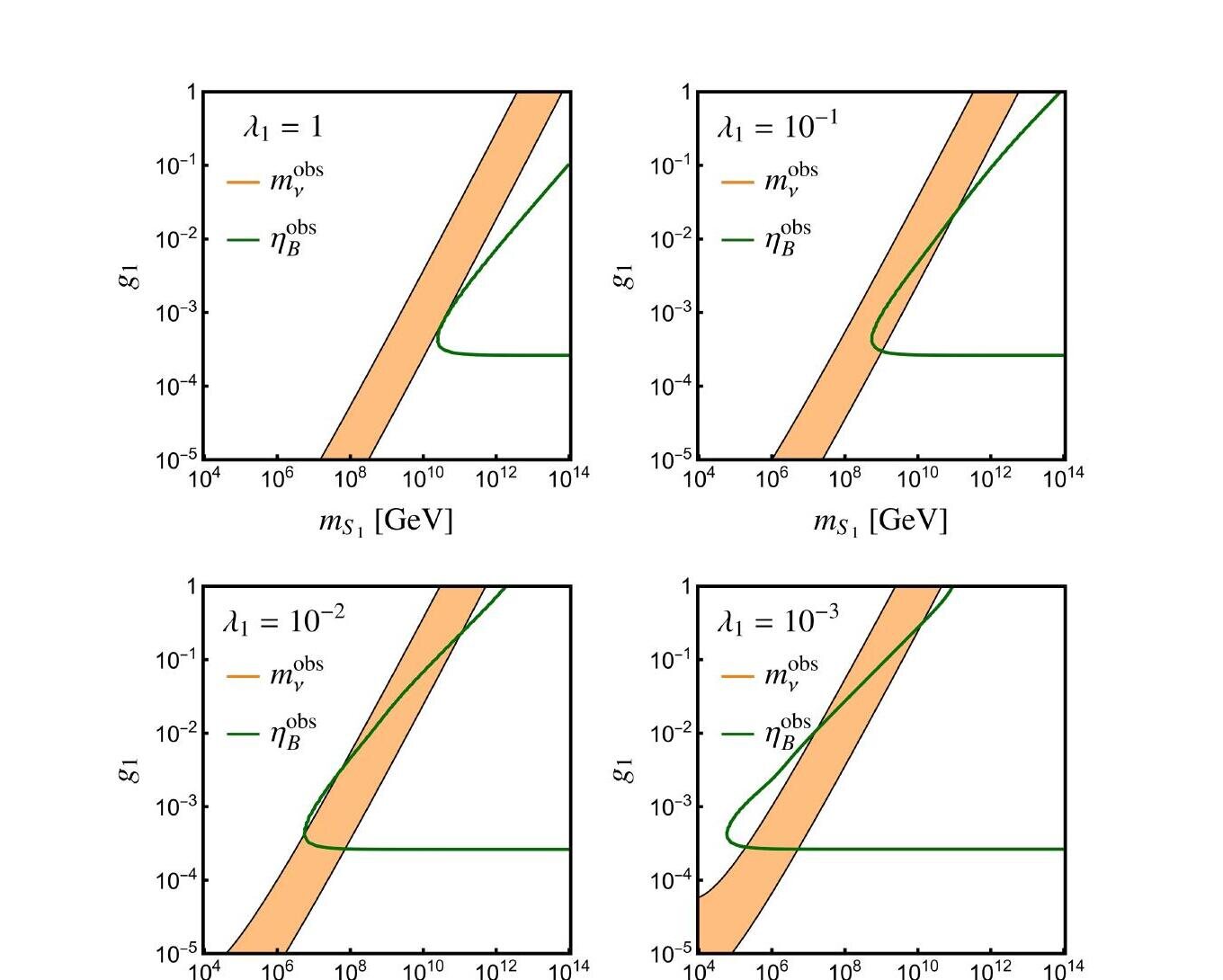
The central result is shown below: there are regions of parameter space where the model reproduces the observed baryon asymmetry ηB and the observed neutrino mass scale simultaneously. A representative benchmark point has S1 with a mass of 108 GeV, R̃2 at 5 TeV, and couplings around 10−3–0.025 — that is, none of the couplings or masses has to be fine-tuned to an absurd value.
Both puzzles, one model
Parameter regions exist where the observed ηB = 6.2 × 10⁻¹⁰ and the observed neutrino mass scale are produced together, using a benchmark with S1 at 108 GeV and R̃2 at 5 TeV.
Washout knows about neutrino mass
The ΔL = 2 washout rate is proportional to the neutrino mass. A big neutrino mass inevitably brings strong washout that erases the asymmetry — so the two effects must be computed together, consistently, rather than separately.
A narrow window for couplings
If the coupling λ1 drops below about 10−4, there is too little CP violation and no asymmetry at all. If the couplings are too large, washout wins instead. In between lies the viable window, and for small couplings the asymmetry grows as the square of g1.
Constraints can be dodged
Experimental bounds depend either on the mass of R̃2 or on couplings the mechanism does not need. For example, sidestepping the proton-decay bound requires a diquark coupling below about 10−9, and rare kaon decays (NA62) push the S1 mass above 32 GeV for the benchmark point.
Heavy enough to hide — for now
Neutrinoless double beta decay (KamLAND-Zen) requires S1 heavier than 4.3 × 10⁴ GeV at the benchmark point, or 5.7 × 10⁸ GeV with order-one couplings. The ATLAS search for leptoquarks decaying to a bottom quark and a tau already excludes masses below 1460 GeV for a coupling of 3.
Future experiments could see it
The mechanism barely depends on R̃2, so a light, strongly coupled R̃2 could show up at future colliders or in next-generation neutrinoless double beta decay searches — while the rest of the model stays out of reach.
In one line: A single scalar-leptoquark model can generate both the observed matter–antimatter asymmetry and the observed neutrino mass scale through the same lepton-number-violating interactions, without conflicting with any existing experiment.
Why it matters
The origin of matter and the origin of neutrino mass are usually treated as separate mysteries. This paper shows that a well-motivated class of models — radiative neutrino mass models built from leptoquarks — can solve both at once, and explains why earlier attempts had failed: the washout processes that erase the asymmetry are themselves proportional to the neutrino mass, so the two calculations cannot be separated. The result also sharpens a philosophical point: because a large neutrino mass would wash out the asymmetry, the smallness of the observed neutrino mass might partly be a selection effect — a universe with heavier neutrinos could have ended up with no matter at all. The author argues that similar conclusions likely hold for other radiative neutrino-mass models, making this a template rather than a one-off.
Key concepts
- Leptoquark
- A hypothetical scalar or vector particle that couples to both a quark and a lepton, so it can turn quarks into leptons and vice versa. Leptoquarks are searched for at the LHC and in rare decays such as K → πνν.
- Leptogenesis
- The idea that the universe's matter–antimatter asymmetry was generated by lepton-number-violating processes in the early universe, with electroweak sphalerons later converting part of the lepton asymmetry into a baryon asymmetry.
- Majorana neutrino
- A neutrino that is its own antiparticle. Its mass violates lepton number, which is why the same interactions that give neutrinos mass can also help explain the matter–antimatter asymmetry.
- CP violation
- A difference in the behaviour of particles and antiparticles. Leptogenesis requires the decays of a heavy particle and its antiparticle to happen at slightly different rates; here the difference comes from interference between a tree-level decay and a one-loop decay of the leptoquark S1.
- Washout
- Scattering processes in the early universe that can erase a newly generated asymmetry before it becomes permanent. In this model the ΔL = 2 washout rate is proportional to the neutrino mass.
- ΔL = 2
- A process that changes lepton number by two units. It is the hallmark of Majorana neutrino masses, and in this model it comes from couplings between two leptoquarks and the Higgs field.
Citation
Kåre Fridell, Leptogenesis and neutrino mass with scalar leptoquarks, Journal of High Energy Physics 05 (2025) 096. arXiv:2411.03282 [hep-ph] · doi:10.1007/JHEP05(2025)096. Figures reproduced from the paper, which is published open access under a CC BY 4.0 license; this page is a plain-language summary and any simplification is the fault of the summary, not the author.