2020 · Proceedings of Science (ICHEP 2020) · Conference proceedings
Implications of Rare Kaon Decays on Lepton Number Violating Interactions
The rare decays K → πνν are some of the cleanest hunting grounds for new physics — and if neutrinos are their own antiparticles, the same decays can be driven by an interaction that violates lepton number. This six-page ICHEP 2020 conference contribution is the short version of the authors' full paper: it shows that NA62's existing data already push the scale of such lepton-number-violating new physics above about 17 TeV, and that a discovery would put high-scale leptogenesis under tension while pointing to radiatively generated neutrino masses.
Published in: Frank F. Deppisch, Kåre Fridell, Julia Harz, Implications of Rare Kaon Decays on Lepton Number Violating Interactions, PoS(ICHEP2020)130. doi:10.22323/1.390.0130 · free PDF on pos.sissa.it · preprint on arXiv. The full analysis is the companion paper Probing lepton number violating interactions in rare kaon decays; these proceedings are the short conference write-up, not the full paper.
Background: rare kaons and the mystery of neutrino mass
Neutrino oscillations prove that neutrinos have tiny masses, but the Standard Model offers no explanation for them. If neutrinos received their mass from the Higgs boson in the usual way, the corresponding Yukawa coupling would have to be of order 10−12 — millions of times smaller than the electron's 2.9 × 10⁻⁶, the smallest coupling in the Standard Model. That weird lopsidedness suggests something else is going on, and the most popular idea is a Majorana mass term: a mass that makes each neutrino identical to its own antiparticle and violates lepton number by two units.
Lepton number is an accidental symmetry of the Standard Model — the theory respects it, but quantum effects (sphaleron transitions) break it anomalously. That anomaly is cosmologically useful: it allows an asymmetry generated in the lepton sector of the early Universe to be converted into the observed baryon asymmetry, the mechanism behind leptogenesis. It also makes lepton-number violation a double-edged sword: the same kind of interaction could be the origin of matter, or, if it is too strong, it could wash out an asymmetry that leptogenesis had already created.
The rare decays K+ → π+νν̄ and KL → π⁰νν̄ are prime targets for this physics: extremely suppressed in the Standard Model, theoretically very clean, and being hunted right now by the NA62 experiment at CERN (and KOTO in Japan, for the neutral mode). In the Standard Model the two neutrinos are a neutrino–antineutrino pair produced by a vector current. A lepton-number-violating (LNV) interaction would instead emit two neutrinos or two antineutrinos through a scalar current. Because neutrinos leave no trace in the detector, the two cases look identical event by event — only the shape of the kinematic distributions differs. Majorana masses can arise through higher-order processes involving extra leptons or quarks, and in that case the rare kaon decays may be the most stringent experimental probe of the responsible new physics.
What the paper does
- Works model-independently in effective field theory. Instead of guessing new particles, the authors write down every operator built from known Standard Model fields that violates lepton number by two units and has odd mass dimension, suppressed by powers of a new-physics scale Λ. The lowest possible dimension for K → πνν is dimension 7, through the operator O3b, made of two lepton doublets, a quark doublet, a down-type quark and the Higgs field. It is “short range”: no extra vertices are needed for the decay to happen.
- Connects the operator to neutrino mass. The same operator generates a Majorana neutrino mass at loop level, δmν ≈ yd v² / (16π² Λ³), where yd is the down-quark Yukawa coupling and v the Higgs vacuum expectation value. If this loop had to produce mν = 0.1 eV with generic couplings, the scale would have to be Λ ≥ 5.2 × 10⁴ TeV — far beyond any kaon experiment. The authors stress that this is only an estimate, which a concrete model can shift substantially.
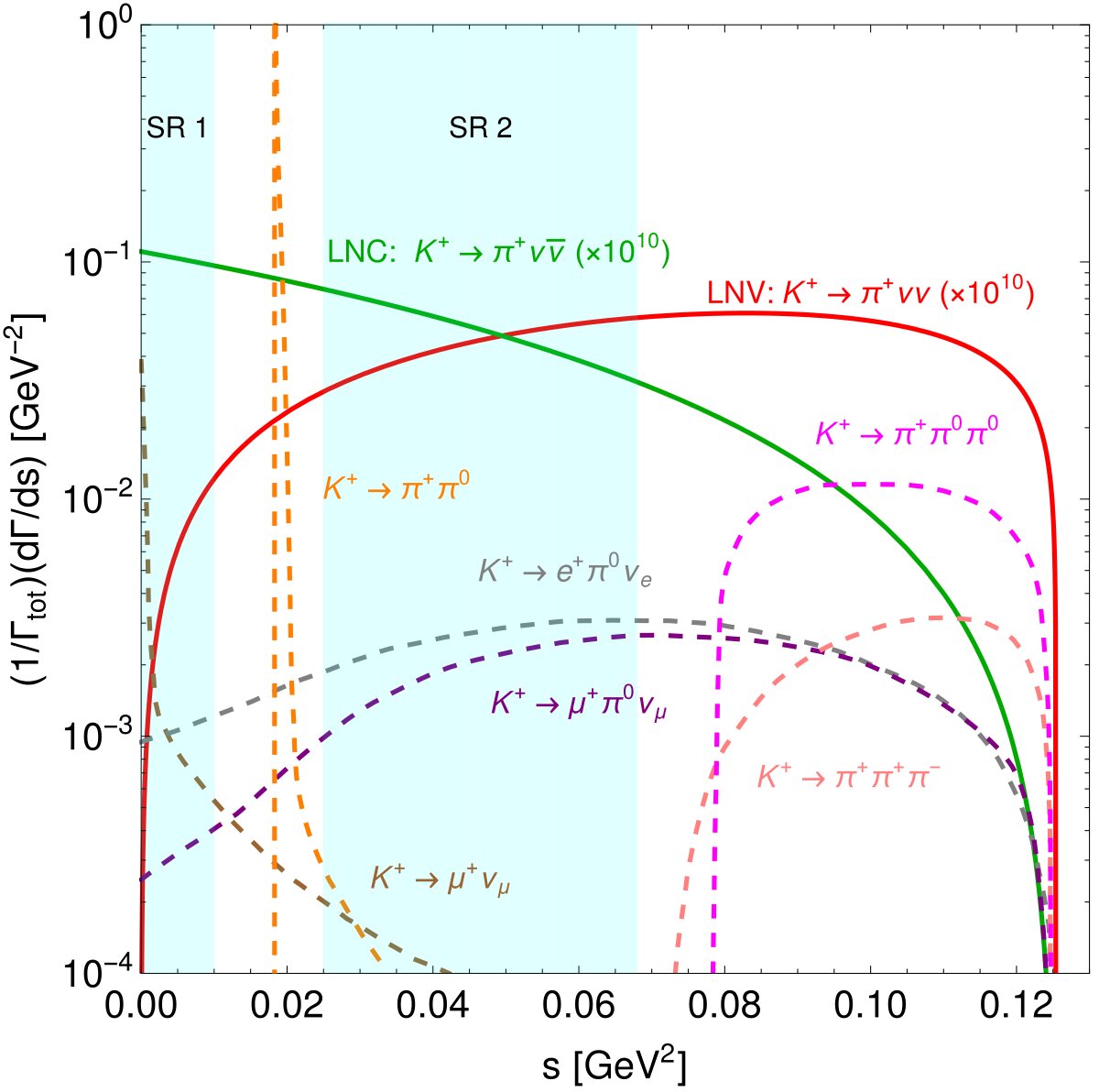
- Computes how the LNV decay would look. The authors work out the squared matrix element for K → πνν with a scalar current and compare it with the Standard Model's vector current. The scalar current reshapes the decay: the Standard Model distribution peaks at low missing energy, while the LNV distribution peaks at high missing energy. Folding these shapes through NA62's two signal regions turns the measured branching-ratio limit into a bound on the new-physics scale Λ, correcting for the fact that NA62's cuts are optimized for the Standard Model shape.
- Follows the washout in the early Universe. A high-scale leptogenesis scenario generates a lepton asymmetry at temperatures around 10⁹ GeV or above. Any LNV process still active at lower temperatures erases part of it. Using a simplified Boltzmann equation, the authors find the temperature down to which a washout driven by O3b remains effective.
What they found
| Current | NA62 SR 1 | NA62 SR 2 |
|---|---|---|
| Vector (Standard Model) | 6% | 17% |
| Scalar (LNV) | 0.3% | 15% |
Two things stand out. A signal in SR 1 would plainly point to the Standard Model decay, while an LNV signal concentrates in SR 2, where both decays are accepted at similar rates (17% versus 15%). With a very large data set, comparing event counts in the two regions could reveal the LNV nature of the interaction — though the extremely small branching ratio makes collecting such a data set very hard.
Already above 17 TeV
NA62's current 90% confidence upper limit on the branching ratio, 1.78 × 10⁻¹⁰, translates — once the scalar-current acceptance is taken into account — into a lower bound of Λ > 17.2 TeV on the scale of LNV new physics.
Nearly 20 TeV with the next data
With NA62's projected future sensitivity of 1.11 × 10⁻¹⁰, the same analysis reaches Λ > 19.6 TeV.
Washout down to the electroweak scale
If the LNV interaction sits close to those limits, the washout of a pre-existing lepton asymmetry stays effective down to 196 GeV (current data) or 213 GeV (future data) — not far above the 174 GeV electroweak scale at which sphalerons switch off.
Neutrino mass pulls the other way
The same operator radiatively generates neutrino mass: generic couplings producing mν = 0.1 eV would need Λ ≥ 5.2 × 10⁴ TeV. The authors stress this is only an estimate that concrete models can soften — but it is why an observable kaon signal would hint at non-generic, radiatively generated neutrino masses.
In one line: Rare-kaon data already require any lepton-number-violating interaction to sit above about 17 TeV — and if one is discovered there, the same interaction would wash out a high-scale lepton asymmetry and put standard leptogenesis under pressure.
Why it matters
A K → πνν signal alone cannot strictly prove that lepton number is violated, because the escaping neutrinos hide the difference between the two hypotheses. The scalar-versus-vector shape of the pion energy distribution is the best clue available, and exploiting it would require experiments to publish dedicated selections for scalar currents and, eventually, very large data sets. The payoff would be enormous: lepton-number violation at the TeV scale would connect the origin of neutrino mass to the baryon asymmetry of the Universe and squeeze the simplest high-scale leptogenesis scenarios. An LNV kaon signal would also suggest that neutrino masses are radiatively generated — through loops involving new particles — rather than through the simple Higgs mechanism of the other fermions.
This page describes the short conference proceedings. The full analysis, with all derivations and details, is in the companion paper Probing lepton number violating interactions in rare kaon decays, which has its own plain-language page on this site.
Key concepts
- Lepton number (L)
- A bookkeeping rule that counts leptons (electrons, muons, taus, neutrinos) as +1 and antileptons as −1. The Standard Model conserves it in practice, but a Majorana neutrino mass would break it by two units (ΔL = 2).
- Majorana neutrino
- A neutrino that is identical to its own antiparticle. If true, a rare kaon decay can emit two neutrinos (or two antineutrinos) instead of a neutrino–antineutrino pair — the difference that makes K → πνν a lepton-number violation probe.
- Effective operator and the scale Λ
- When the new heavy particles are too heavy to produce directly, their effects can be described by contact interactions built from known fields, suppressed by powers of a new-physics scale Λ. Higher mass dimension means more suppression — here the relevant operator has dimension 7.
- Scalar vs vector current
- The Standard Model decay uses a vector current, while the LNV operator uses a scalar current. This changes how the pion's energy is distributed between low and high missing energy, even though the visible final state — a pion plus nothing — looks the same.
- Leptogenesis and washout
- A scenario in which the matter–antimatter asymmetry of the Universe is first generated in the lepton sector at a high temperature. LNV interactions active later can “wash out” that asymmetry, erasing it before it can do its job.
- Signal region and acceptance
- Experiments count events only in carefully chosen kinematic windows where the background is under control. The fraction of a given signal that falls inside is its acceptance; it depends on the shape of the signal distribution, which is why scalar and vector currents give different limits.
Citation
Frank F. Deppisch, Kåre Fridell, Julia Harz, Implications of Rare Kaon Decays on Lepton Number Violating Interactions, Proceedings of Science, PoS(ICHEP2020)130 (2021). doi:10.22323/1.390.0130 · arXiv:2012.14825 [hep-ph] · pos.sissa.it/390/130. Proceedings of the 40th International Conference on High Energy Physics (ICHEP2020), Prague, 28 July – 6 August 2020 (virtual meeting). This is the short conference write-up; the full analysis is F. F. Deppisch, K. Fridell, J. Harz, JHEP 12 (2020) 186 — see also the plain-language page for the full paper. Figure reproduced from the paper (© the authors, CC BY-NC-ND 4.0); this page is a plain-language summary and any simplification is the fault of the summary, not the authors.