2019 · Journal of High Energy Physics · Open access
Non-relativistic Effective Interactions of Spin 1 Dark Matter
Dark matter is usually imagined as a scalar or a fermion. This paper works out what happens if it is instead a spin-1 — “vector” — particle, like a heavy cousin of the photon. The complete menu of interactions with atomic nuclei turns out to contain two entries that exist only for spin-1 dark matter and had been missed before. For dark matter lighter than about 50 GeV, ignoring them can change predicted direct-detection rates by up to a factor of ten.
Published in: Riccardo Catena, Kåre Fridell, Martin B. Krauss, Non-relativistic Effective Interactions of Spin 1 Dark Matter, JHEP 08 (2019) 030. doi:10.1007/JHEP08(2019)030 · free preprint on arXiv
Background: what spin does to the search
Direct-detection experiments sit deep underground and wait for a particle of the Milky Way's dark matter to bump into an atomic nucleus. When that happens the nucleus recoils, and the recoil energy is the signal. How many recoils a detector should see depends on how the dark matter interacts with protons and neutrons — and that depends on the properties of the dark-matter particle itself.
Theorists describe those interactions in three ways. A simplified model adds one dark-matter particle and one mediator particle to the Standard Model. A relativistic effective field theory writes down every interaction allowed by special relativity. A non-relativistic effective theory turns those interactions into a catalogue of quantum-mechanical operators built from a few basic ingredients: the identity, the momentum transferred in the collision, the dark matter's velocity and spin, and the nucleon's spin.
That catalogue had been worked out in detail for dark matter with spin 0 and spin ½. Spin 1 — the vector case — had hardly been explored. Vector particles carry their spin in polarisation vectors, which can be combined into a symmetric object that simply cannot be built for scalars or fermions. So spin-1 dark matter could interact with nuclei in ways previous catalogues never listed.
What the paper does
- Build two simplified models. In the first, a spin-1 dark-matter particle talks to quarks through a spin-0 mediator. In the second, the mediator also has spin 1, and its interactions involve several new couplings (b3–b7), two of which — b6 and b7 — must be complex.
- Reduce to non-relativistic quantum mechanics. Galactic dark matter moves at about a thousandth of the speed of light, and the momentum it transfers to a nucleus is much smaller than the mediator mass. The authors “integrate out” the mediator, match the quark-level interactions onto nucleons using nucleon form factors, and expand the scattering amplitude to second order in the momentum transfer q/mN and first order in the relative velocity. The result is the list of quantum-mechanical operators each model generates.
- Compare with the standard catalogue. The spin-0 mediator generates only two familiar operators, O1 and O10. The spin-1 mediator generates a longer list — and, crucially, two operators that were not in the eighteen-operator catalogue: O19 and O20, quadratic in q and linear in the symmetric combination of DM polarisation vectors.
- Compute rates and relic densities. For three benchmark models the team computes expected dark-matter recoil rates on a xenon target, with the new operators included and left out, assuming the standard local dark-matter density of 0.4 GeV cm−3. They then calculate the dark-matter relic density for the same models and ask whether a future DARWIN-like signal could be consistent with the amount of dark matter seen in the cosmic microwave background.
The two new operators (in the paper's notation):
O19 = (q/mN) · S · (q/mN)
O20 = (SN × q/mN) · S · (q/mN)
Here q is the momentum transfer, mN the nucleon mass, SN the nucleon spin, and S the symmetric combination of the dark matter's polarisation vectors. Both operators contain q twice, which normally makes them a small correction: a collision that barely transfers momentum cannot see them. But in the models where they arise, no simpler momentum-independent operator shows up at leading order to take over, so the new terms end up mattering.
What they found
Two operators, three parents
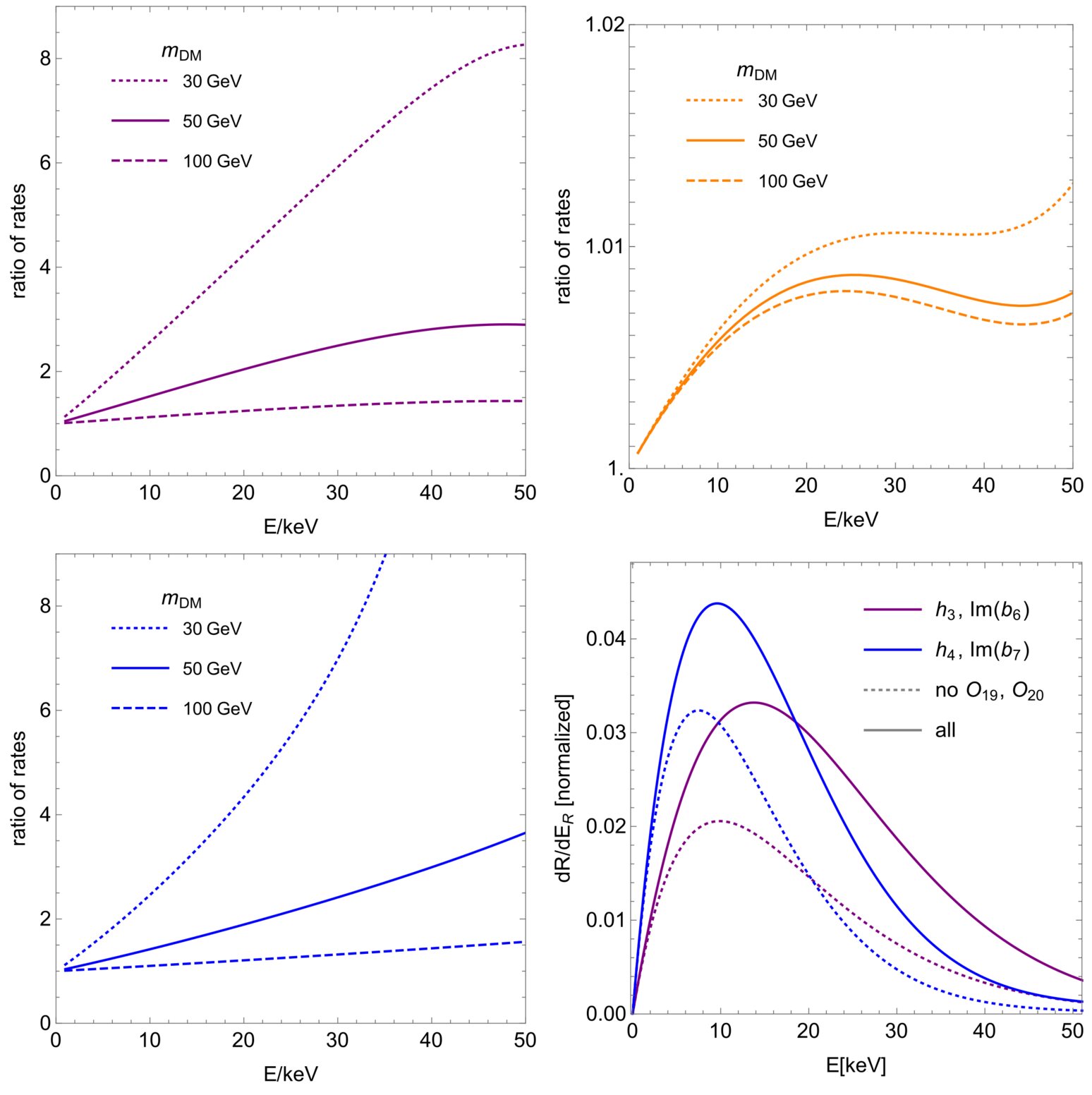
O19 is generated by the coupling combination (h3, Im b6), while O20 comes from (h3, Re b6) and from (h4, Im b7). These benchmark models simply cannot be described by the old eighteen-operator catalogue.
Rates up to ten times too small
For the models (h3, Im b6) and (h4, Im b7), neglecting the new operators underestimates the recoil rate, especially for dark matter lighter than 50 GeV and recoil energies above about 20 keV — by up to one order of magnitude.
The spectrum changes shape
Leaving out O19 or O20 does not just lower the overall rate: the predicted recoil spectrum peaks at smaller recoil energies, so the spectral distribution of events is appreciably distorted as well.
One model is safe
In the (h3, Re b6) model O20 also appears, but so does the standard operator O17, which keeps the correction below the 2% level at all recoil energies and masses studied.
First events are the tricky ones
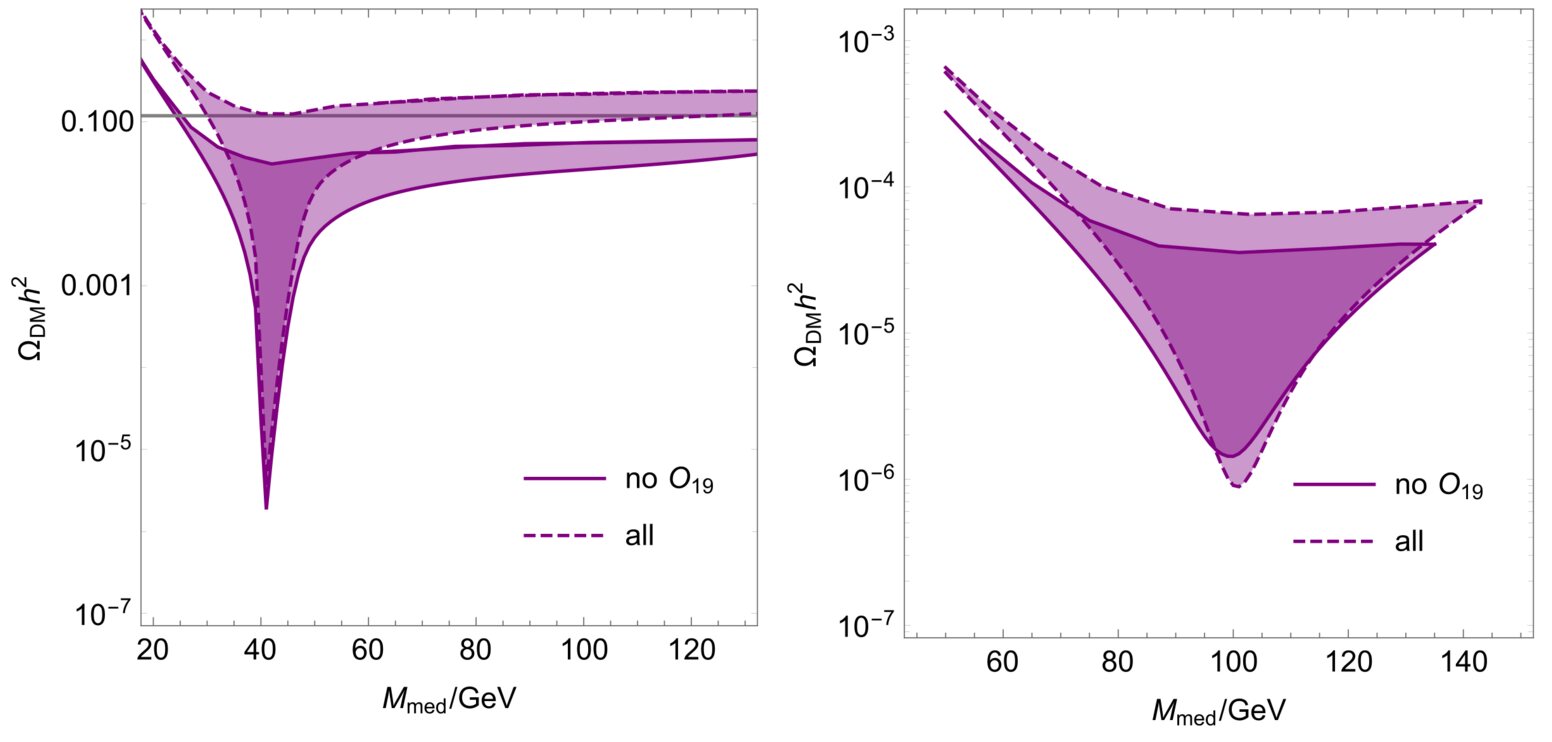
For a simplified DARWIN detector (80 ton×year exposure, 5–45 keV signal region), the compatible mediator-mass range agrees with the CMB relic density only if O19 is included — dramatically so when the assumed signal is a single event; with 150 events the difference is milder.
Four more operators exist on paper
At the same order in the expansion, four further Hermitian operators (O21–O24) can be built from the same basic ingredients and the symmetric polarisation combination — but no known simplified model generates them.
In one line: If dark matter is a spin-1 particle, two previously overlooked operators can change direct-detection predictions by up to an order of magnitude — and they change how a first signal should be compared with the cosmic microwave background.
Why it matters
Direct-detection experiments are pushing towards ever lighter dark matter, and that is exactly the mass range — below about 50 GeV — where the new operators bite hardest. The paper also highlights the first few recorded events as the situation where including or omitting an operator can change whether a signal looks compatible with the relic density measured by the cosmic microwave background. Getting the operator catalogue right is therefore not an academic exercise: it decides how experimental data get translated into statements about the dark matter of the Universe.
More broadly, the work connects two of the three standard ways of describing dark matter: it shows which non-relativistic operators a popular class of simplified models actually generates, completing earlier work on scalar and fermion dark matter for the vector case.
Key concepts
- Spin-1 (vector) particle
- A particle that carries one unit of intrinsic angular momentum — like the photon, the W and the Z bosons. Dark matter candidates with spin 1 are possible extensions of the Standard Model, but were studied far less than scalar (spin 0) and fermion (spin ½) candidates.
- Polarisation vector
- The object that describes the spin state of a vector particle, roughly the direction in space in which the particle is “polarised”. Combining the polarisation vectors before and after a collision gives a symmetric object that exists only for spin-1 dark matter — the source of the two new operators.
- Simplified model
- A minimal extension of the Standard Model containing one dark-matter particle and one mediator particle that connects it to ordinary quarks. Simple enough to compute with, concrete enough to test against several experiments at once.
- Non-relativistic reduction
- Rewriting a relativistic theory of particle collisions in the slow-motion limit: the dark matter moves at a tiny fraction of the speed of light, and the momentum transferred to a nucleus is small. The result is a catalogue of quantum-mechanical operators — the language of direct detection.
- Momentum transfer
- The momentum the incoming dark-matter particle hands to the nucleus. It grows with the dark matter's mass and with the recoil energy; an operator “quadratic in the momentum transfer” is normally suppressed in slow collisions.
- Relic density
- The amount of dark matter left over from the hot early Universe, usually written ΩDMh2. The cosmic microwave background measures it to be about 0.12; a viable dark-matter model must reproduce that value through thermal freeze-out.
Citation
Riccardo Catena, Kåre Fridell, Martin B. Krauss, Non-relativistic Effective Interactions of Spin 1 Dark Matter, Journal of High Energy Physics 08 (2019) 030. arXiv:1907.02910 [hep-ph] · doi:10.1007/JHEP08(2019)030. Figures reproduced from the paper; this page is a plain-language summary and any simplification is the fault of the summary, not the authors.