2026 · Journal of High Energy Physics · Open access
Feasibility study of lepton number violation in rare B and K meson decays
Experiments such as Belle II, NA62 and KOTO have measured rare meson decays into a meson plus invisible particles. Those invisible particles could be an ordinary neutrino–antineutrino pair, or a lepton-number-violating pair of two neutrinos. This paper asks when the second possibility could really explain a future excess — and finds that it only survives if the new interaction almost ignores at least one type of lepton, or if the new physics scale is very close to the electroweak scale.
Published in: M. Endo, K. Fridell, S. Iwamoto, Y. Mura, K. Yamamoto, Feasibility Study of Lepton Number Violation in Rare B and K Meson Decays, JHEP 06 (2026) 132. doi:10.1007/JHEP06(2026)132 · free preprint on arXiv
Background: neutrinos, lepton number and invisible decays
Neutrinos have tiny but nonzero masses, and the simplest explanation is that they are Majorana particles: each neutrino is its own antiparticle. That would mean lepton number — the count of leptons minus antileptons — is not conserved by nature. So far, however, lepton number violation (LNV) has never been seen directly.
The decays B+ → K+νν and K → πνν are promising places to look. In the Standard Model they are strongly suppressed, and through a subtle chain of loop diagrams they occur only about once in two hundred thousand (for the B) or ten billion (for the K) decays. Detectors cannot identify the neutrinos, so experiments only count events where the meson is seen and everything else is missing energy. That means the invisible pair could be a neutrino–antineutrino pair (the Standard Model option) or a pair of two neutrinos, or two antineutrinos — a lepton-number-violating option. Any difference between the measured rates and the Standard Model predictions could be a hint of LNV.
At the level of particle physics this grows even more interesting in the Standard Model effective field theory (SMEFT), where heavy unknown particles are integrated out and leave behind higher-dimensional interactions. The lowest-dimensional LNV operator is the dimension-5 Weinberg operator, which can generate neutrino masses. The next option is a family of dimension-7 operators that couple two quarks, two leptons and the Higgs field, and can turn a b quark into an s quark or an s quark into a d quark while producing a lepton-number-violating neutrino pair. These are exactly the transitions behind B → Kνν and K → πνν.
Previous work had studied such operators in isolation. This paper puts them under three simultaneous spotlights: the rare meson decays, the washout of the matter–antimatter asymmetry in the early Universe, and neutrinoless double beta decay (0νββ) — plus the constraint that the same operators generate neutrino masses at the quantum level.
What the paper does
- Rare decays. The authors work out how the dimension-7 LNV operators contribute to B+ → K+νν, K+ → π+νν and KL → π0νν, and translate the measured rates and future projections into limits on the operator coefficients as a function of the new-physics cutoff scale Λ.
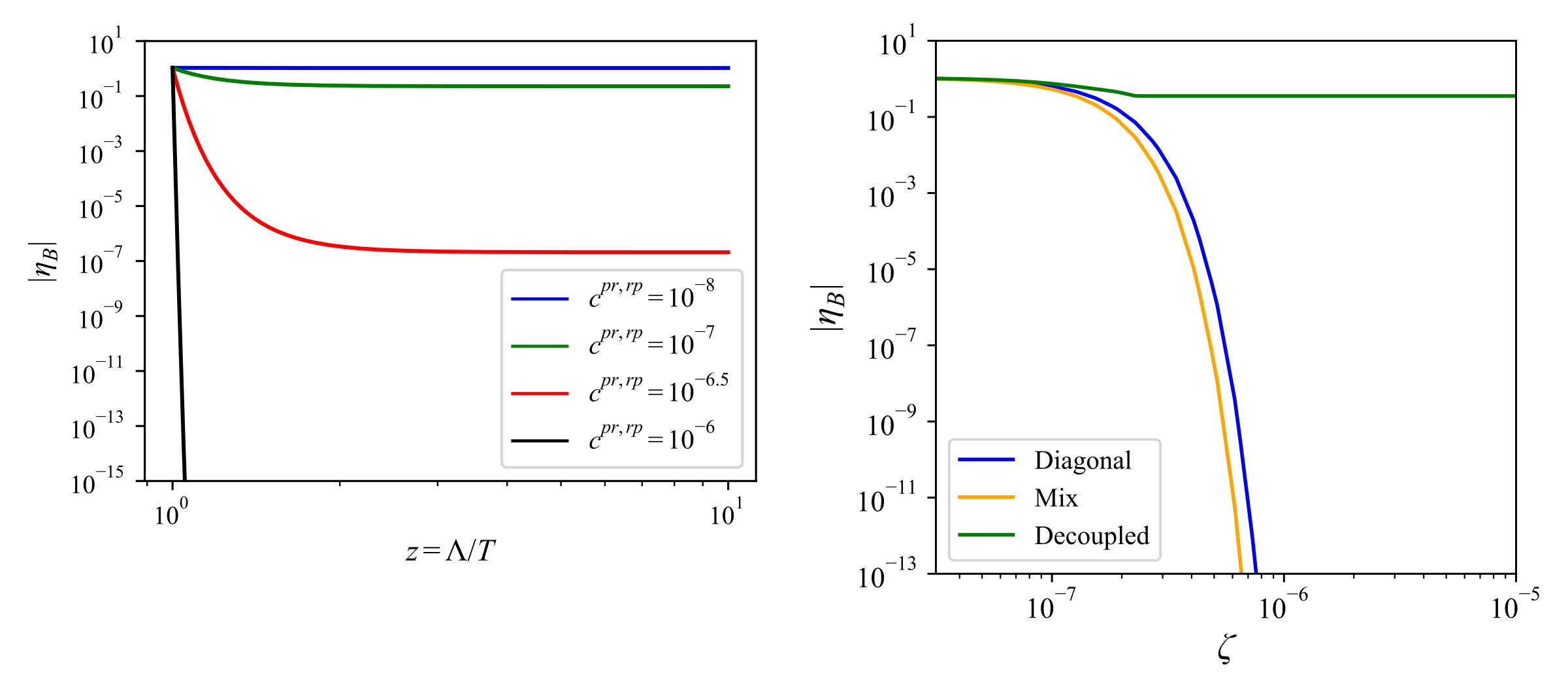
- Early Universe. If LNV interactions act while the electroweak sphalerons are still active, they can erase the B − ℓ asymmetry from which the observed baryon asymmetry descends. The authors solve the Boltzmann equations for the asymmetries B/3 − ℓα (one for each lepton flavor) instead of just the total lepton number, and require that the final baryon-to-photon ratio matches the observed value ηB = 6.14 × 10⁻¹⁰.
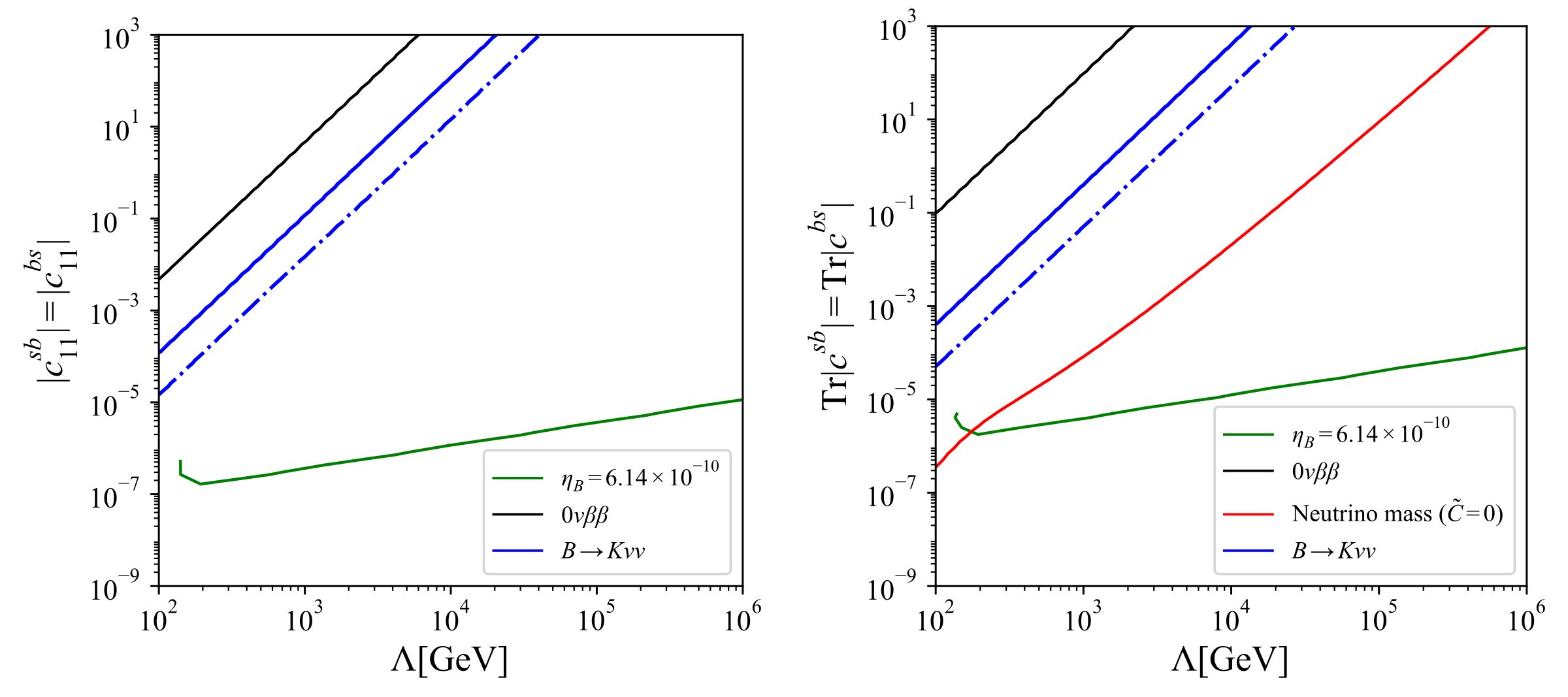
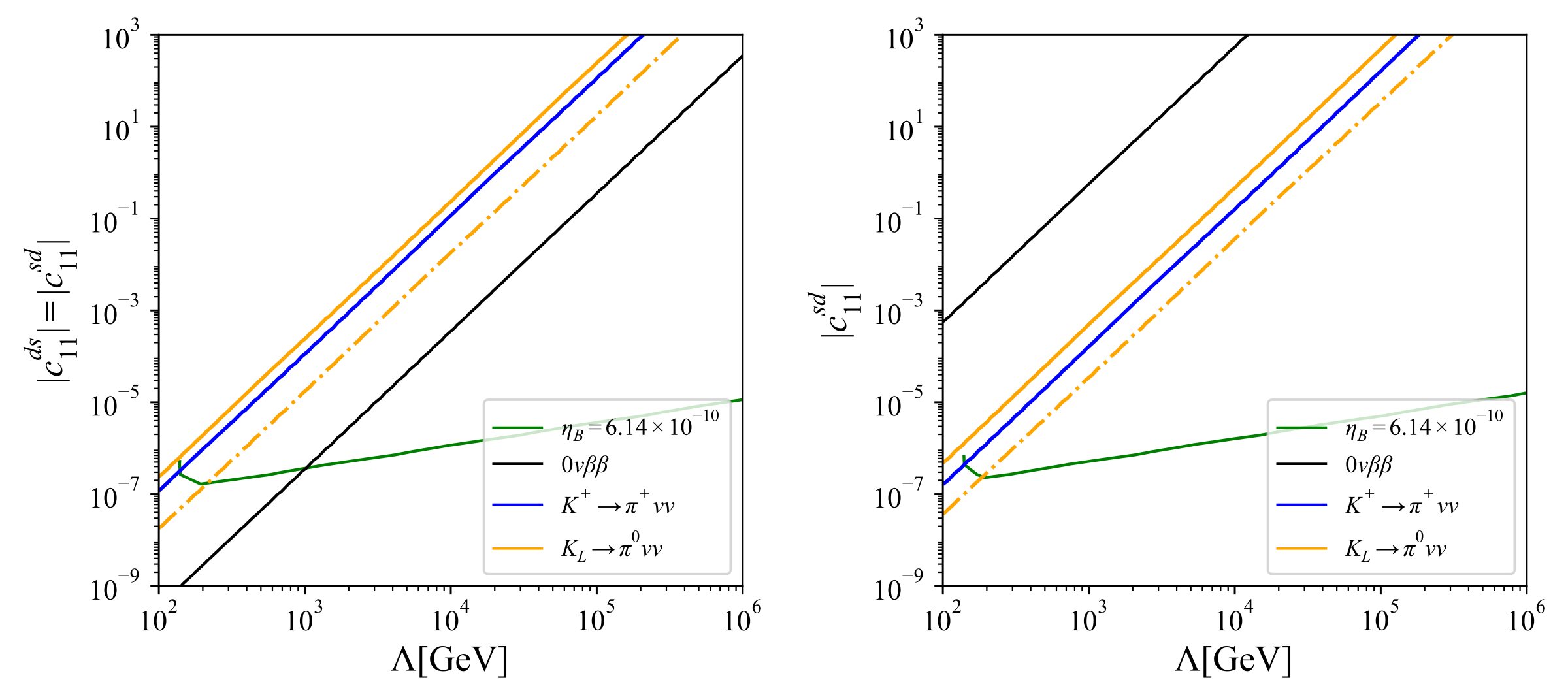
- Neutrinoless double beta decay. Even though the operators change down-quark flavor, they can drive 0νββ: at the tree level through the Cabibbo–Kobayashi–Maskawa mixing when the operator contains a first-generation down quark, and at one loop for the other quark flavors. The authors confront these contributions with the KamLAND-Zen bound.
- Neutrino masses. The dimension-7 operators generate neutrino masses at the two-loop level, proportional to quark masses. The authors compute this explicitly and then add the dim-5 Weinberg operator so that the observed neutrino masses are reproduced for any choice of the dimension-7 couplings, checking that the Weinberg operator does not spoil the story.
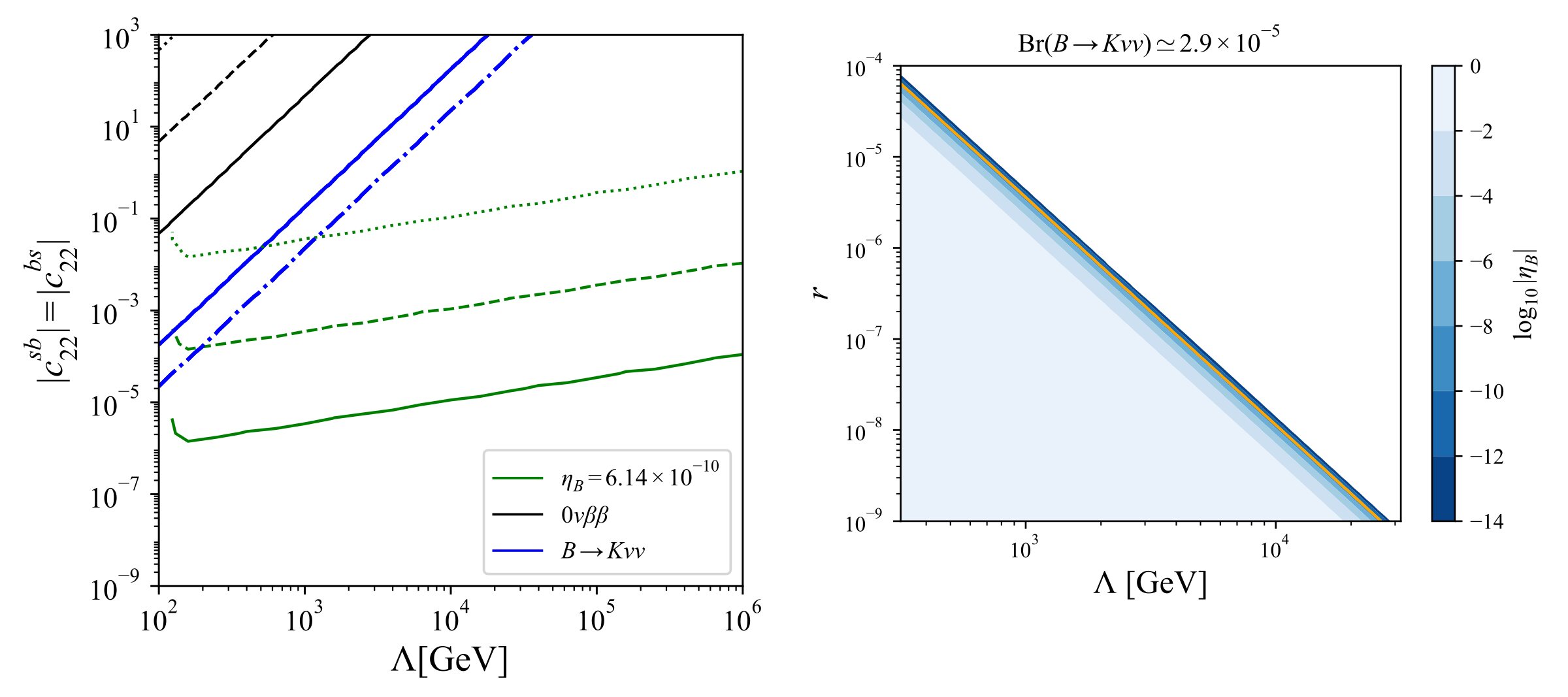
To keep the analysis concrete they study three lepton-flavor patterns: Scenario 1, where the couplings are the same for every lepton flavor; Scenario 2, where their flavor structure traces the measured neutrino mass matrix; and Scenario 3, where the couplings of the first lepton generation are suppressed by a factor r, so in the limit r → 0 that flavor is completely decoupled.
| Observable | Standard Model | Experiment |
|---|---|---|
| Br(B+ → K+νν̄) | (5.58 ± 0.37) × 10−6 | (2.3 ± 0.5 (stat) +0.5−0.4 (syst)) × 10−5 — Belle II, 2.7σ above the SM |
| Br(K+ → π+νν̄) | (8.60 ± 0.42) × 10−11 | (13.0 +3.3−3.0) × 10−11 — NA62 |
| Br(KL → π0νν̄) | (2.94 ± 0.15) × 10−11 | < 2.2 × 10⁻⁹ — KOTO (90% C.L.) |
| Half-life of 136Xe for 0νββ | — | > 3.8 × 1026 yr — KamLAND-Zen (90% C.L.) |
| Baryon-to-photon ratio ηB | — | 6.14 × 10⁻¹⁰ — cosmic microwave background (Planck) |
What they found
B → Kνν: a narrow window survives
In Scenarios 1 and 2, any coupling large enough to make the LNV contribution to B+ → K+νν visible to Belle II would also have erased the primordial asymmetry. The way out is flavor: in Scenario 3, where first-generation leptons couple with a strength suppressed by r, the asymmetry survives and a signal within Belle II's projected reach (50 ab−1) is allowed if r ≲ 10−3 for Λ ≳ 200 GeV.
K → πνν: 0νββ squeezes hardest
For K decays, a nonzero Cds coupling makes neutrinoless double beta decay a tree-level effect and corners the parameter space. With Cds switched off, a sizable LNV contribution to future K measurements needs Λ ≲ 200 GeV in Scenarios 1 and 2.
Flavor structure decides everything
Diagonal and mixing lepton-flavor patterns wash out the asymmetry in essentially the same way, but decoupling one lepton flavor preserves its share of the asymmetry. For K decays, suppressing the first-generation couplings also relaxes the 0νββ bound, because only electron-flavored operators contribute to that decay. An observed excess plus a non-observation of 0νββ would therefore already point to a specific flavor pattern.
The Weinberg operator fits in
The dimension-7 operators do generate neutrino masses at two loops — non-negligibly so. The authors show the observed masses can still be reproduced by adding the dimension-5 Weinberg operator, absorbing the dimension-7 mass contributions into its coefficient, and that the Weinberg operator's extra effects on washout and on 0νββ are negligible.
In one line: A lepton-number-violating explanation of future excesses in B → Kνν and K → πνν is possible, but only if the new interaction almost ignores at least one lepton flavor (or, for the K decays, one quark ordering and a low cutoff) — otherwise the early Universe and neutrinoless double beta decay have already ruled it out.
Why it matters
Rare meson decays into invisible particles are one of the few windows where lepton number violation could hide in plain sight, and this paper shows that the window is not free: the same interactions that would produce a signal also threaten the matter–antimatter asymmetry and nuclear decays. By tying together flavor physics, cosmology and neutrinoless double beta decay in a single calculation, the authors map out precisely which flavor structures could still be at work — and which future measurements would test them. If an excess is ever confirmed while 0νββ stays unseen, the pattern of constraints would itself be a clue to the new particles hiding above the electroweak scale; any direct observation of these decays would open a new direction toward understanding where lepton number violation comes from.
Key concepts
- Lepton number violation (LNV)
- Any process that changes the number of leptons minus antileptons. It would occur if neutrinos are their own antiparticles (Majorana), and it is needed to explain why the Universe did not end up with equal matter and antimatter.
- Neutrino mass and the Weinberg operator
- Neutrino masses could come from a dimension-5 interaction that pairs two lepton doublets with two Higgs fields. After the Higgs gets its vacuum expectation value this operator gives neutrinos a small Majorana mass, and its coefficient is one way to parametrize lepton number violation.
- Effective field theory and dimension
- Heavy unknown particles can be “integrated out”, leaving contact interactions written in terms of known fields. Each interaction's dimension fixes how strongly it is suppressed by the high-energy cutoff Λ: the dimension-7 operators discussed here are relatively close to the Standard Model and can be probed by rare decays.
- Invisible final states
- Experiments like Belle II, NA62 and KOTO reconstruct a B or K meson and see nothing else. Because the missing neutrinos are not identified, a lepton-number-conserving neutrino–antineutrino pair and a lepton-number-violating neutrino–neutrino pair look exactly the same in the detector.
- Washout of the baryon asymmetry
- At high temperatures the electroweak sphalerons violate baryon and lepton number while conserving B − ℓ. If lepton-number-violating interactions are still active then, they can erase the B − ℓ asymmetry left by baryogenesis, so too-strong LNV interactions are ruled out by the measured ηB = 6.14 × 10⁻¹⁰.
- Neutrinoless double beta decay (0νββ)
- A nuclear decay in which two neutrons become two protons and two electrons with no neutrinos emitted — possible only if neutrinos are Majorana particles. A long lifetime or no signal at all (KamLAND-Zen and future experiments) constrains any new source of LNV.
Citation
Motoi Endo, Kåre Fridell, Sho Iwamoto, Yushi Mura, Kei Yamamoto, Feasibility Study of Lepton Number Violation in Rare B and K Meson Decays, Journal of High Energy Physics 06 (2026) 132. arXiv:2601.16422 [hep-ph] · doi:10.1007/JHEP06(2026)132.
Figures reproduced from the paper, which is published open access under a Creative Commons Attribution (CC BY 4.0) licence. This page is a plain-language summary; any simplification is the fault of the summary, not the authors.