2024 · Journal of High Energy Physics · Open access
Heavy photophobic ALP at the LHC
Axion-like particles are among the most hunted new particles in physics. Most searches look for them decaying into two photons — so what happens if a heavy axion-like particle barely couples to photons at all? This paper shows that LHC data on multi-boson final states already rule out a large part of the previously unexplored mass range.
Published in: M. Aiko, M. Endo, K. Fridell, Heavy photophobic ALP at the LHC, JHEP 06 (2024) 194. doi:10.1007/JHEP06(2024)194 · free preprint on arXiv
Background: the particle that hides from photons
An axion-like particle (ALP) is a very light, electrically neutral boson that arises in many theories beyond the Standard Model. ALPs are usually searched for through their decay into two photons — the famous “axion → diphoton” signature — which makes them visible as a bump in the diphoton mass spectrum at the LHC.
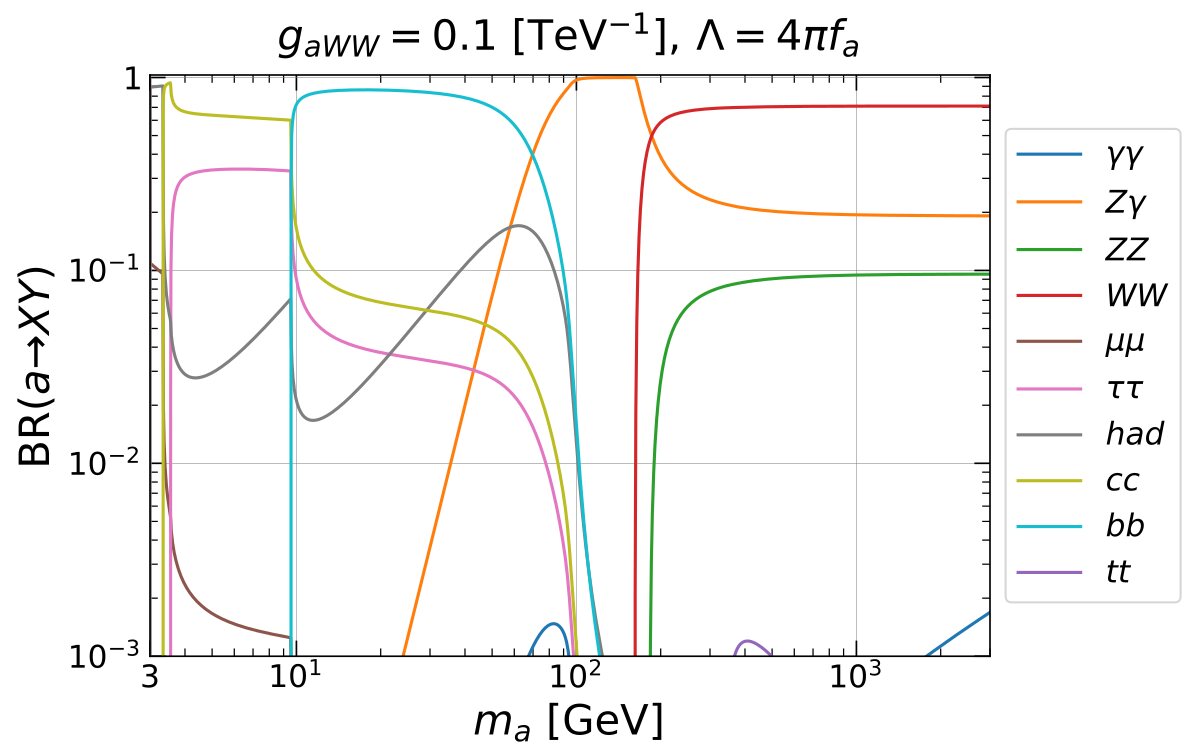
But an ALP does not have to couple to photons. In a photophobic ALP, the coupling to two photons is strongly suppressed, while couplings to the electroweak gauge bosons W, Z and the photon-mixing Zγ can remain sizable. That makes it nearly invisible to the standard diphoton searches — and it means the best way to look for it is through final states with several electroweak bosons.
Previous work had studied this idea for ALP masses up to about 100 GeV. Heavier photophobic ALPs had hardly been tested at all.
What the paper does
The authors take three existing LHC Run-II analyses and reinterpret them for the photophobic ALP:
- CMS search for WWW production — a multi-boson final state with same-sign lepton pairs, sensitive to ALPs decaying into W pairs.
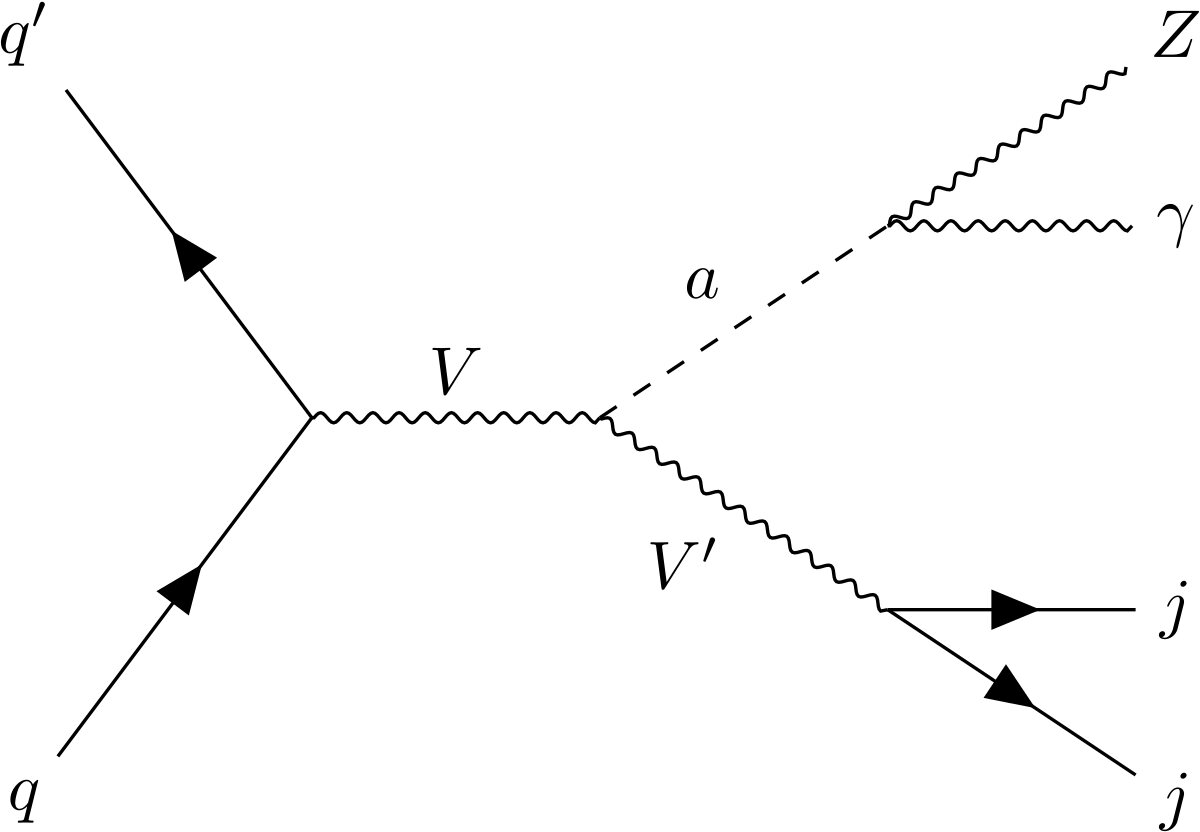
- ATLAS search for Z(→νν)γ + jets — a mono-Z-like signature with missing energy, where the ALP is produced on-shell together with two jets and decays into Zγ.
- ATLAS resonance search for Z(→ℓ⁺ℓ⁻)γ — a fully reconstructible Zγ resonance, using both leptons from the Z decay.
For each analysis, the team computes how many ALP signal events the search would have seen for a given ALP–W coupling, and compares that with the observed limits. Because the ALP is produced on-shell, the signal rate grows quadratically with the coupling — which lets the data be turned directly into an upper bound on the coupling strength as a function of the ALP mass.
What they found
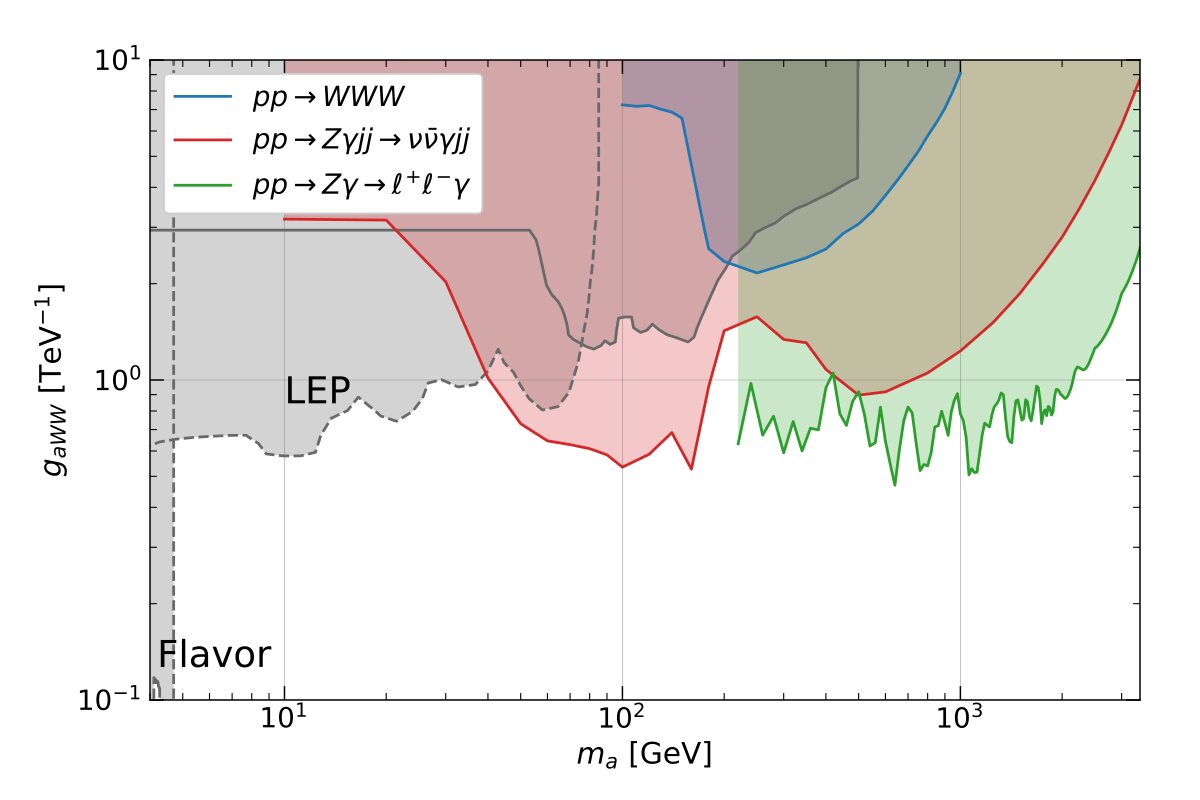
40–220 GeV: look with Z→νν
The ATLAS Z(→νν)γ+jets search gives the tightest bound in this mass window, beating the multi-W search.
220–3400 GeV: look with Z→ℓℓ
For heavier ALPs, the clean Z(→ℓ⁺ℓ⁻)γ resonance search is the most sensitive, extending the reach far beyond previous constraints.
Old bounds pushed aside
In the region above ~100 GeV, the new constraints improve dramatically over earlier LHC results, closing most of the gap in the parameter space.
Gluon coupling helps
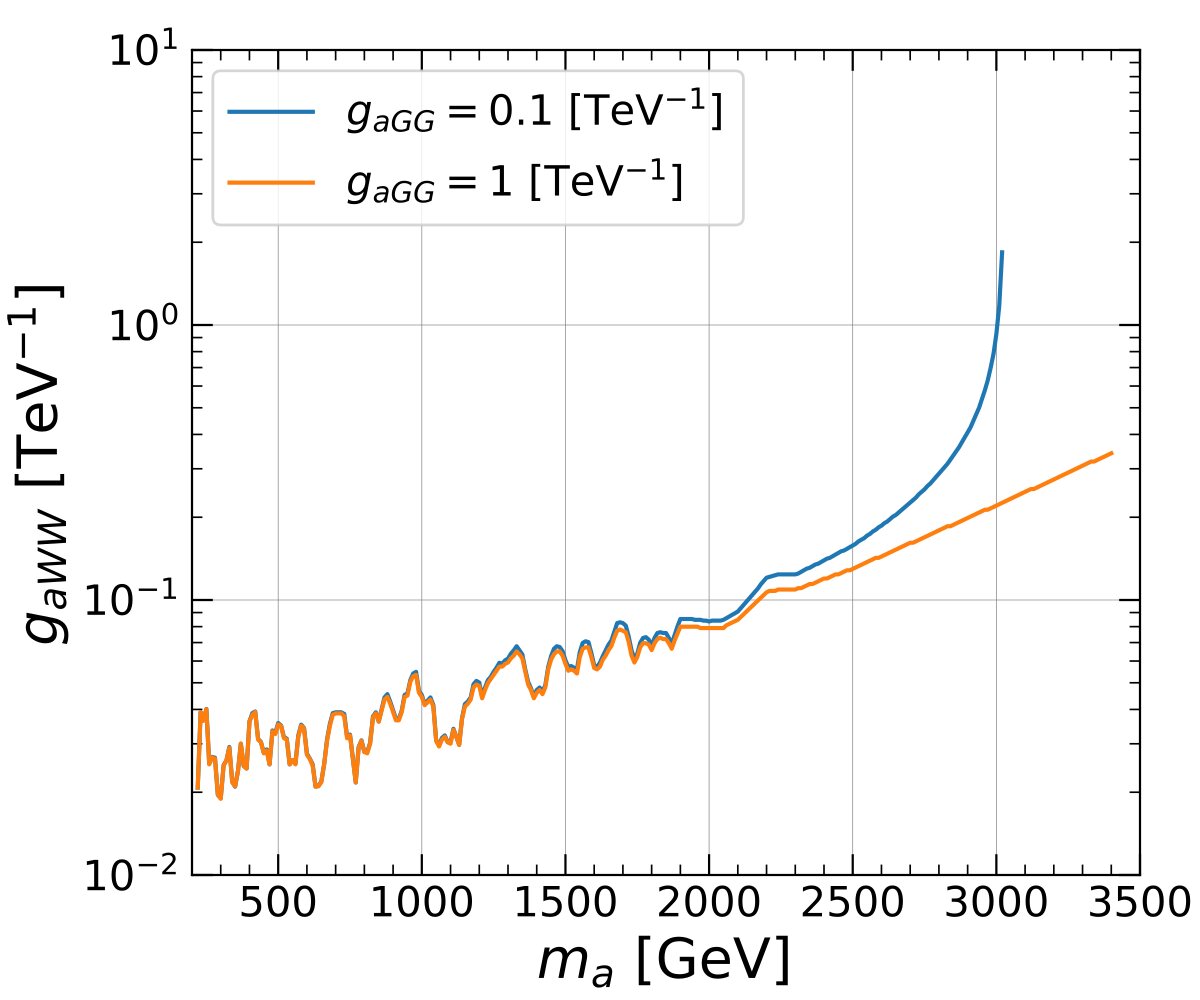
If the ALP also couples to gluons, it is produced copiously in gluon fusion. A larger gluon coupling then strengthens the neutrino-channel limits at high masses.
In one line: LHC multi-boson data already constrain photophobic ALPs up to masses of about 3.4 TeV — a region where diphoton searches are blind.
Why it matters
Searches for new particles tend to assume the new particle leaves a particular fingerprint, and the diphoton channel is the classic fingerprint for axion-like particles. This work shows that a whole class of “hidden” heavy ALPs can be tested with data that already exists — no new experiment needed — simply by asking the right question of LHC events with Z, W and photon final states. As the LHC accumulates more data, the same strategy will reach further into the mass range.
Key concepts
- Axion-like particle (ALP)
- A light, neutral pseudoscalar boson predicted in many extensions of the Standard Model, usually coupled to photons and other gauge bosons.
- Photophobic
- Literally “light-fearing”: an ALP whose coupling to two photons is strongly suppressed, so it evades diphoton searches.
- On-shell production
- A process in which the intermediate particle (here the ALP) is a real, physical particle rather than a virtual fluctuation — its rate grows quadratically with the coupling, making it the dominant production mechanism.
- Reinterpretation
- Taking the published results of an existing experimental search and recasting them for a different theoretical model, without redoing the experiment.
Citation
Masashi Aiko, Motoi Endo, Kåre Fridell, Heavy photophobic ALP at the LHC, Journal of High Energy Physics 06 (2024) 194. arXiv:2401.13323 [hep-ph] · doi:10.1007/JHEP06(2024)194. Figures reproduced from the paper; this page is a plain-language summary and any simplification is the fault of the summary, not the authors.