2022 · Snowmass 2021 white paper · Preprint
New Ideas in Baryogenesis: A Snowmass White Paper
The Standard Model cannot explain why the Universe contains more matter than antimatter. This community white paper, written for the Snowmass 2021 planning process, surveys thirteen new mechanisms that could generate the missing asymmetry — many of them at energies low enough to be tested — and seven proposals for how upcoming experiments, from the LHC and neutrino detectors to neutron-oscillation and gravitational-wave searches, can probe them.
Community white paper: G. Elor, J. Harz, S. Ipek, B. Shakya et al. (24 authors including Kåre Fridell), New Ideas in Baryogenesis: A Snowmass White Paper, contribution to Snowmass 2021 (2022). arXiv:2203.05010 [hep-ph]
Background: the missing antimatter
Measurements of the cosmic microwave background and of Big Bang nucleosynthesis agree: for every photon in the Universe there are about (6.10 ± 0.4) × 10−10 more baryons (protons and neutrons) than antibaryons. That tiny excess is why galaxies, stars and people exist at all — and why, after inflation, it must have been generated dynamically rather than inherited from earlier times.
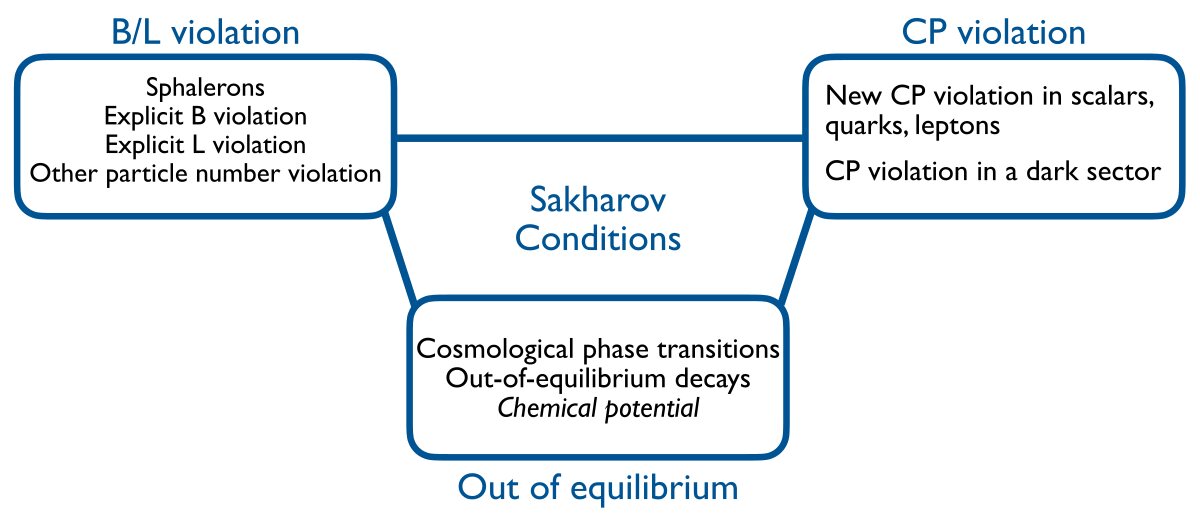
In 1967 Andrei Sakharov showed what any such mechanism needs. Three conditions must be met: (i) baryon number must be violated, (ii) C and CP symmetry must be violated (particles and antiparticles must behave differently), and (iii) the process must happen out of thermal equilibrium. The Standard Model fails on all counts: its CP violation in the quark sector is orders of magnitude too small, it has no suitable out-of-equilibrium process, and its baryon-number-violating “sphaleron” processes are efficient only above about 130 GeV, when the electroweak symmetry was restored. Something beyond the Standard Model is required.
What the paper does
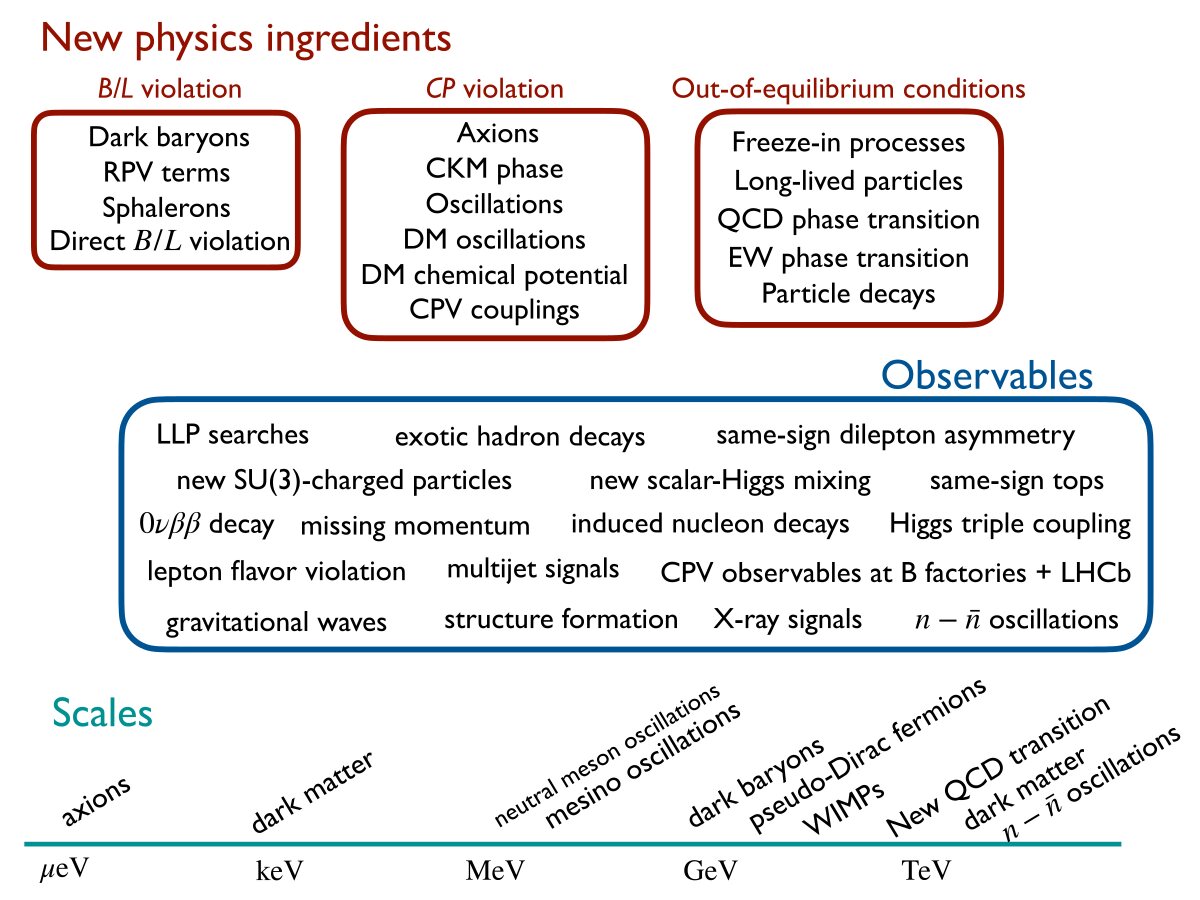
This is not a single-result paper but a community report, solicited from the TF08 topical group for the Snowmass 2021 particle-physics planning exercise. It has two halves. Section 2 collects thirteen baryogenesis mechanisms proposed in the preceding decade, each contributed by researchers who work on it, with an emphasis on experimental consequences. Section 3 presents seven new proposals for testing more traditional mechanisms — leptogenesis and Affleck–Dine baryogenesis among them — that were long thought to lie beyond experimental reach.
Kåre Fridell is one of the 24 co-authors. His contribution, with Julia Harz, Chandan Hati and Bibhushan Shakya, is section 3.2 on probing high-scale baryogenesis with neutron–antineutron oscillations (described below).
Inside the new mechanisms
The thirteen models differ widely, but the trend is clear: modern baryogenesis does not have to live at inaccessible energies. A few examples from the survey:
- Axiogenesis — the rotation of a cosmological axion field generates the baryon asymmetry, while the same dynamics accounts for the dark matter.
- Wash-in leptogenesis — CP violation and B–L violation need not happen at the same time; right-handed neutrinos can reprocess a primordial charge asymmetry created at much higher temperatures.
- WIMP-triggered baryogenesis — the freeze-out of weakly interacting dark matter supplies the required out-of-equilibrium condition.
- Hylogenesis and darkogenesis — an asymmetry is first produced in a dark sector and shared with ordinary matter; the closeness of the dark and visible energy densities Ωc ≈ 5 Ωb may then have a common origin.
- Particle–antiparticle oscillations — pseudo-Dirac fermions, mesinos and mesons that oscillate and decay can create CP violation and an asymmetry at remarkably low temperatures.
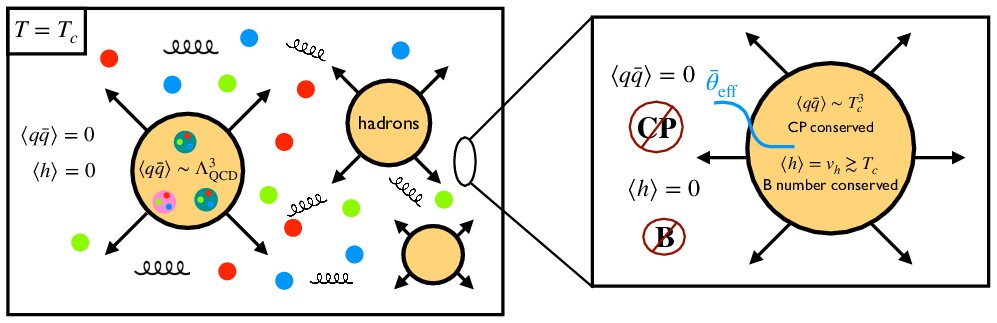
- QCD baryogenesis — a new scalar can change the QCD confinement scale itself, turning the strong-interaction transition into a first-order event at hundreds of GeV where baryon-number violation switches off inside expanding bubbles.
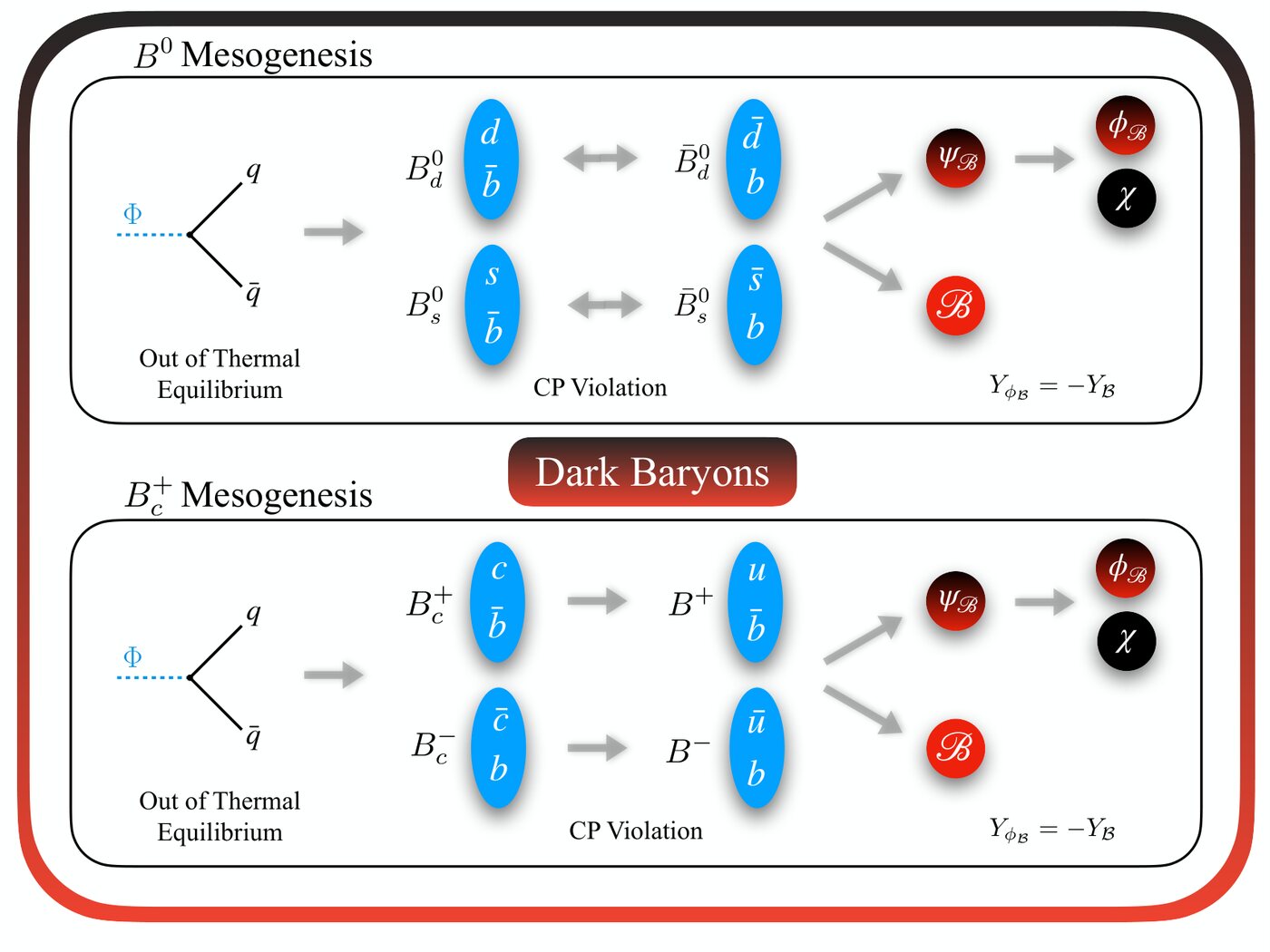
Mesogenesis is the most dramatic example of low-scale baryogenesis in the survey. A scalar of 10–100 GeV decays into quark–antiquark pairs after the Universe has cooled to MeV temperatures, between Big Bang nucleosynthesis and the QCD transition. The resulting mesons oscillate or decay with CP violation out of equilibrium, and the daughter mesons decay into a new dark baryon plus ordinary matter. Baryon number is never violated overall: the new dark state carries baryon number −1, so the visible and dark sectors end up with equal and opposite asymmetries — matter and dark matter made together.
New ways to test old ideas
The second half of the white paper turns to mechanisms that predate the recent wave of ideas. Section 3.2, contributed by Kåre Fridell and collaborators, argues that neutron–antineutron oscillations are a sharp probe of high-scale baryogenesis. A free neutron can in principle turn into an antineutron — a change of baryon number by two units — and experiments have not seen it. Current limits are a lifetime longer than 0.86 × 10⁸ s for free oscillations and longer than 4.7 × 10⁸ s for neutrons bound in nuclei, the latter from Super-Kamiokande.
The upcoming NNBAR experiment at the European Spallation Source and the DUNE neutrino programme will improve these limits by orders of magnitude. The section shows that a discovery would have striking consequences: the same new physics would have kept washout processes in equilibrium down to about 100 TeV, so the observed baryon asymmetry must then have been generated below that scale — within reach of a future 100 TeV collider. In models where neutron–antineutron oscillations are mediated by two new bosons and a heavy Majorana fermion, projected experiments can probe new particle masses across roughly 1–1000 TeV; in diquark models, a signal with diquark masses below a few hundred TeV would rule out baryogenesis dominated by very strong washout even with maximal CP violation.
Other testing proposals in the white paper include: probing Affleck–Dine baryogenesis through secondary gravitational waves emitted when its long-lived Q-ball remnants decay; using neutrinoless double-beta decay, rare meson decays and same-sign dileptons at colliders to test TeV-scale lepton-number violation; searching for imprints of leptogenesis in the sky through cosmological collider physics, where inflation supplies collision energies up to about 1013 GeV; gravitational waves from cosmic strings, which future detectors could use to probe the entire range of thermal leptogenesis; vacuum-stability constraints on the minimal leptogenesis scenario; and gravitational-wave and Higgs-coupling tests of first-order phase transitions — the Higgs sector would have to be modified to produce one, since with a 125 GeV Higgs the Standard Model transition is a smooth crossover, leaving no out-of-equilibrium stage for electroweak baryogenesis.
What they found
One number to explain
The baryon-to-photon ratio is (6.10 ± 0.4) × 10−10, measured at Big Bang nucleosynthesis and in the cosmic microwave background. Any successful mechanism must reproduce it.
The Standard Model falls short
Sphalerons violate baryon number efficiently above T ≳ 130 GeV, but quark CP violation is orders of magnitude too small and no Standard Model process leaves thermal equilibrium.
Baryogenesis can be low-scale
Mesogenesis works at MeV temperatures with a mediating scalar of 10–100 GeV; mesino-oscillation models can generate the asymmetry at temperatures as low as the QCD scale, 1–200 MeV.
Neutron oscillations: not yet seen
Current limits: free neutron–antineutron oscillation lifetime above 0.86 × 10⁸ s; bound neutrons (Super-Kamiokande) above 4.7 × 10⁸ s. NNBAR and DUNE will improve these by orders of magnitude.
A discovery would corner new physics
An observed neutron–antineutron oscillation would imply washout remains effective up to about 100 TeV, so baryogenesis must occur below 100 TeV — and the responsible particles could then be found at a future 100 TeV collider.
Mass ranges in reach
In the Majorana-fermion realisation, neutron-oscillation experiments probe new masses of 1–1000 TeV (10–1000 TeV for one variant); diquarks below a few hundred TeV would be excluded by a signal even with maximal CP violation.
In one line: New ideas have pulled baryogenesis down from inaccessible energies — the white paper maps the mechanisms and shows how colliders, neutrino experiments, neutron-oscillation searches, dark-matter probes and gravitational-wave detectors can each test part of the story.
Why it matters
For decades the origin of the matter–antimatter asymmetry looked like a problem that particle physics might never be able to test: the classic mechanisms operate at energies far beyond any experiment. This white paper documents a change of mood. Many new mechanisms generate the asymmetry at low scales, and because they typically touch dark matter, collider physics, flavour physics and cosmology at once, they come with multiple experimental handles. The neutron–antineutron chapter is a case study in that logic: a tabletop-scale oscillation search can reach 100 TeV physics and tell us when in cosmic history the Universe chose matter over antimatter.
Key concepts
- Baryon asymmetry of the Universe
- The observed excess of matter over antimatter — about 6 × 10⁻¹⁰ baryons per photon. Baryogenesis is the general name for mechanisms that create it after inflation.
- Sakharov conditions
- The three requirements for generating a matter–antimatter asymmetry: violation of baryon number, violation of C and CP symmetry, and a departure from thermal equilibrium.
- CP violation
- A difference in the behaviour of particles and their antiparticles (up to a mirror reflection). Without it, a process and its antiparticle version would proceed at exactly the same rate.
- Sphaleron
- A collective process of the weak interactions that can change baryon number. It is negligible today but fast in the hot early Universe, above roughly 130 GeV.
- Washout
- Processes that erase an existing asymmetry — for example, interactions that turn baryons back into antimatter, or vice versa. A successful mechanism must outrun them.
- Neutron–antineutron oscillation
- A hypothetical transformation of a neutron into an antineutron, changing baryon number by two units. Not yet observed; the best current limits come from reactor experiments and Super-Kamiokande.
Citation
Gilly Elor, Julia Harz, Seyda Ipek, Bibhushan Shakya, Nikita Blinov, Raymond T. Co, Yanou Cui, Arnab Dasgupta, Hooman Davoudiasl, Fatemeh Elahi, Kåre Fridell, Akshay Ghalsasi, Keisuke Harigaya, Chandan Hati, Peisi Huang, Azadeh Maleknejad, Robert McGehee, David E. Morrissey, Kai Schmitz, Michael Shamma, Brian Shuve, David Tucker-Smith, Jorinde van de Vis, Graham White, New Ideas in Baryogenesis: A Snowmass White Paper, contribution to Snowmass 2021, 2022. arXiv:2203.05010 [hep-ph] · INSPIRE record. Figures reproduced from the paper; this page is a plain-language summary and any simplification is the fault of the summary, not the authors.