2022 · Journal of Physics: Conference Series · Open access conference proceedings
Transition neutrino magnetic moments in CEνNS
Coherent elastic neutrino–nucleus scattering (CEνNS) turns a humble neutrino bounce into a new-physics search. This short conference proceedings shows how a transition magnetic moment — a coupling that lets an active neutrino turn into a sterile partner and emit a photon — could show up in the NUCLEUS experiment, and argues that the photon signal would reveal properties of the sterile neutrino itself.
Published in: P. D. Bolton, F. F. Deppisch, K. Fridell, J. Harz, C. Hati, S. Kulkarni, Transition neutrino magnetic moments in CEνNS, Journal of Physics: Conference Series 2156 (2022) 012218, proceedings of the 17th International Conference on Topics in Astroparticle and Underground Physics (TAUP 2021). doi:10.1088/1742-6596/2156/1/012218 · free PDF via INSPIRE
This is a short 4-page conference contribution. The full analysis lives in the companion paper, Probing active-sterile neutrino transition magnetic moments with photon emission from CEνNS (Phys. Rev. D 106 (2022) 035036) — follow the link for the details.
Background: a bounce that is easy to miss
Coherent elastic neutrino–nucleus scattering (CEνNS) is what happens when a neutrino strikes an entire atomic nucleus at once, without breaking it apart. The nucleus recoils with a tiny amount of energy — in the keV range — which is exactly what made the process so hard to see. It was first observed by the COHERENT experiment in 2017, and the near-future NUCLEUS experiment at the Chooz nuclear site in France aims to reach sensitivity to nuclear recoils as small as about 10 eV.
Now that the process itself is established — it is predicted by the Standard Model — the interest has shifted to using it as a tool: to pin down neutrino oscillation parameters or to hunt for physics beyond the Standard Model. One such possibility is an enhanced neutrino magnetic moment, a coupling between neutrinos and photons that opens an extra interaction channel between neutrinos and nuclei and would enhance the CEνNS signal.
What the paper does
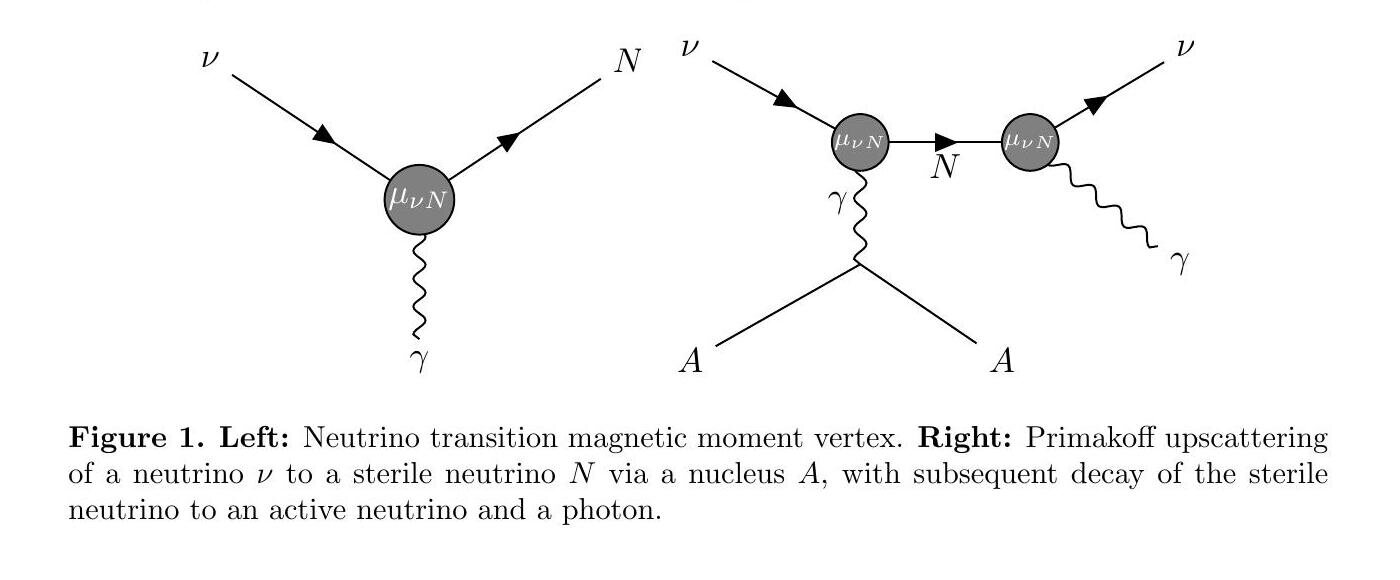
The novel ingredient here is that one of the two fermions in the magnetic-moment vertex can be a sterile neutrino N — a hypothetical heavy partner that does not feel the weak force and can be either Dirac or Majorana. Instead of the usual magnetic moment connecting two active neutrinos, this is a transition magnetic moment μνN connecting an active neutrino to the sterile one. In the language of effective field theory it is a dimension-5 operator, and it can be completed into a full renormalisable model, for example an inverse seesaw. If the sterile neutrino is a Majorana particle, the same vertex also feeds a radiative mass term for the active neutrinos — a possible explanation of where their masses come from.
A transition magnetic moment lets a neutrino upscatter off a nucleus into the sterile state (a process called Primakoff upscattering). If the sterile neutrino is heavy enough, it decays back into an active neutrino and a photon. The proceedings lays out a concrete search strategy: place a photon detector a distance l0 downstream of the CEνNS target, so that sterile neutrinos decaying inside the set-up emit a photon that can be detected. The decay probability is captured by an effective width ΓN ∝ 1/l0 — longer distances generally mean a larger fraction of sterile neutrinos producing a signal. If the nuclear recoil is recorded too, the photon and the recoil are coincident, giving a clean signature with efficient background rejection.
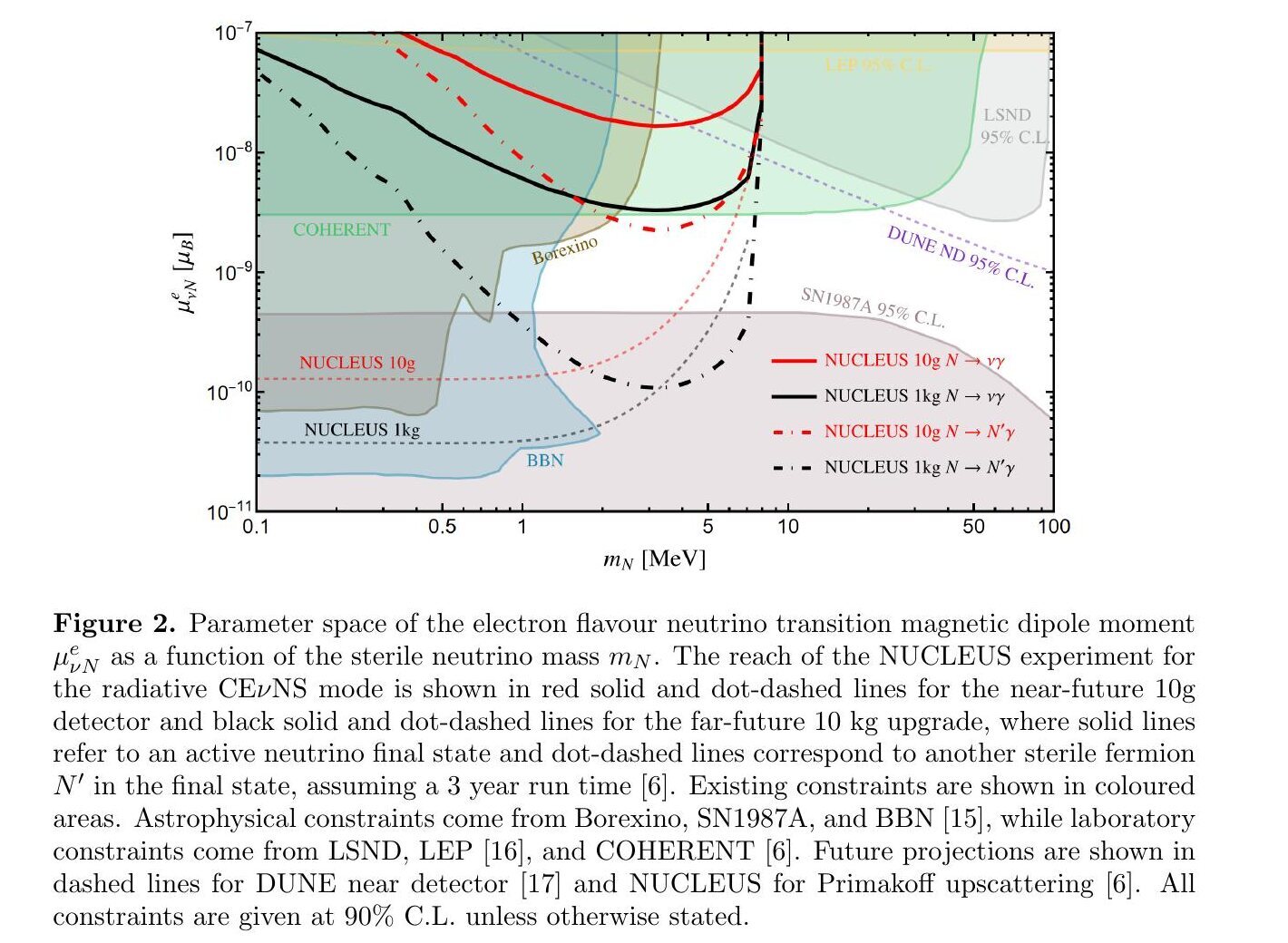
The relevant coupling depends on neutrino flavour. Reactors — like the one feeding NUCLEUS — produce electron-flavour antineutrinos, so this proceedings focuses on the electron-flavour coupling μeνN, comparing the NUCLEUS projections with astrophysical limits (Borexino, SN1987A, BBN) and laboratory limits (LSND, LEP, COHERENT), as well as future projections from the DUNE near detector.
What they found
The photon channel is a details detector
The projected NUCLEUS reach for the radiative mode (photon detection, active neutrino in the final state) lies within the region already excluded by COHERENT. So the point of the photon search is not to break new ground on the magnetic moment, but to reconstruct the details of a possible Primakoff signal.
Two couplings versus one
COHERENT's exclusion assumes the magnetic moment shows up as a deviation in the standard CEνNS recoil signal — one magnetic-moment vertex. The radiative mode involves two such vertices, upscattering and decay, which is why its projected line is weaker in the parameter space.
Primakoff search reaches new ground
The recoil-only Primakoff upscattering limit expected from the near-future and far-future NUCLEUS lies well within parameter space that is still unconstrained, so that channel is where new territory is won.
MeV-scale sterile neutrinos
The improved sensitivity of NUCLEUS will let sterile neutrinos with MeV-scale masses be probed in regions of parameter space that are so far unconstrained.
More than one decay channel
In the radiative mode the sterile neutrino need not decay to an electron-flavour neutrino; other final-state sterile fermions N′ are possible, which could enhance the experimental reach further.
Coincidence beats background
Requiring a final-state photon together with a nuclear recoil in the target reduces backgrounds and helps identify which process produced the signals.
In one line: A transition magnetic moment lets CEνNS experiments look for a sterile neutrino through a recoil-plus-photon coincidence; for the NUCLEUS experiment the radiative signal is expected inside already-excluded territory, making it a tool to deduce the sterile neutrino's properties rather than to push the exclusion frontier.
Why it matters
CEνNS experiments are new, and this proceedings argues that their potential is largely still untapped. The radiative channel adds a powerful consistency check: a photon and a nuclear recoil arriving together would be difficult to fake, and the properties of that photon carry information about the sterile neutrino behind it. Meanwhile, the simpler recoil-only search projects into genuinely unconstrained region for MeV-scale sterile neutrinos, where the magnetic moment could also be linked to the origin of the active neutrino masses. The next generation of CEνNS experiments will be crucial in developing this relatively new search mode.
Key concepts
- CEνNS (coherent elastic neutrino–nucleus scattering)
- A neutrino hitting a whole nucleus at once and making it recoil gently, without breaking it apart. The larger “target” makes the interaction more likely, but the tiny recoil energy makes it hard to detect.
- Transition magnetic moment
- A coupling between a photon and two different neutrino states — here an active neutrino and a sterile neutrino — which lets one turn into the other while emitting or absorbing a photon.
- Sterile neutrino
- A hypothetical heavy neutrino that does not feel the weak force and therefore barely interacts. It could mix with the known neutrinos and take part in generating their masses.
- Primakoff upscattering
- Converting a light neutrino into a heavier sterile one by scattering it off the electric field of a nucleus. The nucleus recoils; the sterile neutrino can later decay back.
- Nuclear recoil
- The small kick a nucleus receives when a neutrino bounces off it — the primary signal CEνNS experiments look for.
- Coincidence signal
- Two signals seen together in time — here a photon and a nuclear recoil — which strongly reduces background because random events rarely line up.
Citation
Patrick D. Bolton, Frank F. Deppisch, Kåre Fridell, Julia Harz, Chandan Hati, Suchita Kulkarni, Transition neutrino magnetic moments in CEνNS, Journal of Physics: Conference Series 2156 (2022) 012218, proceedings of the 17th International Conference on Topics in Astroparticle and Underground Physics (TAUP 2021). doi:10.1088/1742-6596/2156/1/012218 · free PDF via INSPIRE. Published open access under a Creative Commons Attribution 3.0 licence. Figures reproduced from the paper; this page is a plain-language summary and any simplification is the fault of the summary, not the authors.