2023 · Journal of High Energy Physics · Open access
Lepton flavor physics at μ⁺μ⁺ colliders
Future muon colliders could collide two antimuons (μ⁺μ⁺) instead of a muon–antimuon pair. This paper shows that a 2 TeV μ⁺μ⁺ collider with 1 ab⁻¹ of data could produce well over a hundred μ⁺μ⁺ → μ⁺τ⁺ events — a process that changes lepton flavor and is forbidden in the Standard Model — while still respecting every existing bound from rare muon and tau decays. In the type-II seesaw model the size and pattern of those events would directly reflect the neutrino mass matrix, including its CP-violating phases.
Published in: Kåre Fridell, Ryuichiro Kitano, Ryoto Takai, Lepton flavor physics at μ⁺μ⁺ colliders, JHEP 06 (2023) 086. doi:10.1007/JHEP06(2023)086 · free preprint on arXiv
Background: why μ⁺μ⁺, and why lepton flavor?
A muon collider would collide muons rather than protons, giving a much cleaner environment and multi-TeV energies in a relatively small machine. It is usually imagined as μ⁺μ⁻ (particle–antiparticle), but a μ⁺μ⁺ collider — two beams of the same positively charged antimuons — may be easier to build first. The technology for a dense, low-emittance μ⁺ beam from laser-ionized muonium is already used in the muon g−2 experiment at J-PARC, and a polarized μ⁺ beam would add extra handles for identifying new physics.
The Standard Model conserves lepton flavor: a muon never turns into a tau. Any observation of lepton flavor violation (LFV) would be a clean sign of new physics. So far LFV has only been constrained, never seen: experiments at PSI have watched about 10¹³ muons, and B factories about 10⁸ taus. Those rare-decay searches already push the scale of possible new LFV interactions to roughly 100 TeV (muon decays) and 10 TeV (tau decays). A high-energy collider can probe the same interactions directly, through scattering such as μ⁺μ⁺ → μ⁺τ⁺.
What the paper does
- Model-independent operators. The authors write the most general dimension-six four-fermion interactions among charged leptons and compute the rate of μ⁺μ⁺ → μ⁺τ⁺, comparing it with the same operator's contribution to rare decays like τ → 3μ and μ → 3e. The two beams are both μ⁺, so the process needs no annihilation — it is a clean, low-background signature with two same-sign charged leptons, one of them tagged as a τ.
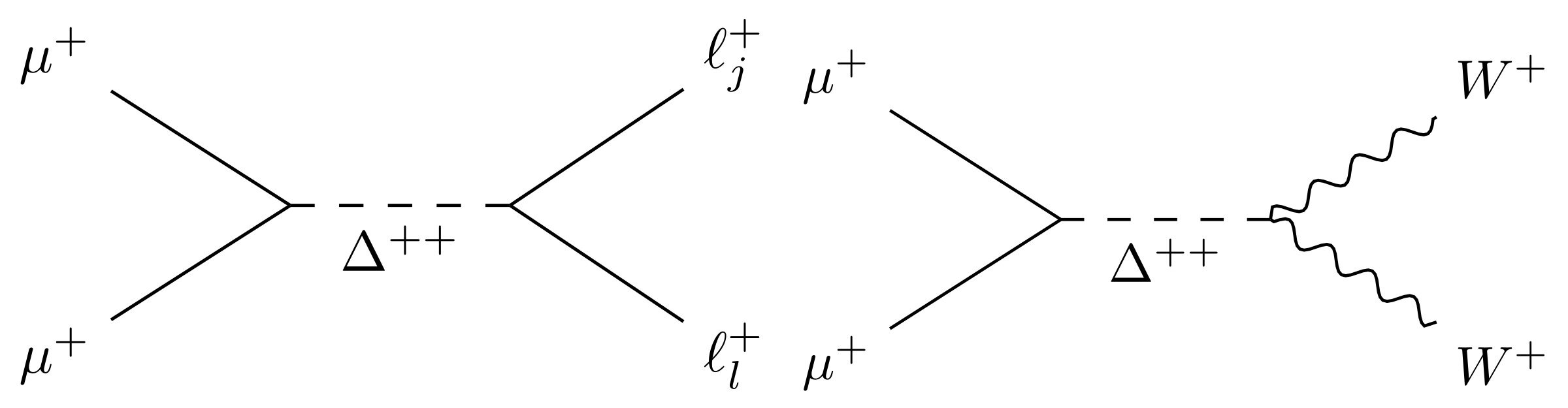
- A concrete model. They then work in the type-II seesaw model, in which neutrino masses come from a Higgs triplet containing a doubly charged scalar, Δ⁺⁺. This particle can be exchanged in the μ⁺μ⁺ → ℓ⁺ℓ⁺ channel, and its couplings are tied directly to the neutrino mass matrix.
- Collider vs. neutrino data. Finally they study the flavor-conserving process μ⁺μ⁺ → μ⁺μ⁺ (elastic scattering) and the ratios of different LFV final states, showing how a collider measurement could be cross-checked against neutrino oscillation data.
What they found
Over a hundred events, within the rules
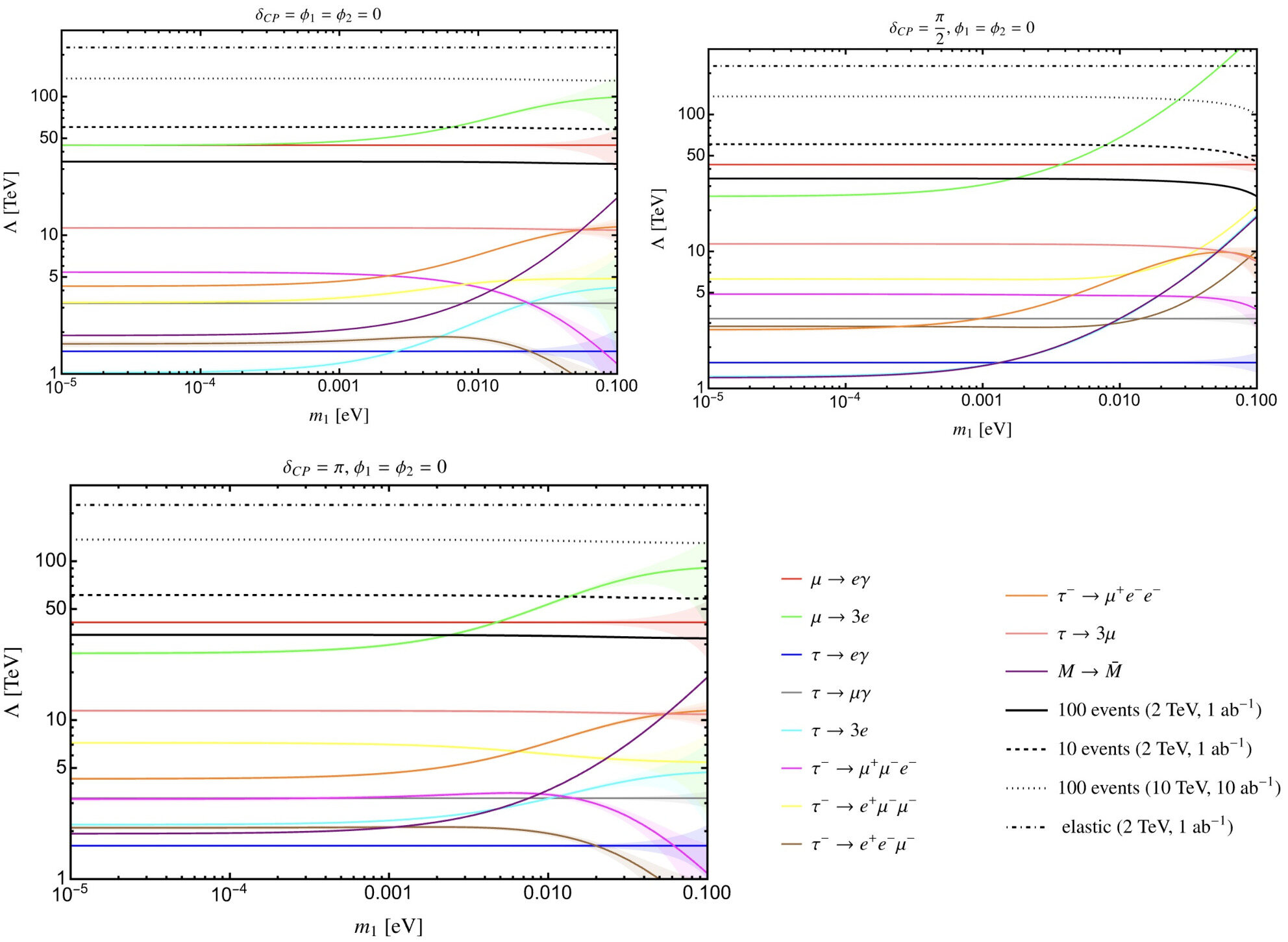
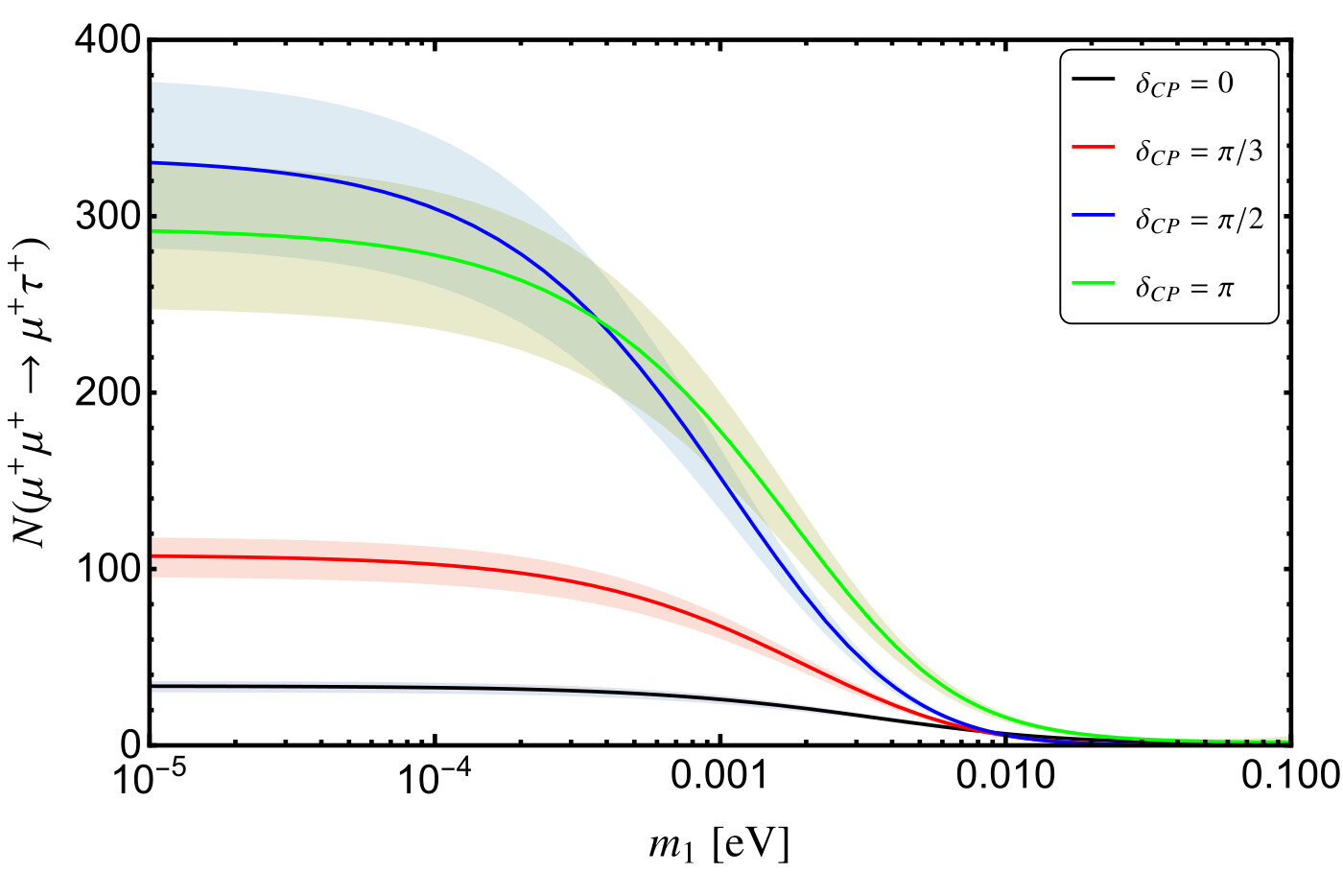
With μ⁺μ⁺ → μ⁺τ⁺ mediated by the new interactions, a 2 TeV collider with 1 ab⁻¹ can see more than 100 events while the μ → 3e branching ratio stays right at its experimental bound. The number swings with the CP phase δCP: about 30 events if δCP = 0, rising to a few hundred around δCP = π/2.
7900 vs 130 events
If the new operators couple with no flavor hierarchy, the current Belle bound on τ → 3μ would allow as many as 7.9×10³ events at 2 TeV and 1 ab⁻¹. Even Belle II's projected sensitivity of 3.5×10⁻¹⁰ would leave about 130 events — still plenty to discover.
A ≈30 TeV microscope
For hierarchical neutrino masses and no CP violation, the 2 TeV collider probes new-physics scales of order 30 TeV (Λ = 34 TeV in the reference case) — comparable to the ≈45 TeV reach of the μ → eγ and μ → 3e experiments. At 10 TeV with 10 ab⁻¹ the event numbers grow 250-fold, and the collider beats all existing rare-decay bounds over almost the whole range of the lightest neutrino mass.
Elastic scattering reaches even further
The flavor-conserving process μ⁺μ⁺ → μ⁺μ⁺ interferes with the Standard Model, so its rate responds linearly to the new coupling. Using its angular distribution, the reach is Λelastic > 187 TeV at 90% confidence for 1 ab⁻¹ — corresponding to Λ > 225 TeV, far beyond the LFV channels.
Ratios read the neutrino mass matrix
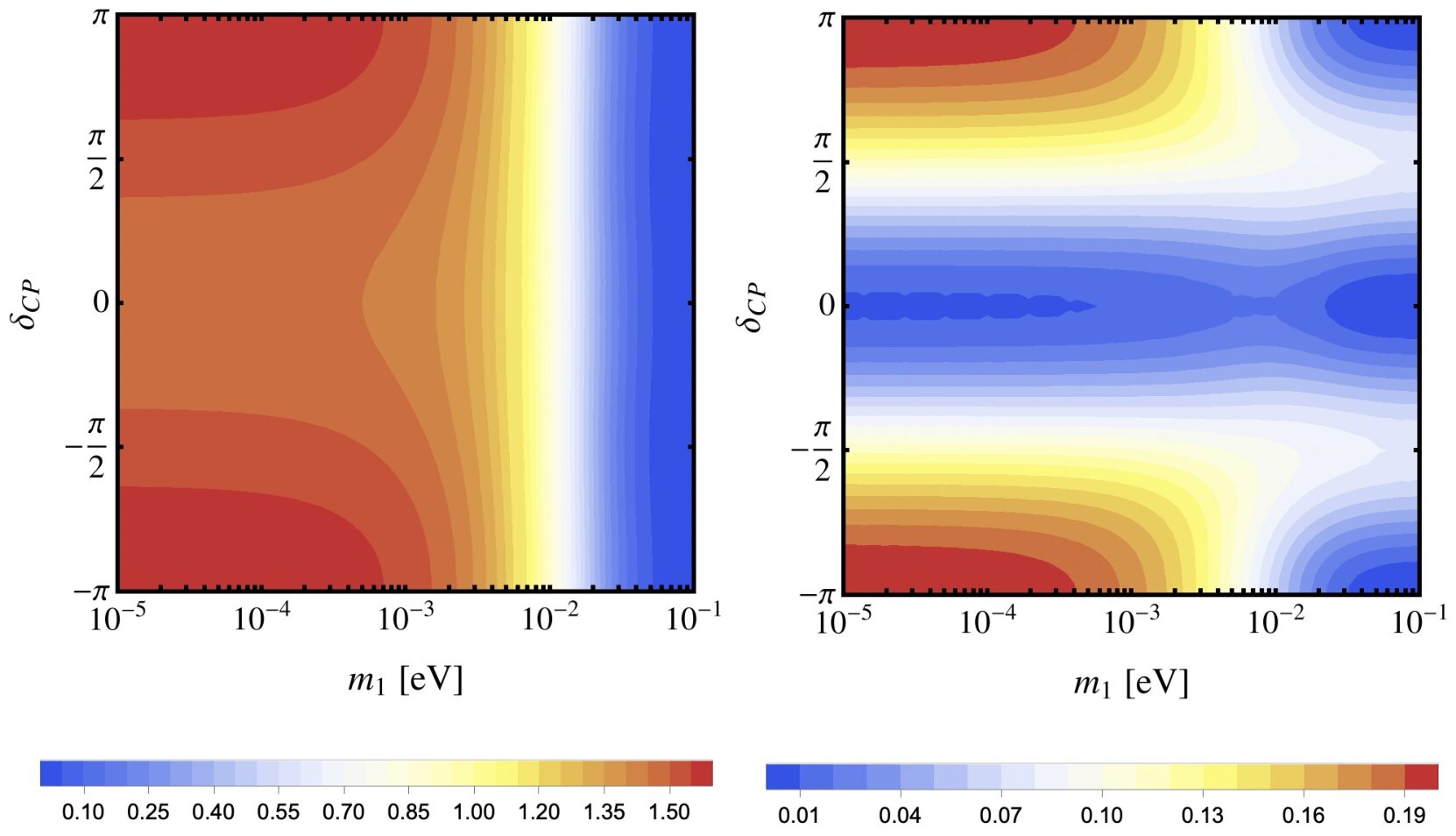
In the type-II seesaw the ratios 2|mμτ/mττ|² and 2|meτ/mττ|² involve no free parameters. The e⁺τ⁺ channel depends strongly on δCP, the μ⁺τ⁺ channel mostly on the lightest neutrino mass, and both depend on the Majorana phase φ₂. Today's mixing-angle uncertainties translate into 30–50% uncertainties on these predictions.
In one line: A future 2 TeV μ⁺μ⁺ collider with 1 ab⁻¹ could discover lepton flavor violation in μ⁺μ⁺ → μ⁺τ⁺ with a few hundred events — even under the strictest rare-decay bounds — and the pattern of events would carry information about neutrino masses and CP violation.
Why it matters
Lepton flavor violation is one of the sharpest possible signs of physics beyond the Standard Model, and it is currently hunted only through rare decays. This paper shows that the two approaches are complementary: which one wins depends on how the new interactions are arranged among the three lepton families. If new physics prefers heavy flavors — as it does in the type-II seesaw, where the mixing follows the neutrino mass matrix — a muon collider can see events that rare-decay experiments cannot reach, and vice versa.
If such events were observed, their ratios would not just be numbers: in the type-II seesaw they are fixed by the very same mass matrix that generates neutrino masses. Comparing collider ratios with neutrino oscillation data could therefore help reveal the origin of neutrino masses and test whether CP violation in the neutrino sector leaves a trace in charged-lepton processes. The μ⁺μ⁺ option also matters practically: same-sign muon beams could be built with established J-PARC technology and can be polarized, features that may bring such a machine sooner.
Key concepts
- Lepton flavor violation (LFV)
- A process in which one charged-lepton family turns into another — for example a muon into a tau. The Standard Model forbids this, so any observation would be new physics.
- μ⁺μ⁺ collider
- A hypothetical collider of two same-sign antimuon beams. Because there is no particle–antiparticle annihilation, a doubly charged particle such as Δ⁺⁺ can be produced directly in the collision.
- Effective operator and scale Λ
- When new particles are too heavy to produce directly, their effects can be written as contact interactions suppressed by powers of a scale Λ — the higher Λ is, the weaker and harder to see the effect.
- Type-II seesaw model
- A model that gives neutrinos mass through a Higgs triplet, introducing a doubly charged scalar Δ⁺⁺ whose couplings to leptons are proportional to the neutrino mass matrix.
- Integrated luminosity (ab⁻¹)
- A measure of how much data a collider has collected: 1 ab⁻¹ is 10⁴² collisions per square centimetre. More luminosity means more events and better sensitivity.
- CP-violating phases
- Extra angles in the neutrino mixing matrix (one Dirac phase δCP and two Majorana phases) that make neutrinos and antineutrinos behave differently — and, as this paper shows, also change LFV event rates.
- Elastic scattering interference
- In μ⁺μ⁺ → μ⁺μ⁺ the new physics adds quantum-mechanically to the known Standard Model amplitude, so the signal grows linearly with the new coupling instead of quadratically — giving an especially long reach.
Citation
Kåre Fridell, Ryuichiro Kitano, Ryoto Takai, Lepton flavor physics at μ⁺μ⁺ colliders, Journal of High Energy Physics 06 (2023) 086. arXiv:2304.14020 [hep-ph] · doi:10.1007/JHEP06(2023)086. Figures reproduced from the paper, which is open access under CC BY 4.0; this page is a plain-language summary and any simplification is the fault of the summary, not the authors.