2021 · Proceedings of Science (ICHEP 2020) · Conference proceedings
Probing Baryogenesis using Neutron-Anti-Neutron Oscillation
A neutron quietly turning into its own antineutron would violate baryon number — one of the ingredients needed to explain why the Universe has matter left over. This short ICHEP 2020 contribution lays out the effective theory of neutron–antineutron oscillation, computes how efficiently the same interaction would erase a pre-existing matter–antimatter asymmetry in the early Universe, and finds that at new-physics scales around 106 GeV the washout stays strong up to temperatures close to 105 GeV — far above the electroweak scale.
Published in: K. Fridell, J. Harz, C. Hati, Probing Baryogenesis using Neutron-Anti-Neutron Oscillation, PoS ICHEP2020 (2021) 243. doi:10.22323/1.390.0243 · free to read on pos.sissa.it. This is the short conference write-up; the full analysis is the companion paper Probing baryogenesis with neutron-antineutron oscillations (JHEP 11 (2021) 185), where the baryogenesis models themselves are built and tested.
Background: a missing-antimatter problem and a flipping neutron
The Standard Model cannot explain why the Universe contains matter but almost no antimatter. To generate such an imbalance, Sakharov taught us, a theory needs three things: a process that violates baryon number (or, more precisely, the difference between baryon and lepton number), a difference between matter and antimatter (C and CP violation), and a departure from thermal equilibrium. In the Standard Model, sphaleron processes — collective rearrangements of the electroweak vacuum — violate the sum of baryon and lepton number, but that alone is not enough to explain the asymmetry. Additional sources of baryon- or lepton-number violation are needed, and there are only a handful of ways to test such violation in a laboratory: neutron–antineutron oscillation, dinucleon decay, neutrinoless double beta decay, and proton decay.
Neutron–antineutron oscillation (n–n̄) is the hypothetical conversion of a neutron into its antineutron. It changes baryon number by two units, |ΔB| = 2, and it cannot happen in the Standard Model. Experiments search for it in two ways: with neutrons bound inside nuclei (bound searches) and with free neutrons in a beam or bottle (free searches). The strongest current limits are τ ≥ 4.7 × 10⁸ s from the Super-Kamiokande bound search and τ ≥ 0.86 × 10⁸ s for free neutrons from the ILL experiment. Both are expected to improve: the DUNE experiment aims to reach about 7 × 10⁸ s for the bound search, while the NNBAR experiment at the European Spallation Source is expected to push the free-neutron limit to at least 3 × 10⁹ s.
The connection to baryogenesis is two-sided. Neutron–antineutron oscillation tells us about baryon-number violation only — by itself not enough to create the asymmetry, but in concrete models the same new particles can carry the other required ingredients. And a baryon-number-violating reaction that can produce an asymmetry can also destroy one: run in the wrong direction, it washes out an asymmetry that was generated earlier at higher temperatures. The paper studies this washout in the language of effective operators.
What the paper does
- Writes the effective theory of the oscillation. The new particles that mediate n–n̄ oscillation are assumed much heavier than the neutron, so their effect can be captured by six-quark operators of mass dimension nine, suppressed by powers of the new-physics scale Λ. Four such operators (O1, O2, O3, O5) have non-vanishing hadronic matrix elements, computed with lattice QCD, and together they determine the oscillation time.
- Runs the operators up to the new-physics scale. The oscillation happens at low energy, but the coefficients that encode new physics are defined at high energy. The authors evolve the operators from a low scale μ0 (between the bottom- and charm-quark masses) up to the new-physics scale μNP > mt with renormalisation group running, connecting the laboratory observable to physics at a possibly very high scale.
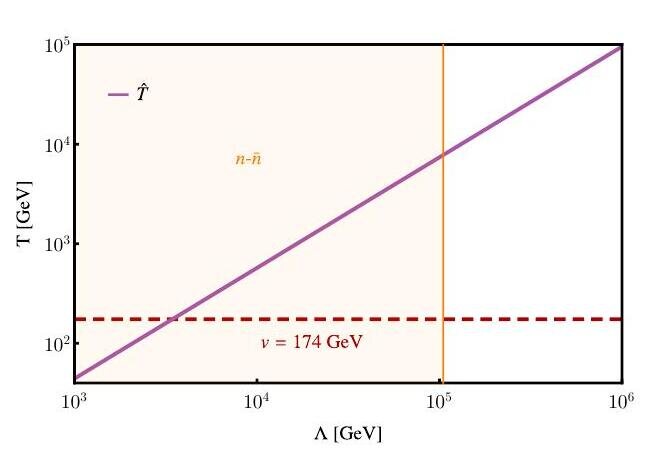
- Computes the washout with Boltzmann equations. A Boltzmann equation tracks how the baryon density evolves under the baryon-number-violating interaction. For operator O5 the equilibrium scattering rate scales as T14 and the washout rate as T11 — a dramatic growth with temperature. Comparing the washout rate with the expansion rate of the Universe defines a temperature T̂ above which the washout is strong.
- Points to the full analysis. Judging concrete high- and low-scale baryogenesis models requires the complete set of Boltzmann equations, including CP-violating decays of the new particles; the authors carry that out in the companion full paper (see the plain-language page).
What they found
A washout that grows violently with temperature
For operator O5, the scattering rate scales as T14 and the washout rate as T11. Weak though the interaction may be today, in the hot early Universe it was extremely efficient at destroying a baryon asymmetry.
Washout far above the electroweak scale
In figure 1 the washout temperature T̂ passes the electroweak scale (174 GeV) for new-physics scales already around a few × 103 GeV, and reaches nearly 105 GeV for Λ ≈ 106 GeV. Any asymmetry generated at higher temperatures would have been erased.
Today’s experiments already reach the interesting range
The orange band in figure 1 is the new-physics scale currently probed by the Super-Kamiokande limit, τ ≥ 4.7 × 10⁸ s. Upcoming searches go further: DUNE targets about 7 × 10⁸ s (bound) and NNBAR at ESS at least 3 × 10⁹ s (free).
Both a signal and a non-signal inform baryogenesis
A discovery would point to new physics tied to the matter–antimatter asymmetry; improved limits, conversely, would exclude baryogenesis models that predict an observable oscillation rate. Which models survive is worked out in the companion full paper.
In one line: the same baryon-number-violating interaction that could lie behind the matter–antimatter asymmetry would have washed it out up to temperatures far above the electroweak scale — and the new-physics scales that current and upcoming neutron–antineutron experiments probe sit right in that washout range.
Why it matters
Neutron–antineutron oscillation is one of the very few processes that can be tested both in a laboratory and against the origin of matter. As DUNE and the European Spallation Source’s NNBAR push the sensitivity to the oscillation time, the interpretation of a possible signal becomes urgent: depending on the new-physics scale, the same interaction may or may not have been able to erase an asymmetry generated early on. This proceedings sets up the effective theory and the Boltzmann-equation machinery for that interpretation; the companion full paper applies it to concrete baryogenesis models, showing how searches for the mediating particles at the LHC and oscillation experiments together can test whether the origin of matter is within experimental reach.
Key concepts
- Neutron–antineutron oscillation (n–n̄)
- A neutron spontaneously converting into its antineutron. It changes baryon number by two units, has never been observed, and is searched for with both free neutrons and neutrons bound in nuclei.
- Baryon number
- A bookkeeping rule that counts protons and neutrons as +1 and their antiparticles as −1 (quarks carry 1/3). A surviving matter–antimatter asymmetry requires baryon number to be violated in the early Universe.
- Baryogenesis and the Sakharov conditions
- Any mechanism that generated more matter than antimatter. It needs baryon-number violation, a matter–antimatter difference (C and CP violation), and a departure from thermal equilibrium.
- Washout
- Baryon-number-violating reactions that erase an existing asymmetry rather than create one. When their rate beats the expansion rate of the Universe, they push the asymmetry toward zero — the central effect studied here.
- Effective field theory
- A way to describe heavy new particles one cannot produce directly, by writing down the interactions of the known particles they induce. Here the oscillation is described by six-quark operators of mass dimension nine, suppressed by the new-physics scale Λ.
- Renormalisation group running
- The change of interaction strengths with the energy scale at which they are measured. It lets the authors connect the low-energy oscillation to coefficients defined at high energy, where the new particles live.
Citation
Kåre Fridell, Julia Harz, Chandan Hati, Probing Baryogenesis using Neutron-Anti-Neutron Oscillation, Proceedings of Science, PoS(ICHEP2020)243 (2021). doi:10.22323/1.390.0243 · pos.sissa.it/390/243. Proceedings of the 40th International Conference on High Energy Physics (ICHEP2020), Prague, 28 July – 6 August 2020 (virtual meeting); preprint number TUM-HEP-1300/20. This is the short conference write-up; the full analysis is K. Fridell, J. Harz, C. Hati, JHEP 11 (2021) 185, arXiv:2105.06487 — see also the plain-language page for the full paper. Figures reproduced from the paper (© the authors, CC BY-NC-ND 4.0); this page is a plain-language summary and any simplification is the fault of the summary, not the authors.